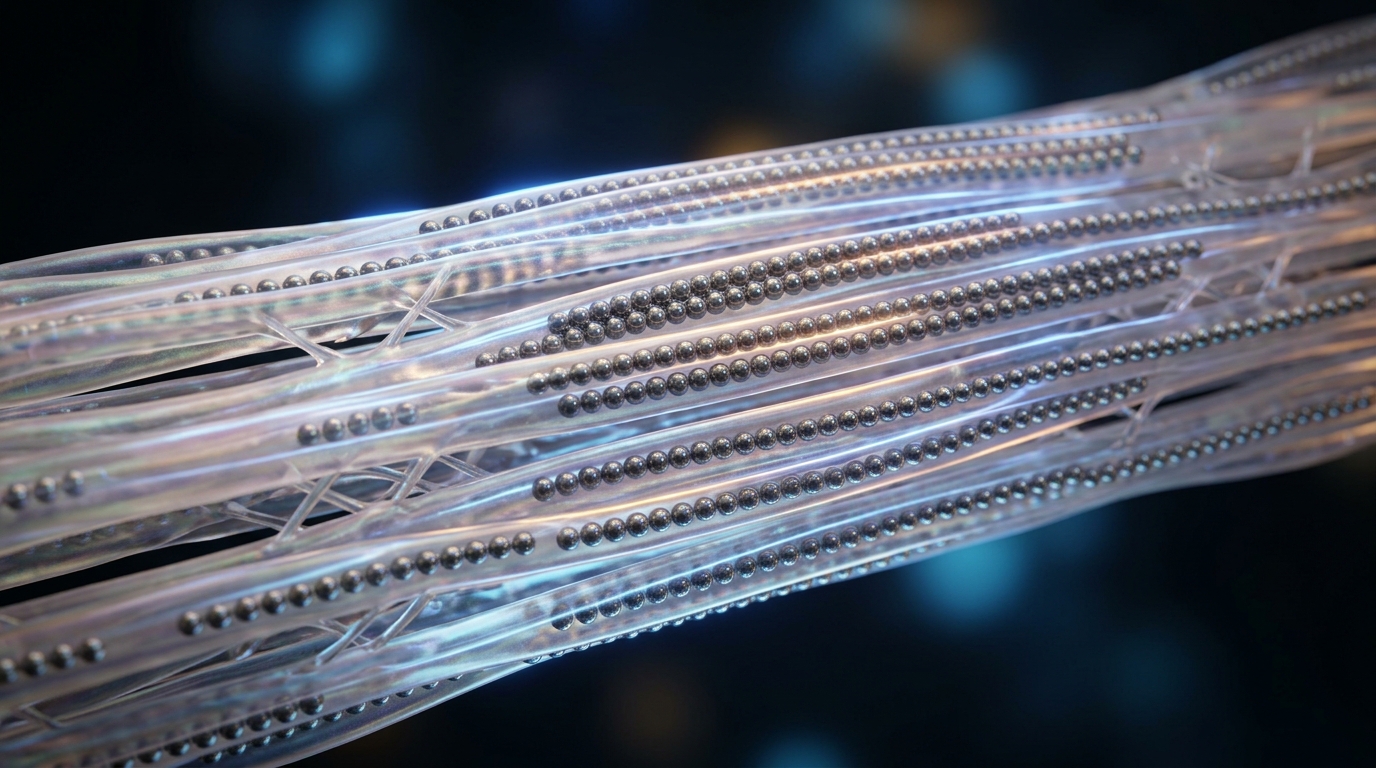
Anisotropic hydrogels modeled on load-bearing biological tissues are promising candidates for artificial cartilage, yet how they deform under load and how their internal structure reinforces them have remained only partly understood. A new study in the Journal of Materials Science addresses this gap by combining in situ deformation visualization with molecular dynamics simulations to examine polyvinyl alcohol hydrogels reinforced with oriented Fe3O4 nanoparticles under static and cyclic compression.
The researchers systematically varied three factors: the content of Fe3O4 nanoparticles, the orientation of those particles within the hydrogel, and the rate at which load was applied. The study examined the effects of Fe3O4 content, nanoparticle orientation and loading rate on the mechanical and deformation behavior of the hydrogels.
The tensile results showed a clear trade-off with particle loading. As Fe3O4 content decreased, tensile strength rose, reaching 2.154 ± 0.047 MPa, and the maximum creep displacement also increased. The compressive modulus followed the opposite trend, rising as nanoparticle content increased. The experimental results show that tensile strength and maximum creep displacement increase as Fe3O4 content decreases, whereas the compressive modulus shows the opposite trend.
Orientation proved equally decisive. Hydrogels in which the nanoparticles were arranged parallel to the loading direction showed higher tensile strength and a higher compressive modulus than their counterparts, while also exhibiting lower creep. The parallel orientation hydrogels had higher tensile strength and compressive modulus, as well as lower creep properties.
Under cyclic compression, the deformation rate decreased as Fe3O4 content and loading rate increased. Under cyclic compression conditions, the deformation rate decreased with increasing Fe3O4 content and loading rate.
The loading configuration also shaped the response. Under unconfined compression, the deformation rate was large and the deformation behavior was continuous. Under unconfined compression, the deformation rate is large and the deformation behavior is continuous.
The molecular dynamics simulations added a mechanistic layer to the experiments. The molecular simulation results show that the anisotropic structure can reduce the torsion energy of the dihedral angle. Combined with experimental observation and molecular simulation, the study discussed the load transfer mechanism of the hydrogels at different scales.
By pairing experimental observation with molecular simulation, the authors discussed the load-transfer mechanisms of the hydrogels across different scales and systematically clarified how differences in orientation structure influence deformation behavior. The study systematically clarified the influence of orientation structure differences on the deformation behavior of anisotropic hydrogels, providing a theoretical basis for the structural design and application of anisotropic soft materials.
The study investigated PVA-Fe3O4 hydrogels using in situ deformation visualization and molecular dynamics simulations under static and cyclic compression.
Subject of Research: Orientation-dependent deformation and load-transfer mechanisms in anisotropic PVA–Fe3O4 hydrogels under static and cyclic compression
Article Title: Orientation-dependent deformation behavior and load-transfer mechanisms in anisotropic PVA–Fe3O4 hydrogels under static and cyclic compression
Article References: Han, X., Cen, J., Zhang, X., Feng, C., Chen, Q., Chen, K., Feng, H., & Zhang, D. (2026). Orientation-dependent deformation behavior and load-transfer mechanisms in anisotropic PVA–Fe3O4 hydrogels under static and cyclic compression. Journal of Materials Science. https://doi.org/10.1007/s10853-026-14028-5
Image Credits: AI Generated
DOI: 10.1007/s10853-026-14028-5
Keywords: PVA hydrogels, Fe3O4 nanoparticles, anisotropy, compression, load transfer, molecular dynamics, artificial cartilage, creep, cyclic loading, nanocomposites, Orientation-dependent, deformation
News Source: Denise Maddox. (November 4, 2026). Anisotropic PVA–Fe3O4 hydrogels show orientation-dependent strength and load transfer under compression. Scienmag.