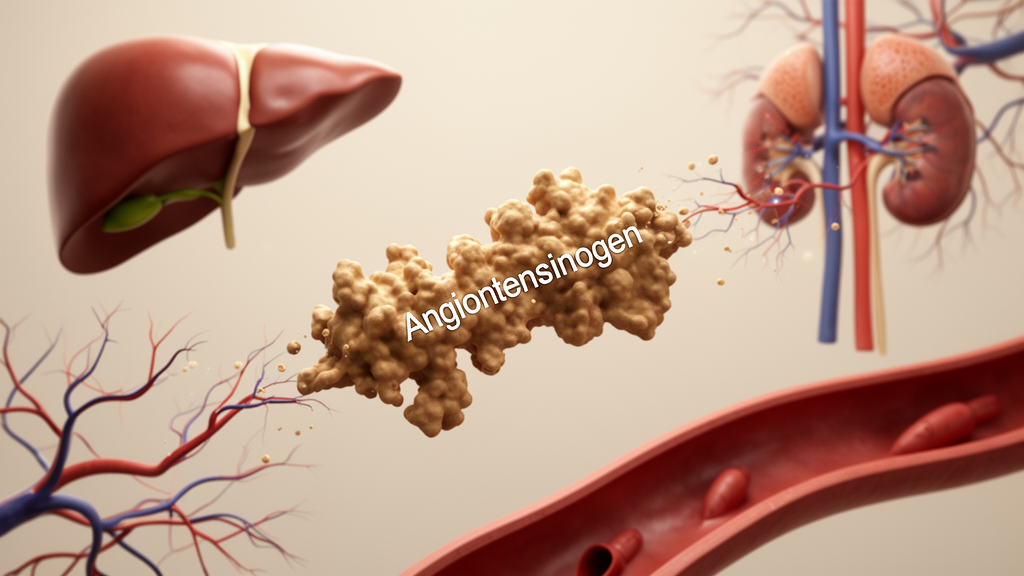
A review of angiotensinogen (AGT) concludes that the protein is not a uniform signal carried throughout the body, but a context-dependent mediator whose effects depend on its origin, molecular form, route of delivery and local receptor environment. The analysis draws a clear distinction between experimental evidence from animal models and findings in humans. Mouse studies using source-specific knockout and lineage tracing provide the strongest causal evidence for one major pathway, AGT trafficking from the liver to the kidney, whereas many other proposed interorgan routes remain less firmly established.
The liver supplies the bulk of circulating AGT, but AGT found in peripheral tissues need not have come directly from the liver. It may instead be produced locally or arrive through vascular retention, glomerular filtration, barrier crossing or receptor-mediated uptake. These routes can differ in how much protein reaches a tissue and in the molecular forms available for signaling.
The review therefore treats tissue abundance as an incomplete indicator: even a high concentration of AGT does not reveal its source, delivery route or biological activity. Source-specific genetic experiments in mice offer the most detailed evidence that the liver contributes AGT to the kidney. By deleting AGT in defined cell populations and tracing cellular lineages, researchers can test causal links between a particular source and a target organ more precisely than measurements of circulating protein alone.
For most other proposed axes of interorgan communication, the available evidence does not provide that same granularity. The distinction matters because a pathway is not established merely because AGT and an organ response are observed together; a correlation does not identify where the protein originated or how it reached the tissue. The protein’s molecular state adds another layer.
Intact AGT and des(Ang I)AGT can have effects that differ from those of angiotensin II and, under some conditions, can oppose them. Enzymatic processing can therefore change the direction as well as the magnitude of a response. The review’s model consequently places AGT upstream of several possible outcomes, with its output shaped by the form in which it is present, its local accessibility, the reactions it undergoes and the receptors available to act on it.
Measuring total AGT alone cannot establish which molecular form is present or which pathway is being engaged. Human genetic loss-of-function studies provide strong evidence for two essential functions of AGT: renal morphogenesis and blood-pressure regulation. In contrast, observational cohorts and biomarker studies generally cannot establish the tissue origin of the measured protein or the route by which it reached its target.
Such human observations are valuable for identifying associations, but they must be separated from the source-specific causal circuits demonstrated in animal models. The findings also open a possible therapeutic path centered on suppressing AGT in hepatocytes. The review identifies zilebesiran and tonlamarsen as agents that target hepatocytes and can produce durable AGT suppression.
This approach could potentially ease treatment burden relative to conventional daily treatment with angiotensin-converting enzyme inhibitors or angiotensin receptor blockers. That comparison represents a potential advantage rather than a demonstrated clinical benefit, and the review reports that solid cardiovascular and renal outcome data for AGT-suppressing treatment are still lacking. A major unresolved issue is the safety margin for lowering AGT.
The protein supports renal morphogenesis and blood-pressure regulation, while the review identifies renal self-regulation, fluid–electrolyte balance and pressor responses to physiological stress as functions that could be affected if suppression becomes too extensive. The slow offset of action associated with these agents may allow prolonged suppression, but it does not answer how much reduction is tolerable or whether the absence of cardiovascular and renal outcome data represents a limitation for clinical use. Overall, the review presents AGT as an upstream determinant with conditional effects rather than a ubiquitous interorgan signaling molecule.
Its influence depends on which organ produces it, how it reaches a target, whether it remains intact or is processed, and what receptor environment surrounds it. The evidence is strongest for a liver-to-kidney pathway in mice and for AGT’s genetic importance in human renal development and blood-pressure regulation. Applying that knowledge to therapy will require carefully separating established circuits from plausible pathways and recognizing that durable biochemical suppression, by itself, does not establish improved clinical outcomes.
Subject of Research: Tissue origins, molecular processing and therapeutic targeting of angiotensinogen in interorgan communication.
Article Title: Angiotensinogen as a molecular hub in interorgan communication
Article References: Zhou, J., Ye, X., Wang, Y., Hong, M., Rong, J., Wang, J., & Xu, Y. (2026). Angiotensinogen as a molecular hub in interorgan communication. Journal of Translational Medicine. https://doi.org/10.1186/s12967-026-09074-1
Image Credits: AI Generated
DOI: 10.1186/s12967-026-09074-1
Keywords: angiotensinogen, interorgan communication, liver-kidney signaling, renal morphogenesis, blood pressure, angiotensin II, hepatocyte targeting, zilebesiran, tonlamarsen, source-specific knockout, molecular, interorgan
News Source: Ophelia Keating. (October 21, 2026). Angiotensinogen operates as a context-dependent interorgan signaling protein. Scienmag.