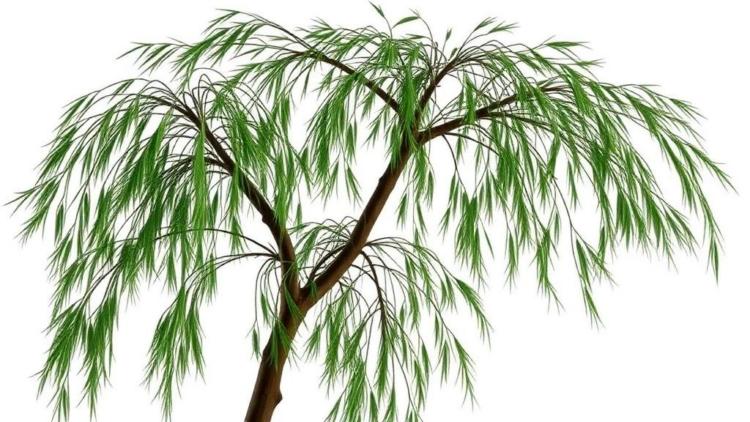
Deep in the river valleys of northeastern Asia grows a tree so unusual that botanists gave it a genus all to itself. Chosenia arbutifolia, the Korean willow, is a living relic of the willow family, the Salicaceae, with sweeping branches, reddish bark, and a lineage that diverged from its better-known cousins long ago. Now, a team of researchers at the Jiangsu Academy of Forestry in Nanjing has peered inside its genome to catalog one of the most important families of developmental genes in the plant kingdom, and their findings, published in BMC Genomics, offer both an evolutionary portrait of a rare tree and a practical toolkit for improving its economically vital relatives.
The focus of the study is the WUSCHEL-related homeobox family, known to plant biologists simply as WOX. These genes encode transcription factors, proteins that bind to DNA and switch other genes on or off, and they sit at the very heart of how a plant builds itself. Every leaf, root, flower, and woody stem that a plant produces originates from meristems, small reservoirs of stem-like cells at growing tips, and WOX genes are the master regulators that maintain those reservoirs, decide when their cells differentiate, and coordinate the hormonal and environmental signals that shape the entire body plan. In the model plant Arabidopsis thaliana, the founding member WUSCHEL was famously shown to control the stem-cell niche in flowers, and since then the family has been implicated in everything from embryo patterning to wound healing and drought tolerance.
WOX genes come in a small number of subfamilies that have been conserved across hundreds of millions of years of plant evolution. The ancient clade, including WOX13-type genes, is found even in bryophytes and lycophytes, while the intermediate WOX8, WOX9, and WOX14 clades and the modern WOX1 through WOX5 and WUS clades expanded alongside the flowering plants. The modern clade members took on specialized roles: WOX1 and WUS, for example, cooperate to flatten leaves and build lateral organs, while WOX5 maintains the root tip stem-cell niche. Because the family is so central, comparing its membership and structure across species reveals how developmental programs have been duplicated, lost, and repurposed as lineages diversified.
That is precisely what the Nanjing team set out to do for Chosenia. Using a genome-wide search, they identified 14 WOX genes in the Korean willow, which they named CaWOX1 through CaWOX14. Fourteen is a number that will look familiar to anyone who has studied the family in poplar and other willows, and that similarity is itself informative: it suggests the gene complement in this relict genus has remained remarkably stable since it split from the rest of the Salicaceae. The 14 genes were mapped onto 11 of the tree’s chromosomes, and the arrangement pointed to the family’s expansion history. Eight of the genes arose through tandem duplication, a process in which a gene is copied side by side with its original on the same chromosome, one of the most common engines of new gene function in plant genomes.
To make sense of what these 14 proteins do, the researchers built phylogenetic trees comparing the CaWOX sequences with WOX proteins from other species. The analysis sorted the family into four conserved subgroups, and here the story became one of remarkable conservatism. Members of the same subgroup shared highly conserved motifs, the short stretches of amino acids that define what a protein can do, as well as similar gene structures, meaning the exon and intron architecture of the genes had been preserved through evolution. In other words, even after tens of millions of years of independent evolution in a relict lineage, the functional hardware of each WOX subgroup remains essentially intact.
The comparative genomics added a subtle but important nuance. Within the Salicaceae, the CaWOX family showed strong collinearity, meaning the genes sit in matching syntenic blocks on the chromosomes of related species, a signature of descent from shared ancestral copies following the whole-genome duplication that shaped the willow family. Against Arabidopsis, however, a much more distantly related rosid, the collinearity was weak. This pattern tells an evolutionary story in two acts: the deep architecture of the WOX family is ancient and shared across flowering plants, but the fine-grained chromosomal organization reflects the more recent and family-specific history of the Salicaceae, including their own genome duplication events.
Structure alone does not reveal function, so the team turned to the DNA sequences upstream of each gene, the promoters that control when and where a gene is switched on. Scanning these regions for cis-elements, the short motifs recognized by other regulatory proteins, they found a striking enrichment of elements associated with meristem development, hormone response, and abiotic stress. That combination makes biological sense. WOX genes must respond to auxin, cytokinin, and other hormonal cues that position new organs, and in trees that live along cold, fast-changing river systems, stress-responsive regulation of growth is likely to be a matter of survival. The promoter evidence suggests the CaWOX genes are wired to integrate developmental commands with environmental signals.
The most tangible results came from expression profiling across tissues. The data revealed a clean division of labor among the 14 genes. A cluster comprising CaWOX3, CaWOX4, CaWOX5, CaWOX9, and CaWOX11 was active in leaves, implicating these genes in leaf development and in maintaining the physiological functions of mature foliage. A second group, CaWOX1, CaWOX6, CaWOX10, and CaWOX14, was associated with root development, consistent with the known roles of their counterparts in other species in organizing root meristems and lateral root formation. And one gene stood apart: CaWOX12 was linked to the secondary growth of stems, the process by which the vascular cambium lays down wood and thickens the trunk. For a tree, that single gene’s job may be the most consequential of all.
Why does this matter beyond the herbarium? Chosenia arbutifolia is rare and ecologically specialized, but its relatives in the Salicaceae, the poplars and willows, are among the most important trees in forestry, used for timber, pulp, biomass energy, and riverbank stabilization. Wood properties, growth rate, and stress tolerance are precisely the traits that breeding programs try to improve, and the WOX family sits upstream of all three. By clarifying which CaWOX genes govern leaf function, root architecture, and secondary growth, the study delivers a set of candidate genes for functional verification and, ultimately, for molecular breeding. A gene tied to cambium activity, for instance, is an obvious target for anyone hoping to modify wood density or stem form, while stress-responsive WOX promoters could inform engineering of drought- or cold-tolerant lines.
The work also carries a conservation dimension. As a monotypic genus, Chosenia represents a unique slice of evolutionary history, and understanding its genome helps scientists gauge how much functional diversity is at stake when such relict lineages decline. At the same time, the study demonstrates how modern bioinformatics can extract actionable knowledge from a single genome: a systematic search, phylogenetic placement, motif and structure analysis, synteny comparisons, promoter scanning, and expression mapping together turned 14 anonymous gene sequences into a functional map of a tree’s developmental control system. The authors frame the work as a reference and gene resource for the Salicaceae, and in that sense the Korean willow, a tree with no commercial plantations of its own, may end up contributing to the improvement of forests far beyond its cold northern rivers.
Subject of Research: WUSCHEL-related homeobox gene family evolution and expression in Chosenia arbutifolia
Article Title: Comprehensive analysis of WUSCHEL-related homeobox family in Chosenia arbutifolia (Pall.) A. Skv.: characterization, structure, evolutionary insights, and expression profiles
Article References: Wang, P., zheng, J., jiao, Z., huang, R., wang, W., wang, H., Sui, D., & He, X. (2026). Comprehensive analysis of WUSCHEL-related homeobox family in Chosenia arbutifolia (Pall.) A. Skv.: characterization, structure, evolutionary insights, and expression profiles. BMC Genomics. https://doi.org/10.1186/s12864-026-13285-7
Image Credits: AI Generated
DOI: 10.1186/s12864-026-13285-7
Keywords: WOX genes, Chosenia arbutifolia, Salicaceae, transcription factors, plant meristems, gene family evolution, tandem duplication, secondary growth, phylogenetic analysis, cis-regulatory elements, gene expression, molecular breeding
Cite Scienmag News
APA MLA Chicago
Juliet Wilcox. (October 4, 2026). Ancient Willow Relative Yields Secrets of a Master Gene Family That Builds Plants. Scienmag. https://scienmag.com/ancient-willow-relative-yields-secrets-of-a-master-gene-family-that-builds-plants/
Juliet Wilcox. “Ancient Willow Relative Yields Secrets of a Master Gene Family That Builds Plants.” Scienmag, 4 October 2026, https://scienmag.com/ancient-willow-relative-yields-secrets-of-a-master-gene-family-that-builds-plants/. Accessed 4 October 2026.
Juliet Wilcox. “Ancient Willow Relative Yields Secrets of a Master Gene Family That Builds Plants.” Scienmag. October 4, 2026. https://scienmag.com/ancient-willow-relative-yields-secrets-of-a-master-gene-family-that-builds-plants/
Copy citation Download RIS
Tags: ancient tree lineage genomicsChosenia arbutifoliaChosenia arbutifolia evolutioncis-regulatory elementseconomically important willow relativesgene expressiongene family evolutionmolecular breedingphylogenetic analysisplant developmental gene regulationplant hormone regulation by WOXplant meristem gene functionsplant meristemsplant stem cell regulationSalicaceaeSalicaceae genome analysissecondary growthtandem duplicationtranscription factorstree species adaptation geneticsWillow genetic researchwoody plant growth geneticsWOX gene family in plantsWOX genes