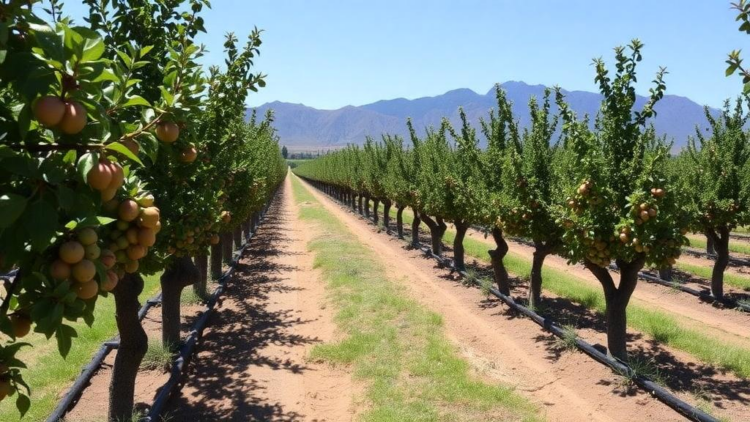
Fruit orchards are among the most unforgiving investments in agriculture. A farmer who plants avocados or mandarins today commits land, water, and capital for decades before the trees reach full production, and there is no easy way back if the water runs dry or the market turns. Now, researchers in Chile have shown that a mathematical optimization model, run over a full twenty-year horizon, can reshape those high-stakes decisions in ways that dramatically change a farm’s fortunes. Applied to a real 2,137-hectare fruit enterprise in the country’s Central Valley, the framework increased cumulative net profit by 32.7 percent compared with the crop pattern the farm actually used at the start of the period.
The study, published in the Journal of Agriculture and Food Research, was led by Luciano Quezada and Eduardo Holzapfel together with colleagues at Chilean institutions. Unlike most optimization work in agriculture, which focuses on annual crops that can be replanted each season, the model was built specifically for perennial systems, where decisions made in one year ripple through the entire lifespan of the orchard. The team formulated a nonlinear programming problem that maximizes net profits over two decades by simultaneously allocating land, irrigation water, and labor among more than a dozen fruit crops, including wine grapes, oranges, avocados, mandarins, lemons, pears, peaches, and kiwifruit.
At the heart of the model lies a set of empirically derived crop-water production functions. These polynomial relationships link the relative yield of each fruit species to its relative evapotranspiration, the ratio of actual to potential water consumption. The curves capture a crucial and often counterintuitive feature of fruit physiology: beyond an optimal point, additional irrigation actually reduces yields. Because the functions are expressed in relative terms, they can be transferred to other regions with comparable crop and irrigation conditions, making the framework adaptable well beyond the original Chilean case study.
The objective function aggregates revenues from fruit sales minus a detailed accounting of production costs, including labor, pruning, harvesting, fertilizers, machinery, pesticides, and the separate costs of surface water and groundwater. Establishment expenses during the first three unproductive years of each orchard are incorporated, along with amortization of irrigation infrastructure distributed over a seventeen-year capital recovery period. Constraints encode the farm’s physical reality: total cultivated area cannot exceed available land, seasonal water deliveries from two surface sources and groundwater rights must cover gross irrigation demand, each crop must receive at least 55 percent of its potential evapotranspiration to avoid catastrophic stress, and annual labor availability caps the sum of person-days demanded across all orchards. The model was implemented in the General Algebraic Modeling System and solved with the MINOS nonlinear solver.
The test bed was a commercial enterprise in the O’Higgins Region, where a Mediterranean climate delivers roughly 652 millimeters of rain concentrated in winter while summers are parched. The researchers reconstructed the farm’s water availability from official records covering 2000 to 2020, a period that tells a sobering story about the region’s hydrology. Surface water supplies peaked in the early 2000s, with more than 28 million cubic meters available in some seasons, then declined sharply from 2008 onward. The 2013–2014 and 2014–2015 seasons brought severe scarcity, and deficits recurred through the end of the decade, a pattern consistent with the megadrought that has gripped central Chile.
A central innovation of the study is its explicit treatment of irrigation efficiency, measured as total distribution efficiency, or TDE, which reflects how uniformly and effectively water reaches the crop. The team compared a high-efficiency scenario of 90 percent TDE against a 70 percent scenario representing the imperfect practices commonly observed on real farms, such as poor irrigation scheduling and excessive application. The difference proved economically decisive. Under 90 percent efficiency, profit losses from water deficits ranged from just 1.0 to 2.2 percent across the farm’s historical crop patterns. At 70 percent efficiency, those losses ballooned to between 4.7 and 8.5 percent, because lower efficiency forces farmers to apply far more water to meet the same crop demand, intensifying shortages in dry years.
The deficit years revealed how the model allocates scarce water rationally. In the worst season, 2014–2015, wine grapes received only 62 percent of their required water under high efficiency, while avocados and kiwifruit received 71 and 80 percent respectively. When efficiency dropped to 70 percent, oranges, avocados, grapefruits, kiwifruit, mandarins, and apples all fell to the 55 percent floor, the minimum the model allows before severe yield penalties set in. These allocations reflect both the shape of each crop’s production function and its economic value, effectively teaching the model to triage water where it does the most good.
The centerpiece of the work is the optimal crop pattern derived from year-2000 conditions. The solution allocated the maximum permitted 30 percent of the farm to avocados and the same to mandarins, with cherries, oranges, lemons, peaches, and wine grapes filling the remainder. Notably, some of the most profitable crops, including cherries, blueberries, and apples, were reduced or excluded entirely, because their intensive seasonal labor demands collided with the farm’s annual labor ceiling. Labor availability, the researchers found, was the single most restrictive constraint shaping the optimal configuration, a finding with broad implications as labor shortages and rising wages squeeze fruit producers worldwide. The optimized pattern required about 7 percent more water per season than the historical 2000 configuration but stayed within the farm’s actual supply, and it generated over one million million Chilean pesos in cumulative profit, a 32.7 percent gain. The advantage was not immediate: the optimized pattern underperformed in the first two seasons, but from 2005–2006 onward it consistently out-earned the historical pattern, peaking at a 50.6 percent annual advantage in 2015–2016.
Sensitivity analysis probed the plan’s robustness. Moderate shocks, such as a 500 percent increase in water costs or a doubling of operational costs, reduced profits by less than 3 percent without changing the crop mix. Even a 300 percent surge in labor costs cut profits by 13.7 percent yet left the allocation untouched. The picture changed with severe water cuts: a 40 percent reduction in availability forced high-demand crops off the land and shaved 16.2 percent from profits. Market shocks proved equally potent, as halving the export price of any single crop removed it from the optimal pattern, with cherries producing the largest single loss at 8.1 percent. Interviews with the farm’s management board added a human dimension: the team praised the model’s long-term scenario capability but noted that directors’ preferences and practical constraints sometimes override purely optimal solutions, and they identified labor shortages and water fluctuations as their top operational challenges.
The authors acknowledge limitations, including the absence of an explicit soil water balance, a static crop pattern over the horizon, and the difficulty of validating against a farm whose plantings changed continuously. Even so, the study marks a rare demonstration that integrated land, water, and labor optimization can be deployed under genuine farm conditions in perennial systems. As climate change tightens water supplies across Mediterranean climates globally, and as labor costs climb, the Chilean results suggest that the most valuable harvest a fruit grower can plan for may be the one computed decades in advance.
Subject of Research: Long-term optimization of crop pattern, irrigation water, and labor allocation in perennial fruit orchards
Article Title: An integrated optimization framework for long-term crop pattern and water resource planning in fruit orchards
Article References: Quezada, L., Holzapfel, E., Kuschel-Otárola, M., Lillo-Saavedra, M., Rivera, D., Garcia-Vila, M., Rivera-Ruiz, D., & Pérez, A. (2026). An integrated optimization framework for long-term crop pattern and water resource planning in fruit orchards. Journal of Agriculture and Food Research, 31, Article 103330. https://doi.org/10.1016/j.jafr.2026.103330
Image Credits: AI Generated
DOI: 10.1016/j.jafr.2026.103330
Keywords: fruit orchards, irrigation optimization, water resources, crop pattern planning, nonlinear programming, Chile, avocado, mandarin, labor constraints, irrigation efficiency, drought, agricultural economics
Cite Scienmag News
APA MLA Chicago
Alan Morgan. (October 4, 2026). Twenty-Year Optimization Model Boosts Orchard Profits by a Third in Water-Scarce Chile. Scienmag. https://scienmag.com/twenty-year-optimization-model-boosts-orchard-profits-by-a-third-in-water-scarce-chile/
Alan Morgan. “Twenty-Year Optimization Model Boosts Orchard Profits by a Third in Water-Scarce Chile.” Scienmag, 4 October 2026, https://scienmag.com/twenty-year-optimization-model-boosts-orchard-profits-by-a-third-in-water-scarce-chile/. Accessed 4 October 2026.
Alan Morgan. “Twenty-Year Optimization Model Boosts Orchard Profits by a Third in Water-Scarce Chile.” Scienmag. October 4, 2026. https://scienmag.com/twenty-year-optimization-model-boosts-orchard-profits-by-a-third-in-water-scarce-chile/
Copy citation Download RIS
Tags: 20-year agricultural decision modelingagricultural economicsavocadoChileChilean fruit farmingclimate-resilient farming modelscrop pattern planningdroughtfruit orchard planning and resource allocationfruit orchardsimpact of optimization on farm profitabilityirrigation efficiencyirrigation optimizationlabor constraintslong-term agricultural investment analysislong-term agricultural optimizationMandarinnonlinear programmingnonlinear programming in agricultureorchard profit enhancementperennial crop management strategiessustainable water use in orchardswater resource management in agriculturewater resources