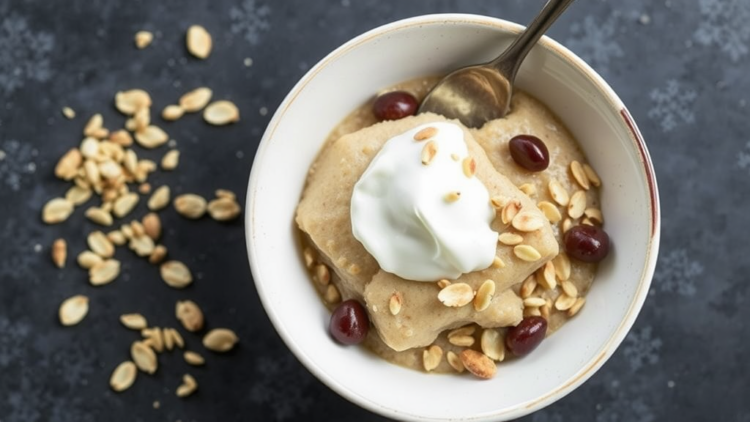
Plant-based desserts are usually judged on taste, but a new study argues that the real test happens quietly inside the refrigerator, over three weeks, where moisture leaks away, acidity creeps upward, and fragile probiotic cells fight for survival. Researchers from Islamic Azad University in Qazvin and the Free University of Bolzano have now developed an oat milk–based cereal dessert that weathers that test remarkably well, thanks to an unusual pairing: microencapsulated Lactiplantibacillus plantarum and a gum extracted from the seeds of Balangu Shirazi (Lallemantia royleana), a mint-family plant long prized in traditional Iranian cuisine for the mucilage that swells around its seeds. The work, published in Food Science and Biotechnology, offers a detailed physicochemical, microbiological, sensory, and textural portrait of what happens when a polysaccharide-rich hydrocolloid and a shielded probiotic culture are combined in a dairy-free matrix.
The team began by characterizing the gum itself, and the numbers explain why this particular hydrocolloid attracted attention. The extracted Balangu Shirazi gum contained just 6.23 percent moisture and 2.08 percent protein, but a substantial 64.71 percent sugar fraction, confirming its identity as a polysaccharide-rich hydrocolloid. Critically, the gum also carried measurable phenolic compounds, about 4.49 mg GAE/g, which translated into moderate antioxidant activity: the gum inhibited 21.01 percent of DPPH radicals in a standard assay. Dynamic light scattering of a diluted dispersion revealed a dominant colloidal population with a hydrodynamic diameter of 46.08 nm and a low polydispersity index of 0.12, indicating a relatively narrow distribution. The authors are careful to note, however, that this measurement reflects colloidal species in the diluted dispersion rather than the dimensions of intact probiotic-containing microcapsules, which were not directly imaged.
Protecting the probiotic cells required an entirely separate engineering effort. Lactiplantibacillus plantarum ATCC 1058 was grown to late logarithmic phase, harvested at roughly 10⁹ CFU/mL, and then entrapped in calcium alginate using an emulsion–external ionic gelation technique. The bacterial suspension was mixed into sterile 4 percent sodium alginate and dropped into canola oil containing Tween 80 under stirring, forming uniform aqueous droplets. Adding cold calcium chloride triggered ionic crosslinking between Ca²⁺ ions and the guluronic acid residues of alginate, hardening each droplet into a microcapsule. The capsules were recovered by centrifugation, washed to remove oil, and dissolved on demand in sodium citrate buffer to release their cargo for counting. By this measure, encapsulation efficiency reached approximately 83.12 percent, meaning most of the cells loaded into the process emerged viable from the alginate matrix.
With the gum and the capsules in hand, the researchers built four dessert formulations around a base of extracted oat milk, corn starch, sucrose, and gelatin. The control, F0, contained neither additive. The three experimental formulations, F1 through F3, each received 1 g of freshly prepared microcapsules delivering roughly 10⁹ CFU/g, but differed in gum concentration: 0.60, 1.25, or 2.50 g, respectively. Because the probiotic load was held constant while the gum varied, differences among F1–F3 could be attributed to BSG concentration, although comparisons with F0 capture the combined effect of both treatments rather than either one alone. The desserts were heat-treated at 85 °C to gelatinize the starch, cooled, inoculated gently to avoid capsule rupture, and stored at 4 °C for 21 days.
Acidification emerged as one of the clearest dose-dependent effects. All treatments saw pH drift downward over storage, but the pace of acidification increased markedly with gum concentration. By day 21, the control retained a relatively high pH of 5.60, while the BSG-containing samples had fallen to between roughly 4.30 and 3.90. Titratable acidity told the same story, rising from 0.16 percent lactic acid equivalents in F0 to 0.35 percent in F3. The authors attribute this progressive acidification to the metabolic activity of lactic acid bacteria converting carbohydrates into organic acids, with the gum’s high carbohydrate content and hydrocolloid structure possibly creating conditions, through enhanced water retention and matrix viscosity, that favor continued microbial activity. They caution, however, that because MRS agar is not strain-specific and recovered colonies were not molecularly confirmed, the acidification cannot be assigned with certainty to the inoculated L. plantarum alone.
Moisture retention, arguably the dessert’s most commercially sensitive property, also improved with gum level. Over three weeks, moisture in F1 fell to 68.0 percent, while F3 held 74.0 percent, compared with the control’s steeper decline. The explanation lies in the gum’s strong water-binding capacity: its polysaccharide network forms a hydrated scaffold that immobilizes water and limits migration out of the matrix. Ash and protein contents rose in parallel with gum concentration, from 0.75 to around 1.15 percent ash and 1.85 to 2.95 percent protein on day one, a direct consequence of the gum’s own mineral and protein fractions. Fat content remained comparatively stable across storage, with the fortified formulations measuring slightly higher than the control, possibly reflecting differences in emulsion stability.
The microbial story was equally encouraging, with important caveats. Presumptive lactic acid bacteria counts on MRS agar stayed high throughout storage in the fortified formulations, hovering near 9 log CFU/g in F1, declining modestly from 9.80 to 8.50 log CFU/g in F2, and even reaching 9.90 log CFU/g in F3 by day 21, well above the 10⁶ threshold often cited for probiotic efficacy. Mold and yeast counts increased in all treatments, but F3, with the most gum and the lowest pH, showed the lowest late-stage counts, at 1.45 log CFU/g versus roughly 1.75–1.90 in the others. The authors suggest the lower pH and higher acidity of F3 may have created less hospitable conditions for spoilage organisms, while the gum’s water-binding and viscosity-modifying properties may have supported bacterial persistence. Because the design lacked free-cell and encapsulation-only controls, however, the independent contributions of the gum and the encapsulation cannot be separated.
Sensory evaluation by 28 semi-trained panelists, scored on nine-point hedonic scales for color, flavor and odor, sweetness, firmness, and overall acceptability, revealed a highly structured sensory space: the first two principal components explained 97.33 percent of total variance. A strong storage-time effect pushed all samples from positive to negative quality scores by day 21, but the fortified formulations started higher and deteriorated more slowly. By day 11, F2 and F3 outperformed the control and even F1 on the main quality axis, and by day 21 the treated samples remained clearly separated from the more degraded control, confirming that the gum helped delay, though not prevent, sensory decline. Texture profiling showed the opposite trade-off: fortified samples were consistently softer than the control, with the effect strongest in F3, though the panel still judged the softer structures acceptable.
The study’s most valuable contribution may be its honesty. The authors repeatedly emphasize that without BSG-only, probiotic-only, and free-cell formulations, the independent functionality of each component cannot be proven, and they frame mechanisms such as hydrocolloid-assisted cell protection as hypotheses consistent with the data rather than demonstrated facts. Still, the practical takeaway stands: a dairy-free cereal dessert fortified with microencapsulated L. plantarum and Balangu Shirazi gum maintained high presumptive lactic acid bacteria counts, retained moisture, resisted spoilage, and stayed sensory-acceptable for three refrigerated weeks. As plant-based functional foods race from niche to mainstream, this work suggests that an ancient seed mucilage, guided by modern encapsulation chemistry and multivariate statistics, could help the next generation of vegan desserts survive the journey from factory to spoon.
Subject of Research: Development of a functional oat milk-based probiotic cereal dessert fortified with microencapsulated Lactiplantibacillus plantarum and Balangu Shirazi (Lallemantia royleana) seed gum
Article Title: Development and characterization of a functional oat milk-based cereal dessert fortified with microencapsulated Lactobacillus plantarum and Balangu Shirazi (Lallemantia royleana) gum
Article References: Daneshniya, M., Joolaei Ahranjani, P., Dehghan, K., Maleki, M. H., Abdolmaleki, F., & Ferrentino, G. (2026). Development and characterization of a functional oat milk-based cereal dessert fortified with microencapsulated Lactobacillus plantarum and Balangu Shirazi (Lallemantia royleana) gum. Food Science and Biotechnology. https://doi.org/10.1007/s10068-026-02302-w
Image Credits: AI Generated
DOI: 10.1007/s10068-026-02302-w
Keywords: oat milk, probiotics, Lactiplantibacillus plantarum, microencapsulation, Balangu Shirazi gum, Lallemantia royleana, hydrocolloids, functional food, dairy-free dessert, antioxidant activity, food science, shelf life
Cite Scienmag News
APA MLA Chicago
Alan Morgan. (September 21, 2026). Ancient Iranian Seed Gum Helps Probiotic Oat Dessert Survive Three Weeks in the Fridge. Scienmag. https://scienmag.com/ancient-iranian-seed-gum-helps-probiotic-oat-dessert-survive-three-weeks-in-the-fridge/
Alan Morgan. “Ancient Iranian Seed Gum Helps Probiotic Oat Dessert Survive Three Weeks in the Fridge.” Scienmag, 21 September 2026, https://scienmag.com/ancient-iranian-seed-gum-helps-probiotic-oat-dessert-survive-three-weeks-in-the-fridge/. Accessed 21 September 2026.
Alan Morgan. “Ancient Iranian Seed Gum Helps Probiotic Oat Dessert Survive Three Weeks in the Fridge.” Scienmag. September 21, 2026. https://scienmag.com/ancient-iranian-seed-gum-helps-probiotic-oat-dessert-survive-three-weeks-in-the-fridge/
Copy citation Download RIS
Tags: Ancient Iranian seed gumantioxidant activityantioxidant properties of traditional Iranian gumsBalangu Shirazi gumBalangu Shirazi seed mucilagedairy-free dessertfood sciencefunctional foodfunctional food preservation techniqueshydrocolloidsimpact of plant-derived gums on probiotic stabilityLactiplantibacillus plantarumLallemantia royleanamicroencapsulated Lactiplantibacillus plantarummicroencapsulationoat milkphysicochemical and microbiological analysis of plant-based probioticsplant-based probiotic food formulationpolysaccharide-rich hydrocolloid in dairy-free dessertsprobiotic oat dessert preservationprobiotic survival in refrigerated plant-based dessertsprobioticsshelf lifetraditional Iranian ingredients in modern functional