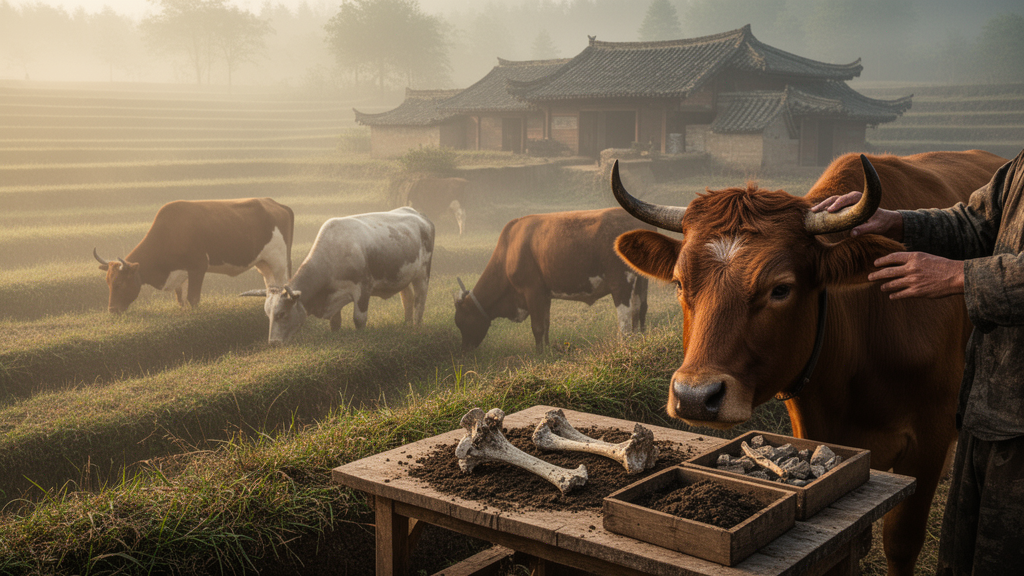
The genetic story of East Asia’s indigenous cattle turns out to be far messier — and far more interesting — than anyone suspected. A new whole-genome study, published in Genome Biology, has sequenced 802 indigenous Chinese cattle representing 55 breeds and populations drawn from across the country’s remarkably diverse landscapes. It is the largest short-read whole-genome sequencing dataset assembled for this underrepresented group to date, and it rewrites what we thought we knew about how these animals came to thrive in environments ranging from the frigid Tibetan plateau to the humid subtropical south.
The research team, led by Xiaoyu Luo, Yushan Li, Nan Wang, and Yang Lyu, with senior authors including Wenfa Lyu, Ningbo Chen, Chuzhao Lei, and Xiaoting Xia, set out to untangle the population structure, genetic origins, and biological adaptations of Chinese cattle. What they found was a genomic patchwork: seven distinct genetic populations within Chinese cattle, each shaped by a combination of inter- and intraspecific introgression. In plain terms, these animals are not the product of a single domestication lineage but of repeated episodes of mixing between different cattle types and even between different bovine species altogether.
Technically, the study hinged on distinguishing two major domesticated cattle lineages: taurine cattle (Bos taurus taurus), the humpless European and West Asian type, and indicine cattle (Bos taurus indicus), the humped zebu of South Asia. By analyzing patterns of linkage disequilibrium, ancestry segments, and allele sharing across the genome, the researchers could identify which regions of each animal’s DNA traced back to which lineage. They also looked for signatures of introgression from wild Asian bovine species — the banteng, gaur, and yak — whose genes occasionally slipped into domestic herds through hybridization at the edges of human settlement.
The geographical distribution of this introgression is anything but random. The team mapped where Asian bovine species introgression appears across Chinese cattle and found clear regional patterns, suggesting that hybridization events occurred locally, in specific agroecological zones, rather than as a single ancient pulse. This matters because it implies that genes from wild relatives were repeatedly incorporated into domestic stocks over centuries, potentially contributing traits that helped cattle survive in particular environments — disease resistance, foraging ability, or tolerance to harsh climates.
Perhaps the most striking finding is a major taurine × indicine admixture event dated to the Tang and Song dynasties, between 894 and 1210 AD. This is not ancient prehistory; it is medieval history, within the lifetime of documented Chinese agricultural systems. The researchers used haplotype-based methods to estimate the timing of this mixing episode and found that it coincided with a period of rapid local adaptation. Genes associated with the immune system showed a predominant effect, suggesting that the influx of indicine genetic material — or the reshuffling of taurine and indicine alleles — gave these cattle a significant immunological boost, possibly helping them cope with new pathogens in the diverse environments of medieval China.
Beyond the admixture event itself, the study produced a comprehensive catalog of genomic loci that underwent divergent selection across East Asia’s agroecological zones. These included genes linked to cold tolerance, heat tolerance, and meat production. In the high-altitude regions, selection signatures pointed to genes that would help cattle cope with hypoxia and extreme cold. In the tropical south, different loci showed evidence of selection for heat tolerance. And in regions where meat production became a priority, yet another set of genes showed divergent selection. The pattern is a textbook example of local adaptation: the same species, shaped by different environmental pressures in different places, evolving distinct genomic solutions to distinct problems.
The implications reach well beyond evolutionary biology. Indigenous East Asian cattle represent a genetic resource that modern breeding programs have largely overlooked in favor of standardized commercial breeds. As climate change alters agricultural conditions and as disease pressures shift, the adaptive alleles harbored by these traditional breeds — many of them the product of centuries of admixture and introgression — could prove invaluable. Understanding which genes confer cold tolerance, heat tolerance, or immune resilience is a first step toward preserving and potentially deploying that diversity.
Methodologically, the study demonstrates the power of large-scale whole-genome sequencing combined with haplotype-based demographic inference. Rather than relying on mitochondrial DNA or a handful of markers, the researchers analyzed the full nuclear genome of each animal, allowing them to detect fine-scale population structure, estimate admixture timing with medieval precision, and identify selection signatures with confidence. The seven-population structure they uncovered within Chinese cattle alone suggests that the country’s traditional breeds are far more genetically distinct than breed labels imply, reflecting genuine evolutionary lineages shaped by geography, history, and human agricultural practice.
What emerges from this work is a portrait of domesticated animals as evolutionary participants in their own right — not passive recipients of human selection but active agents whose genomes record every encounter with wild relatives, every wave of new genetic material, and every environmental challenge they faced. The medieval taurine-indicine mixing event, the repeated introgression from Asian bovine species, and the divergent selection across East Asia’s varied landscapes together tell a story of adaptation that is as much about the animals’ own evolutionary responses as about human husbandry. As the authors conclude, admixture between taurine and indicine cattle, together with introgression from other Asian bovine species, contributed decisively to the adaptive evolution of indigenous East Asian cattle — a finding that should reshape how we think about livestock diversity, conservation, and the genetic legacy hidden in the world’s traditional breeds.
Subject of Research: Genetics
Article Title: Extensive admixture and introgression shape genetic diversity and evolutionary adaptation in indigenous East Asian cattle
Article References: Extensive admixture and introgression shape genetic diversity and evolutionary adaptation in indigenous East Asian cattle. (n.d.). https://doi.org/10.1186/s13059-026-04295-5
Image Credits: AI Generated
DOI: 10.1186/s13059-026-04295-5
Keywords: genomics, cattle, introgression, admixture, East Asia, evolutionary adaptation, livestock, Genome Biology, Extensive, shape, genetic, diversity
News Source: Juliet Wilcox. (October 15, 2026). Ancient cattle love affairs: East Asian cattle genomes reveal Tang-Song dynasty mixing and wild bovine introgression. Scienmag.