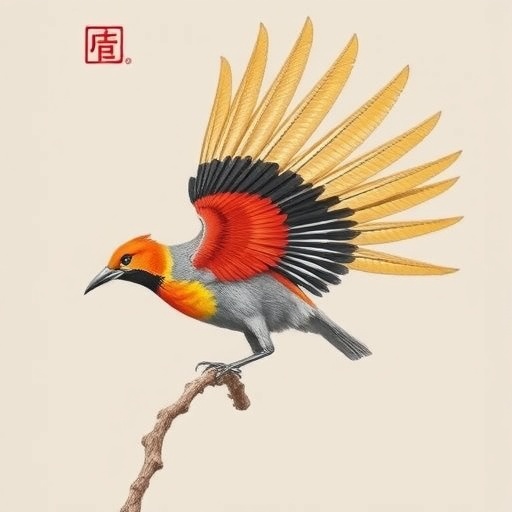
In a remarkable discovery that sheds new light on the mysterious enantiornithine birds of the Mesozoic era, researchers have unveiled a new species distinguished by its extraordinary tail feathers. This early Cretaceous bird, Plumadraco bankoorum, astonishes scientists with hyperelongated ornamental tail feathers that surpass twice the length of its body, representing a new record for tail feather length within its diverse clade. The finding not only challenges previous conceptions of avian morphology from over 120 million years ago but also provides critical insights into the evolutionary biology and courtship behaviors of ancient birds.
The scientists leading this study first set out to establish whether the fossil specimen in question was previously unknown to science. Their rigorous morphological assessment confirmed that Plumadraco bankoorum is indeed a novel species within the Bohaiornithidae family, a subgroup of enantiornithines that thrived during the Mesozoic. What makes this discovery particularly compelling is the completeness and preservation of the specimen’s plumage, including body feathers, intricate wing remiges, and, most notably, the specimen’s elongated tail feathers known as rectrices. The exceptional preservation of one entire tail feather allows researchers to undertake unprecedented anatomical analyses that connect these extinct forms to extant avian species.
A standout feature of Plumadraco bankoorum is the unique structure of its distally modified tail feathers, which display a form of morphological weakening or “enfeeblement” at the distal ends. The rachis, or central shaft of each feather’s racket-shaped terminal segment, conspicuously terminates partway through, a structural trait reminiscent of the ‘rattling’ feathers seen in modern birds like the Indian peafowl. This adaptation suggests that these feathers were not merely ornamental but actively contributed to dynamic display behaviors through visual flickering or sound production when vibrated. Such displays hint at the complexity of sexual selection mechanisms operating in early birds, reinforcing the idea that elaborate feather ornamentation played a key role in mating rituals even 121 million years ago.
From a behavioral perspective, it is plausible that Plumadraco bankoorum males engaged in conspicuous courtship displays using their tail feathers to attract females. Muscle attachment sites inferred from related enantiornithine specimens suggest the capacity for significant tail movement, primarily in vertical planes. This implies that the bird could have performed up-and-down bobbing or sustained tail raising, maximizing the visual impact of its elongated tail ornaments during mating displays. These findings provide a fascinating analogue to courtship behaviors documented in numerous modern bird species exhibiting sexual dimorphism in tail feathers, effectively bridging a temporal gap of over 100 million years.
The paleoenvironment that Plumadraco inhabited was shaped by a mosaic of lakes, streams, and seasonal vegetation consisting of mangroves and woody plants. While not a dense tropical jungle, this setting featured complex vertical structures that would have influenced how animals communicated visually. In such semi-closed canopies, brightly colored and uniquely shaped plumage diverging from background linearity would confer enhanced visibility, especially during intricate courtship dances or social interactions. This ecological backdrop may have exerted evolutionary pressure favoring extravagant tail feather elongation and ornamentation, contributing to the development of Plumadraco’s remarkable morphology.
Interplay between environmental factors and selective pressures is evident in this species’ anatomy and presumed behavior. While other enantiornithines and contemporaneous fauna posed competition for resources, and non-avian predators may have threatened survival, the preeminent evolutionary pressure for Plumadraco appears to have been reproductive success. Interestingly, the fossil evidence indicates that even individuals not fully skeletally mature could have reached sexual maturity, suggesting a life history strategy prioritizing early reproduction despite potentially high mortality. This strategy could explain the investment in conspicuous feather ornamentation despite the associated costs in terms of predation risk or energy expenditure.
The name Plumadraco bankoorum encapsulates both descriptive and commemorative significance. “Plumadraco,” derived from Latin terms for “feather” and “dragon,” evokes the mythological imagery of a clawed, winged flying creature, perfectly capturing the dinosaurian yet avian nature of this enantiornithine bird. The species epithet “bankoorum” honors Winston E. and Paul C. Banko, esteemed ornithologists and conservation biologists whose decades of work in Hawaiian avifauna have profoundly influenced the field. Their contributions and mentorship serve as an inspiration for the scientific community, reinforcing the tradition of naming new species in recognition of individuals who shape our understanding of natural history.
Beyond its contribution to taxonomy and evolutionary biology, the discovery of Plumadraco bankoorum serves as a poignant reminder of the intricate connections between ancient organisms and modern biodiversity. This specimen, absent from sunlight for over 121 million years, now reconnects the public and scientific community with a lost era. Such moments highlight the power of paleontology to not only reconstruct the past but also to foster a broader appreciation of life’s continuous story and the need to conserve living analogues facing ever-growing environmental challenges.
This research further underscores a vital caution in paleontological studies: modern birds are not always suitable analogues for understanding extinct taxa like enantiornithines. Subtle differences in feather microstructure, skeletal morphology, and musculoskeletal arrangements necessitate careful, evidence-based interpretations rather than over-reliance on extant relatives. Continued detailed descriptive work, especially on fossilized feathers and soft tissues, will enhance our comprehension of the evolutionary pathways and ecological roles of these enigmatic Mesozoic birds.
Looking ahead, the research team aims to deepen inquiries into feather morphology and function among other enantiornithine fossils exhibiting preserved feathers. By integrating morphology with biomechanics and behavioral ecology, they hope to unravel the nuances of flight capabilities, display behaviors, and evolutionary ecology in these extinct avians. This multidimensional approach promises to enrich not only paleontological knowledge but also broader scientific discourses on animal communication, sexual selection, and evolutionary innovation.
The study of Plumadraco bankoorum also invites wider public engagement with natural history and scientific discovery. Sharing such revelations serves to shift focus from human-centric concerns to the fascinating complexity and diversity of life on Earth across geological time. As the scientific community brings to light more exceptional fossils, there is an opportunity to educate and inspire future generations to value and protect both ancient and living biodiversity.
Delving into the structural complexity of Plumadraco’s tail feathers opens a portal into prehistoric avian life, revealing that elaborate sexual adornment is not a modern invention but a deeply rooted evolutionary strategy. Through detailed fossil examination and comparative analysis with living birds like the peafowl, this research demystifies how physical traits act as both communication and courtship tools, mastering evolutionary conditions that have shaped life’s ornate designs.
Remarkably, the implications of this discovery extend beyond paleontology, touching on bio-inspired design and biomechanics. Understanding how natural structures achieve lightweight yet flexible ornamentation can inform material science and robotics. Additionally, deciphering the evolutionary strategies behind exaggerated traits helps illuminate the balance between survival and reproductive success, an enduring theme in evolutionary biology.
In summary, the unveiling of Plumadraco bankoorum enriches our understanding of Mesozoic avian diversity, complex feather evolution, and ancient display behaviors. It resonates with the timeless narrative of life’s ingenuity and the enduring dance of natural selection. Studies like this not only reconstruct lost worlds but inspire us to look anew at the living world, appreciating its depth, intricacy, and the myriad stories yet to be told.
Subject of Research: Animals
Article Title: Hyperelongate ornamental tail feathers in a new early Cretaceous enantiornithine bird
News Publication Date: 27-May-2026
Image Credits: Alexander D. Clark
Keywords: Life sciences, Organismal biology, Vertebrates, Birds, Modern birds
Tags: ancient bird species discoveryBohaiornithidae family birdsearly Cretaceous avian morphologyenantiornithine birds Mesozoicevolutionary biology of birdsextinct to extant avian anatomyfossil plumage preservationhyperelongated tail feathersLiaoning China fossilsMesozoic avian courtship behaviorPlumadraco bankoorum speciesUniversity of Chicago paleontology research