• HOME
  • NEWS
  • EXPLORE
    • CAREER
      • Companies
      • Jobs
    • EVENTS
    • iGEM
      • News
      • Team
    • PHOTOS
    • VIDEO
    • WIKI
  • BLOG
  • COMMUNITY
    • FACEBOOK
    • INSTAGRAM
    • TWITTER
Wednesday, July 8, 2026
BIOENGINEER.ORG
No Result
View All Result
  • Login
  • HOME
  • NEWS
  • EXPLORE
    • CAREER
      • Companies
      • Jobs
        • Lecturer
        • PhD Studentship
        • Postdoc
        • Research Assistant
    • EVENTS
    • iGEM
      • News
      • Team
    • PHOTOS
    • VIDEO
    • WIKI
  • BLOG
  • COMMUNITY
    • FACEBOOK
    • INSTAGRAM
    • TWITTER
  • HOME
  • NEWS
  • EXPLORE
    • CAREER
      • Companies
      • Jobs
        • Lecturer
        • PhD Studentship
        • Postdoc
        • Research Assistant
    • EVENTS
    • iGEM
      • News
      • Team
    • PHOTOS
    • VIDEO
    • WIKI
  • BLOG
  • COMMUNITY
    • FACEBOOK
    • INSTAGRAM
    • TWITTER
No Result
View All Result
Bioengineer.org
No Result
View All Result
Home NEWS Science News Chemistry

Analysis of Galileo’s Jupiter entry probe reveals gaps in heat shield modeling

Bioengineer by Bioengineer
October 15, 2019
in Chemistry
Reading Time: 3 mins read
0
IMAGE
Share on FacebookShare on TwitterShare on LinkedinShare on RedditShare on Telegram

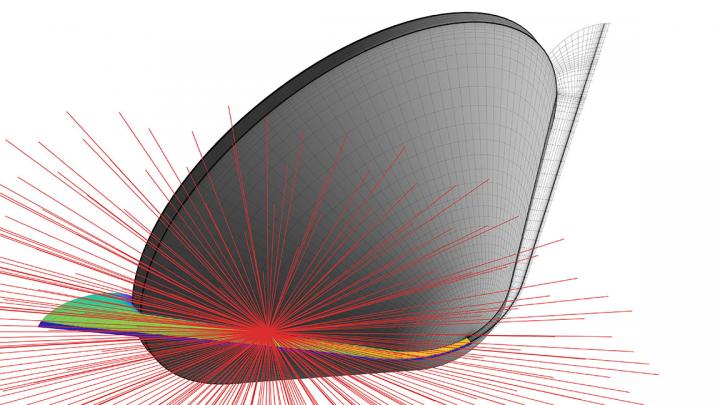
Data from the probe’s 1995 fireball has continued to confound those studying the mission. New simulations and faster computers point to bettering atmospheric entry vehicles.
IMAGE

Credit: Luís S. Fernandes


WASHINGTON, D.C., October 15, 2019 — The entry probe of the Galileo mission to Jupiter entered the planet’s atmosphere in 1995 in fiery fashion. As the probe descended from Mach 50 to Mach 1 and generated enough heat to cause plasma reactions on its surface, it relayed data about the burning of its heat shield that differed from the effects predicted in fluid dynamics models. New work examines what might have caused such a discrepancy.

Researchers at the Universidade de Lisboa and the University of Illinois at Urbana-Champaign report their findings from new fluid radiative dynamics models using data transmitted from the of Galileo’s 30-second entry. The paper, published in Physics of Fluids, from AIP Publishing, employs new computational techniques developed in the nearly 25 years since the mission.

“Early simulations for the probe design were conducted in the 1980s,” said Mario Lino da Silva, an author on the paper. “There are some things we can do in 2019, because we have the computational power, new devices, new theories and new data.”

Galileo’s probe entered Jupiter’s gravity traveling 47.4 kilometers per second, making it one of the fastest man-made objects ever. The fireball caused by the descent warmed the carbon phenolic heat shield to temperatures hotter than the sun’s surface.

Data from the probe revealed the rim of the heat shield burned significantly more than even today’s models would predict, measured by what is called the recession rate.

“The fireball is a kind of soup where a lot of things happen at the same time,” he said. “One problem with modeling is that there are many sources of uncertainty and only one observed parameter, the heat shield recession rate.”

The group recalculated features of the hydrogen-helium mixture the probe passed through, such as viscosity, thermal conductivity and mass diffusion, and found the oft-cited Wilke/Blottner/Eucken transport model failed to accurately model interactions between hydrogen and helium molecules.

They found the radiative heating properties of hydrogen molecules played a significant role in the additional heating the probe’s heat shield experienced.

“The built-in heat shield engineering margins actually saved the spacecraft,” Lino da Silva said.

Lino da Silva hopes the work helps improve future spacecraft design, including upcoming projects to explore Neptune that will likely not reach their destinations until after he has retired.

“In a way, it’s like building cathedrals or the pyramids,” he said. “You don’t get to see the work when it’s finished.”

Lino da Silva next looks to validate some of the simulated findings by reproducing similar conditions in a shock-tube facility tailored for reproducing high-speed flows.

###

The article, “Computational fluid radiative dynamics of the Galileo Jupiter entry,” is authored by Luis dos Santos Fernandes, Bruno Lopez and Mario Lino da Silva. The article will appear in Physics of Fluids on Oct. 15, 2019 (DOI: 10.1063/1.5115264). After that date, it can be accessed at https://aip.scitation.org/doi/10.1063/1.5115264.

ABOUT THE JOURNAL

Physics of Fluids is devoted to the publication of original theoretical, computational, and experimental contributions to the dynamics of gases, liquids, and complex or multiphase fluids. See https://aip.scitation.org/journal/phf.

Media Contact
Larry Frum
[email protected]
301-209-3090

Related Journal Article

http://dx.doi.org/10.1063/1.5115264

Tags: Algorithms/ModelsChemistry/Physics/Materials SciencesMathematics/StatisticsSpace/Planetary ScienceTechnology/Engineering/Computer Science
Share12Tweet8Share2ShareShareShare2

Related Posts

Salt adaptation linked to higher disease risk, Mizzou study finds

Salt adaptation linked to higher disease risk, Mizzou study finds

July 6, 2026
Intelligent Microgrid Management Promises Lower Household Energy Bills and Reduced Diesel Emissions — Chemistry

Intelligent Microgrid Management Promises Lower Household Energy Bills and Reduced Diesel Emissions

July 4, 2026

Graz University of Technology Deciphers the Structural Secrets of MOF Thin Films

July 2, 2026

Breaking Thermodynamic Limits: Wavelength-Driven Catalysis Advances Ammonia Synthesis

July 2, 2026
Please login to join discussion

POPULAR NEWS

  • Detection of EDCs in Breast Milk and Infant Urine Up to Six Months Highlights Early Exposure Risks

    77 shares
    Share 31 Tweet 19
  • New Drug Candidate Developed at McMaster Shows Potential for Treating Brain Cancer

    58 shares
    Share 23 Tweet 15
  • Saying Goodbye to PGY-6: Pediatric Fellowship Realities

    103 shares
    Share 41 Tweet 26
  • KTU Researchers Explore Ultrasound’s Role in Enhancing Blood Flow Beyond Diagnostics

    53 shares
    Share 21 Tweet 13

About

We bring you the latest biotechnology news from best research centers and universities around the world. Check our website.

Follow us

Recent News

Flame retardant BDE-209 targets molecularly linked to ulcerative colitis

Ultra-high frequency particle impacts mimic rockbursts to shatter hard rock

Kidney transplant outcomes in older adults studied by German researchers

Subscribe to Blog via Email

Success! An email was just sent to confirm your subscription. Please find the email now and click 'Confirm' to start subscribing.

Join 83 other subscribers
  • Contact Us

Bioengineer.org © Copyright 2023 All Rights Reserved.

Welcome Back!

Login to your account below

Forgotten Password?

Retrieve your password

Please enter your username or email address to reset your password.

Log In
No Result
View All Result
  • Homepages
    • Home Page 1
    • Home Page 2
  • News
  • National
  • Business
  • Health
  • Lifestyle
  • Science

Bioengineer.org © Copyright 2023 All Rights Reserved.