• HOME
  • NEWS
  • EXPLORE
    • CAREER
      • Companies
      • Jobs
    • EVENTS
    • iGEM
      • News
      • Team
    • PHOTOS
    • VIDEO
    • WIKI
  • BLOG
  • COMMUNITY
    • FACEBOOK
    • INSTAGRAM
    • TWITTER
Friday, June 5, 2026
BIOENGINEER.ORG
No Result
View All Result
  • Login
  • HOME
  • NEWS
  • EXPLORE
    • CAREER
      • Companies
      • Jobs
        • Lecturer
        • PhD Studentship
        • Postdoc
        • Research Assistant
    • EVENTS
    • iGEM
      • News
      • Team
    • PHOTOS
    • VIDEO
    • WIKI
  • BLOG
  • COMMUNITY
    • FACEBOOK
    • INSTAGRAM
    • TWITTER
  • HOME
  • NEWS
  • EXPLORE
    • CAREER
      • Companies
      • Jobs
        • Lecturer
        • PhD Studentship
        • Postdoc
        • Research Assistant
    • EVENTS
    • iGEM
      • News
      • Team
    • PHOTOS
    • VIDEO
    • WIKI
  • BLOG
  • COMMUNITY
    • FACEBOOK
    • INSTAGRAM
    • TWITTER
No Result
View All Result
Bioengineer.org
No Result
View All Result
Home NEWS Science News Chemistry

An increase in the number of extreme cold days in North China during 2003–2012

Bioengineer by Bioengineer
March 8, 2024
in Chemistry
Reading Time: 2 mins read
0
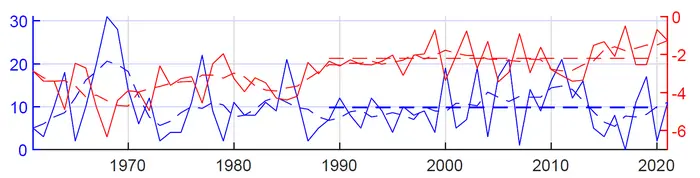
Winter temperature (red solid curve) increases over past decades. Within the study period (1989–2021), the number of extreme cold days (blue solid line) in North China increases around the year 2003 and then decreases around the year 2013. The dashed li
Share on FacebookShare on TwitterShare on LinkedinShare on RedditShare on Telegram

How extreme weather and climate events change is an intriguing issue in the context of global warming. As IPCC AR6 points out, cold extremes have become less frequent and less severe since the 1950s, mainly driven by human-induced climate change. However, cold extremes could also exhibit robust interdecadal changes at regional scale.
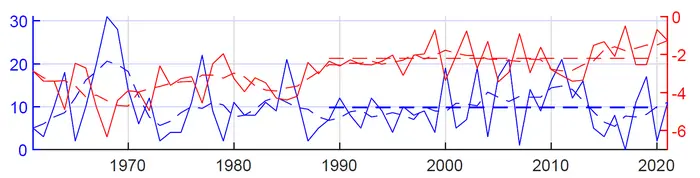
Winter temperature (red solid curve) increases over past decades. Within the study period (1989–2021), the number of extreme cold days (blue solid line) in North China increases around the year 2003 and then decreases around the year 2013. The dashed li

Credit: ZHU Yali

How extreme weather and climate events change is an intriguing issue in the context of global warming. As IPCC AR6 points out, cold extremes have become less frequent and less severe since the 1950s, mainly driven by human-induced climate change. However, cold extremes could also exhibit robust interdecadal changes at regional scale.


A recent study by researchers from the Institute of Atmospheric Physics, Chinese Academy of Sciences, presents robust interdecadal changes in the number of extreme cold days in winter over North China during 1989–2021, and the findings have been published in Atmospheric and Oceanic Science Letters. Specifically, the number of extreme cold days increased around the year 2003 and then decreased around the year 2013, with a value of 8.7 days per year during 1989–2002, 13.5 during 2003–2012, and 6.6 during 2013–2021.


During 2003–2012, the Siberian–Ural High strengthened and the polar jet stream weakened, which favored frequent cold air intrusion into North China, inducing more extreme cold days. In addition, the intensity of extreme cold days in North China showed no significant difference in the three periods. However, the related cold air could influence a larger area, which was especially the case for the stronger cold air center located to the west of Lake Baikal during 2013–2021.


The increase in the number of extreme cold days in North China in 2003–2012 probably arose from natural decadal variability. However, as pointed out by the corresponding author of this study, Prof. Yali Zhu, “This is still a challenging issue that needs further exploration to quantify the relative contributions of natural variability and human activity to regional extreme events.”

How extreme weather and climate events change is an intriguing issue in the context of global warming. As IPCC AR6 points out, cold extremes have become less frequent and less severe since the 1950s, mainly driven by human-induced climate change. However, cold extremes could also exhibit robust interdecadal changes at regional scale.


Journal

Atmospheric and Oceanic Science Letters

DOI

10.1016/j.aosl.2024.100468

Article Title

Interdecadal changes in the frequency of winter extreme cold events in North China during 1989–2021

Article Publication Date

5-Feb-2024

Share12Tweet8Share2ShareShareShare2

Related Posts

Divergent, Precise Alkaloid Remodelling via Few Reactions — Chemistry

Divergent, Precise Alkaloid Remodelling via Few Reactions

June 5, 2026
Physicist Wins NSF CAREER Award to Investigate Stellar Explosions and Element Formation — Chemistry

Physicist Wins NSF CAREER Award to Investigate Stellar Explosions and Element Formation

June 5, 2026

Innovative Approach for Constructing π-Conjugated Panels into Square-Shaped Molecules

June 5, 2026

Governor Abbott Appoints UT San Antonio’s Jeff Prevost to Quantum Advisory Committee

June 5, 2026

POPULAR NEWS

  • ESMO 2025: mRNA COVID Vaccines Enhance Efficacy of Cancer Immunotherapy

    322 shares
    Share 129 Tweet 81
  • Multi-Hospital Study Reveals Long Covid Burden Is Twice as High as Current Estimates

    88 shares
    Share 35 Tweet 22
  • Saying Goodbye to PGY-6: Pediatric Fellowship Realities

    77 shares
    Share 31 Tweet 19
  • Common Food Preservatives Associated with Elevated Blood Pressure and Increased Heart Disease Risk

    57 shares
    Share 23 Tweet 14

About

We bring you the latest biotechnology news from best research centers and universities around the world. Check our website.

Follow us

Recent News

Air Pollution, Genetics Linked to Aortic Stenosis Risk

Desmin Arg150Stop Mutation Causes Harmful Protein Aggregates

Divergent, Precise Alkaloid Remodelling via Few Reactions

Subscribe to Blog via Email

Enter your email address to subscribe to this blog and receive notifications of new posts by email.

Join 82 other subscribers
  • Contact Us

Bioengineer.org © Copyright 2023 All Rights Reserved.

Welcome Back!

Login to your account below

Forgotten Password?

Retrieve your password

Please enter your username or email address to reset your password.

Log In
No Result
View All Result
  • Homepages
    • Home Page 1
    • Home Page 2
  • News
  • National
  • Business
  • Health
  • Lifestyle
  • Science

Bioengineer.org © Copyright 2023 All Rights Reserved.