• HOME
  • NEWS
  • EXPLORE
    • CAREER
      • Companies
      • Jobs
    • EVENTS
    • iGEM
      • News
      • Team
    • PHOTOS
    • VIDEO
    • WIKI
  • BLOG
  • COMMUNITY
    • FACEBOOK
    • INSTAGRAM
    • TWITTER
Thursday, May 14, 2026
BIOENGINEER.ORG
No Result
View All Result
  • Login
  • HOME
  • NEWS
  • EXPLORE
    • CAREER
      • Companies
      • Jobs
        • Lecturer
        • PhD Studentship
        • Postdoc
        • Research Assistant
    • EVENTS
    • iGEM
      • News
      • Team
    • PHOTOS
    • VIDEO
    • WIKI
  • BLOG
  • COMMUNITY
    • FACEBOOK
    • INSTAGRAM
    • TWITTER
  • HOME
  • NEWS
  • EXPLORE
    • CAREER
      • Companies
      • Jobs
        • Lecturer
        • PhD Studentship
        • Postdoc
        • Research Assistant
    • EVENTS
    • iGEM
      • News
      • Team
    • PHOTOS
    • VIDEO
    • WIKI
  • BLOG
  • COMMUNITY
    • FACEBOOK
    • INSTAGRAM
    • TWITTER
No Result
View All Result
Bioengineer.org
No Result
View All Result
Home NEWS Science News Biology

An important function of non-nucleated sperm

Bioengineer by Bioengineer
April 29, 2019
in Biology
Reading Time: 3 mins read
0
IMAGE
Share on FacebookShare on TwitterShare on LinkedinShare on RedditShare on Telegram

IMAGE

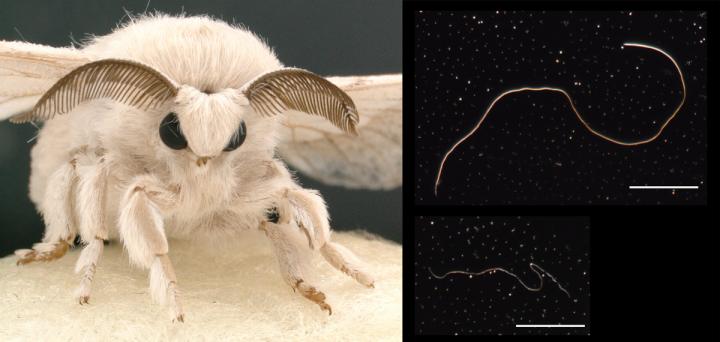
Credit: NIBB

Some animals form characteristic infertile spermatozoa called parasperm, which differ in size and shape compared to fertile sperm produced by single males. Species that have been reported to produce parasperm include snails, cottoid fish, moths and butterflies. Moths and butterflies produce fertile eupyrene sperm and anucleate non-fertile parasperm, which are known as apyrene sperm. A research team at the National Institute for Basic Biology in Japan has identified the gene involved in the formation of the apyrene sperm and has revealed the important function of the apyrene sperm in fertilization using the silk moth, Bombyx mori.

A member of the research team, Dr. Hiroki Sakai said, “Parasperm has been discovered in multiple animals despite its inability to be fertilized itself. From this, there is a possibility that parasperm may play an important role in fertilization.” Although many morphological observations and ecological surveys have been conducted on parasperm, genes involved in the formation of parasperm have not been identified in any species.

The researchers found that Sex-lethal (Sxl), which is a widely studied key sex determination gene in the fruit fly Drosophila melanogaster, is an essential gene for the formation of apyrene sperm in the silk moth “The Sxl gene plays an important role in female determination in the fruit fly. We are surprised that the gene was involved in the formation of non-nucleated sperm.” Dr. Sakai said.

The research group has created a silk moth whose Sxl gene function has been inhibited by the genome editing technology. As a result, they demonstrated that this silk moth could not form accurate apyrene sperm. Furthermore, the mating experiment using Sericology techniques revealed that its eupyrene sperm is normal. Based on this, it was revealed that Sxl is required for the formation of apyrene sperm.

Silk moth males, whose Sxl gene does not work, cannot produce future generations because they cannot produce apyrene sperm. Why can’t they reproduce without apyrene sperm? The research team has clearly shown that apyrene sperm is required for the eupyrene sperm migration in the female organs.

The leader of the research team, Prof. Niimi said, “The significance of this study is that it is the first time that specific genes required for parasperm formation have been identified. Moreover, we demonstrated that parasperm is necessary for eupyrene sperm migration in female organs. The results indicate that anucleate parasparam, while appearing less important in fertilization actually are so, may have a major impact on future sperm research in animals.

###

These results of the study will be published on the week of April 29, 2019 in Proceedings of the National Academy of Sciences of the United States of America.

Proceedings of the National Academy of Sciences of the United States of America

“Dimorphic sperm formation by Sex-lethal” by Hiroki Sakai, Hiroyuki Oshima, Kodai Yuri, Hiroki Gotoh, Takaaki Daimon, Toshinobu Yaginuma, Ken Sahara, Teruyuki Niimi

DOI: 10.1073/pnas.1820101116 (https://doi.org/10.1073/pnas.1820101116)

Media Contact
NIBB Office of PR
[email protected]

Related Journal Article

http://dx.doi.org/10.1073/pnas.1820101116

Tags: BiologyDevelopmental/Reproductive BiologyEvolution
Share12Tweet8Share2ShareShareShare2

Related Posts

Enhancing Disease Surveillance Through SARS-CoV-2 Diversity Analysis in Wastewater — Biology

Enhancing Disease Surveillance Through SARS-CoV-2 Diversity Analysis in Wastewater

May 14, 2026
Parasite Spread Enhanced by Host Wing-Raising Behavior — Biology

Parasite Spread Enhanced by Host Wing-Raising Behavior

May 14, 2026

Hoverflies’ Sexy Eyes Reveal Secrets of Their Aerodynamic Abilities

May 14, 2026

Why Emus Can’t Fly: Unlocking the Mystery Hidden in Bird Embryos

May 14, 2026
Please login to join discussion

POPULAR NEWS

  • Research Indicates Potential Connection Between Prenatal Medication Exposure and Elevated Autism Risk

    842 shares
    Share 337 Tweet 211
  • New Study Reveals Plants Can Detect the Sound of Rain

    729 shares
    Share 291 Tweet 182
  • Salmonella Haem Blocks Macrophages, Boosts Infection

    62 shares
    Share 25 Tweet 16
  • Breastmilk Balances E. coli and Beneficial Bacteria in Infant Gut Microbiomes

    57 shares
    Share 23 Tweet 14

About

We bring you the latest biotechnology news from best research centers and universities around the world. Check our website.

Follow us

Recent News

UofL Pediatrics Researcher Discovers Novel Signaling Mechanism Linked to Anxiety and Overgrooming

New Study Finds No Evidence Linking First Trimester Pain Reliever Use to Birth Defects

Absolute Quantification of IgG Glycans Unlocks New Avenue for Predicting Biological Age

Subscribe to Blog via Email

Enter your email address to subscribe to this blog and receive notifications of new posts by email.

Join 82 other subscribers
  • Contact Us

Bioengineer.org © Copyright 2023 All Rights Reserved.

Welcome Back!

Login to your account below

Forgotten Password?

Retrieve your password

Please enter your username or email address to reset your password.

Log In
No Result
View All Result
  • Homepages
    • Home Page 1
    • Home Page 2
  • News
  • National
  • Business
  • Health
  • Lifestyle
  • Science

Bioengineer.org © Copyright 2023 All Rights Reserved.