An extra copy of a gene that controls synapse formation in the cortex causes excessive inhibitory signaling and may contribute to Down syndrome, according to a new study publishing April 20th in the open access journal PLOS Biology by Bing Ye of the University of Michigan, US, and colleagues. The finding may help explain some of the neurologic consequences of the syndrome.
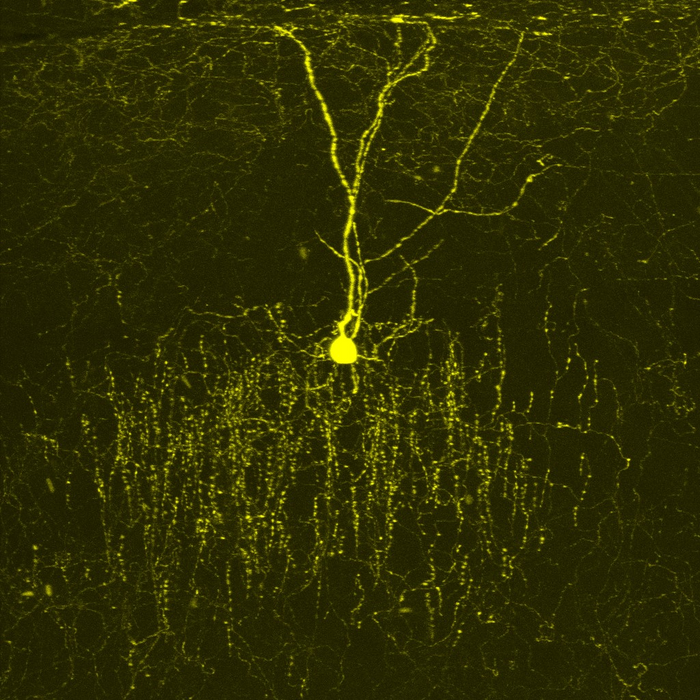
Credit: Bing Ye (CC-BY 4.0, https://creativecommons.org/licenses/by/4.0/)
An extra copy of a gene that controls synapse formation in the cortex causes excessive inhibitory signaling and may contribute to Down syndrome, according to a new study publishing April 20th in the open access journal PLOS Biology by Bing Ye of the University of Michigan, US, and colleagues. The finding may help explain some of the neurologic consequences of the syndrome.
Down syndrome is caused by a trisomy of chromosome 21, where individuals have three rather than two copies of this chromosome. The higher dosage of every gene on chromosome 21 has multiple effects, including neurological ones, but it is unclear exactly which of the 200-300 genes are responsible for which symptoms of the condition.
Previous work, including by the authors of the new study, has shown that a gene encoding Down syndrome cell adhesion molecule (DSCAM) is likely involved in at least some neurological effects, as increased levels in animal models affect the size of presynaptic terminals (regions of neurons that release neurotransmitters to downstream neuronal receptors).
Within the brain, GABAergic synapses release GABA, an inhibitory neurotransmitter that diminishes the firing of its downstream targets. Ye and colleagues asked what the effect of DSCAM triplication was on GABAergic neurons in the neocortex, the outer layer of the brain. They crossed a female mouse carrying a mouse equivalent of chromosome 21 trisomy (used as a model of Down syndrome) with a disomic (euploid) male mouse carrying one normal DSCAM gene and one non-functional mutant gene. Thus, the offspring included euploid mice with two functional copies of DSCAM (effectively normal mice), trisomic mice with three copies of functional DSCAM (modeling Down syndrome), and trisomic mice with two functional copies of DSCAM (i.e., effectively normal for DSCAM, but not for the rest of chromosome 21).
They found that mice with three copies of a functional DSCAM gene had an increase in the number of GABAergic terminals that formed synapses on target neurons in the neocortex. Mice with two functional DSCAM genes had normal numbers of terminals, despite having elevated levels of amyloid precursor protein (APP) in the brain, another biochemical consequence of trisomy 21 (due to triplication of the APP gene).
The effect of gene triplication was seen functionally as well—mice with three copies of the gene had more inhibitory signaling in the target areas of the neocortex, suggesting that excessive DSCAM was the cause of this increased GABAergic synaptic transmission as well as the higher number of GABAergic nerve terminals. The authors found they could trigger the opposite effect (i.e. reduction of nerve terminals and loss of GABAergic signaling) if they prevented the production of normal levels of DSCAM.
“Altered DSCAM expression has been linked to multiple brain disorders,” Ye said, including Down syndrome, autism spectrum disorder, intractable epilepsy, and bipolar disorder. “Our results suggest that dysregulation of DSCAM levels may be a common pathogenic driver of GABAergic dysfunction across these conditions.”
Ye adds, “This study shows excessive inhibitory connections in the cerebral cortex of mouse models of Down syndrome, and demonstrates that the extra copy of the DSCAM gene is the cause.”
#####
In your coverage, please use this URL to provide access to the freely available paper in PLOS Biology: http://journals.plos.org/plosbiology/article?id=10.1371/journal.pbio.3002078
Citation: Liu H, Caballero-Florán RN, Hergenreder T, Yang T, Hull JM, Pan G, et al. (2023) DSCAM gene triplication causes excessive GABAergic synapses in the neocortex in Down syndrome mouse models. PLoS Biol 21(4): e3002078. https://doi.org/10.1371/journal.pbio.3002078
Author Countries: United States
Funding: see manuscript
Journal
PLoS Biology
DOI
10.1371/journal.pbio.3002078
Method of Research
Experimental study
Subject of Research
Animals
COI Statement
Competing interests: The authors have declared that no competing interests exist.