Among Indigenous, rural non-industrial populations inhabiting the tropical forests of lowland Bolivia, researchers report, there appears to be an optimal balance between levels of food consumption and exercise that maximizes healthy brain aging and reduces the risk of disease.
Credit: Michael Gurven
Among Indigenous, rural non-industrial populations inhabiting the tropical forests of lowland Bolivia, researchers report, there appears to be an optimal balance between levels of food consumption and exercise that maximizes healthy brain aging and reduces the risk of disease.
“We hypothesize that energy gain from food intake was positively associated with late life brain health in the physically active, food-limited world of our ancestors, but that obesity and other manifestations of a Western lifestyle now lead to greater cognitive aging and dementia in middle and older ages,” said UC Santa Barbara professor of anthropology Michael Gurven, a senior co-author on a study that published in the Proceedings of the National Academy of Sciences.
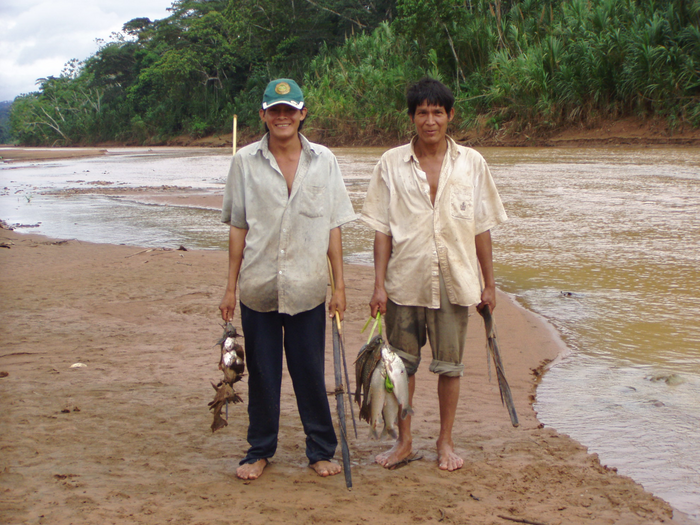
For this paper, the researchers collaborated with the Tsimané and Mosetén tribes, two Indigenous populations that live along tributaries of the Amazon River that flow through lowland Bolivia. In comparison to urban post-industrialized populations, these groups have less reliable access to food and have to exert a lot of effort to get it. They also have less access to modern health care. Meanwhile, people in wealthy countries have largely grown accustomed to eating more and exercising less — habits that are associated with decreased brain volumes and faster cognitive decline.
“We set out to compare rates of brain aging between U.S. and European populations, and two Indigenous Bolivian populations: the Tsimané, who have very low rates of heart disease and minimal dementia, and the Mosetén, who are culturally similar to the Tsimané but whose lifestyle has shifted away from subsistence,” said Gurven, who co-directs the Tsimané Health and Life History Project, a two-decade NIH-funded longitudinal study of health and aging.
The researchers enrolled 1,165 Tsimané and Mosetén adults, aged 40–94 years, and provided them transportation from their remote villages to the closest hospital with a CT scanner. They then used methods developed by study co-author Andrei Irimia, an assistant professor in the USC Leonard Davis School of Gerontology, to accurately measure brain volume from the CT scans. They also measured the participants’ body mass index, blood pressure, total blood cholesterol and other biomarkers of cardiometabolic health.
“We found the fastest brain aging in the U.S. and European cohorts,” Gurven said. “It was slowest in Tsimané and intermediate in Mosetén.” Rates of brain atrophy, or brain shrinking, are correlated with cognitive decline and risks of neurodegenerative diseases such as dementia and Alzheimer’s. In addition to less brain atrophy, the researchers found improved cardiovascular health in the Indigenous groups compared to industrialized populations in the U.S. and Europe.
The environment of limited food availability plays a role in the brain and cardiovascular fitness of nonindustrial societies, according to Irimia, in that “humans historically spent a lot of time exercising out of necessity to find food and their brain aging profiles reflected this lifestyle.”
Studying the Mosetén population illuminated key findings: as a “sister” population to the Tsimané, they share similar languages, ancestral history and agrarian lifestyle. However, the Mosetén have more exposure to modern technology, medicine, infrastructure and education. Based on the researchers’ results, according to Gurven, “the Mosetén’s lifestyle is more vulnerable to the chronic diseases of aging than among the Tsimane, but less so than in post-industrialized countries.”
Among the Tsimané, BMI, adiposity and higher levels of “bad” cholesterol were associated with bigger brain volumes for age. This, however, may be due to individuals being more muscular, on average, than individuals in industrialized countries who have comparable BMIs. Only at the highest levels of BMI, adiposity and cholesterol — closer to the levels more typically observed in the U.S. — was brain volume compromised.
“Our analyses suggest that ‘too much of a good thing,’ or what we call the ‘embarrassment of riches,’ seems to be what’s going on,” Gurven explained. “Greater adiposity, blood cholesterol and other indicators of nutrient intake increase with brain volume, but only up to a point — a ‘sweet spot.’ Not too little and not too much. Beyond the sweet spot, higher levels of adiposity and cholesterol are associated with a smaller brain volume — faster brain aging. That’s consistent with our current environment being mismatched to our evolved biology.”
Co-author Hillard Kaplan, an anthropologist at Chapman University and a co-director of the Tsimané Health and Life History Project, agrees. “During our evolutionary past, more food and less calories spent in getting it resulted in improved health, well-being and ultimately higher reproductive success,” he said. “This evolutionary history selected for psychological and physiological traits that made us desire extra food and less physical work, and with industrialization, those traits led us to overshoot the mark.”
According to Gurven, the study implications carry a hint of optimism. “The same active lifestyle that leads to a healthy heart seems to also lead to a healthy brain, and well into your 70s,” he said. “If people like the Tsimané and Mosetén have found a manageable life-long balance to stave off dementia, then there’s hope for the rest of us.”
Journal
Proceedings of the National Academy of Sciences
DOI
10.1073/pnas.2205448120
Article Title
Brain volume, energy balance, and cardiovascular health in two nonindustrial South American populations
Article Publication Date
20-Mar-2023