• HOME
  • NEWS
  • EXPLORE
    • CAREER
      • Companies
      • Jobs
    • EVENTS
    • iGEM
      • News
      • Team
    • PHOTOS
    • VIDEO
    • WIKI
  • BLOG
  • COMMUNITY
    • FACEBOOK
    • INSTAGRAM
    • TWITTER
Thursday, June 25, 2026
BIOENGINEER.ORG
No Result
View All Result
  • Login
  • HOME
  • NEWS
  • EXPLORE
    • CAREER
      • Companies
      • Jobs
        • Lecturer
        • PhD Studentship
        • Postdoc
        • Research Assistant
    • EVENTS
    • iGEM
      • News
      • Team
    • PHOTOS
    • VIDEO
    • WIKI
  • BLOG
  • COMMUNITY
    • FACEBOOK
    • INSTAGRAM
    • TWITTER
  • HOME
  • NEWS
  • EXPLORE
    • CAREER
      • Companies
      • Jobs
        • Lecturer
        • PhD Studentship
        • Postdoc
        • Research Assistant
    • EVENTS
    • iGEM
      • News
      • Team
    • PHOTOS
    • VIDEO
    • WIKI
  • BLOG
  • COMMUNITY
    • FACEBOOK
    • INSTAGRAM
    • TWITTER
No Result
View All Result
Bioengineer.org
No Result
View All Result
Home NEWS Science News Biology

An abundance of beneficial mutations

Bioengineer by Bioengineer
March 1, 2019
in Biology
Reading Time: 3 mins read
0
IMAGE
Share on FacebookShare on TwitterShare on LinkedinShare on RedditShare on Telegram

IMAGE

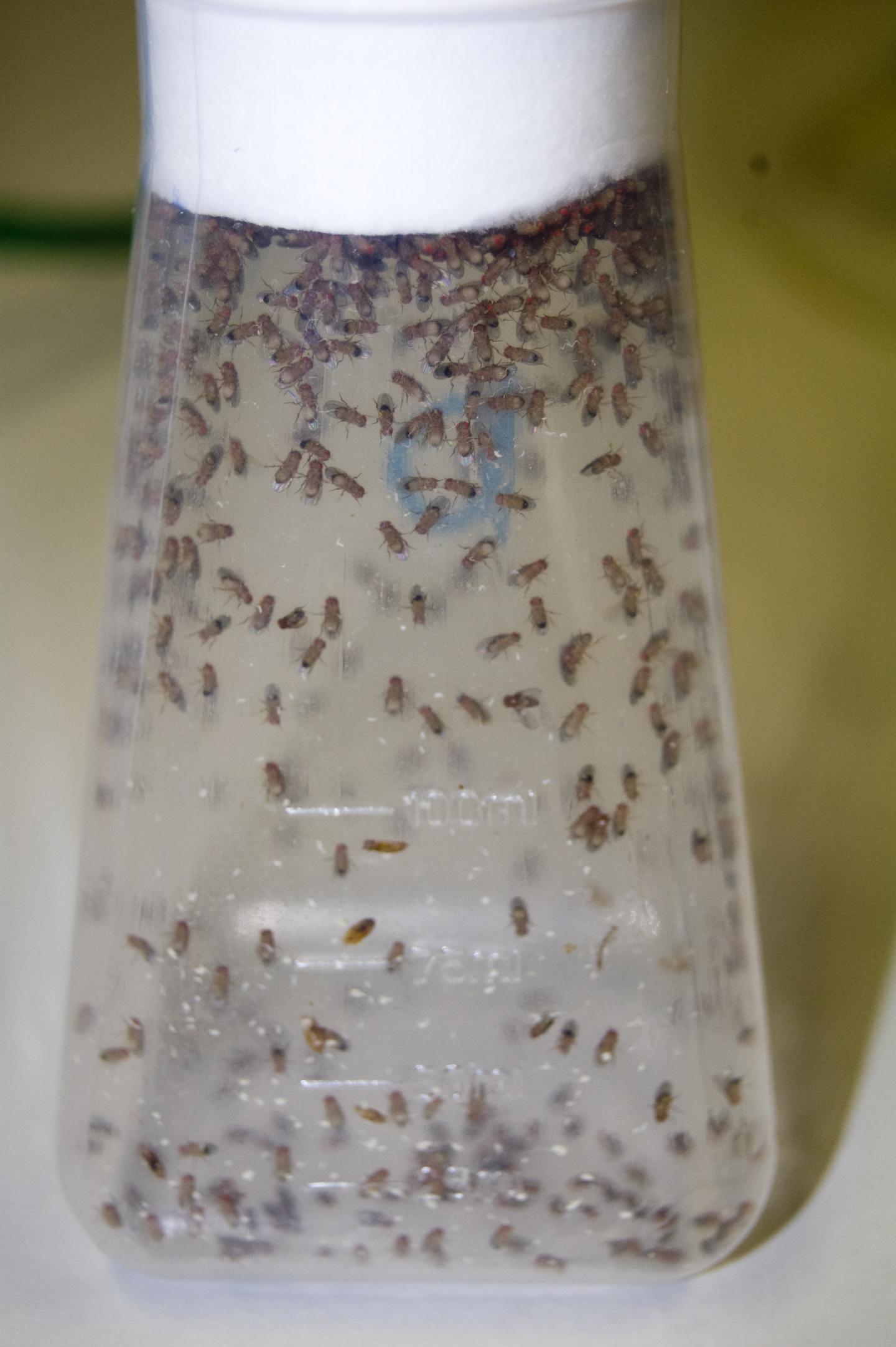
Credit: ©PopGen/Vetmeduni Vienna)

Not just since climate change has it been of enormous interest to understand how populations adapt to new environmental conditions. Scientists assume that most adaptations involve a large number of different genes, but most molecularly characterized adaptations are based on only one or a few genes. This discrepancy has been the source of much conjecture but has remained largely unresolved.

Laboratory model: genetic adaptation to different temperatures

To shed more light on this highly interesting area for the field of evolution, a research team from Vetmeduni Vienna used the method of experimental evolution. The goal of the experiment was to study the adaptive processes of fruit flies (Drosophila simulans) in a precisely controlled laboratory setting. The scientists exposed the flies to a hot environment (up to 28°C) over 60 generations and monitored the genetic changes using the latest sequencing methods. In contrast to previous studies, the authors were able to demonstrate that many genes are involved in the adaptation. A surprising result was that different combinations of genes produced similar adaptations in the different experimental populations. This leads first author Neda Barghi to conclude: “Fruit flies possess more paths for adapting to new environmental conditions than they actually use.” Experts call this observation “genetic redundancy”.

Modification of future testing strategies required

This study with fruit flies not only represents a milestone in the field of theoretical evolutionary biology but also has a concrete impact on studies which seek to demonstrate adaptive processes in natural populations. “Usually parallel signatures of selection, i.e., selection signatures found in several populations, are considered to be especially reliable,” explains Christian Schlötterer from the Institute of Population Genetics. “Our study shows, however, that this procedure must be thoroughly reconsidered in order to obtain a complete picture of the adaptive processes.”

###

Service

The article “Polygenic adaptation fuels genetic redundancy in Drosophila” by Neda Barghi, Raymond Tobler, Viola Nolte, Ana Marija Jakši?, François Mallard, Kathrin Anna Otte, Marlies Dolezal, Thomas Taus, Robert Kofler and Christian Schlötterer was published in PLOS Biology.

About the University of Veterinary Medicine, Vienna

The University of Veterinary Medicine, Vienna in Austria is one of the leading academic and research institutions in the field of Veterinary Sciences in Europe. About 1,300 employees and 2,300 students work on the campus in the north of Vienna which also houses five university clinics and various research sites. Outside of Vienna the university operates Teaching and Research Farms. The Vetmeduni Vienna plays in the global top league: in 2018, it occupies the excellent place 6 in the world-wide Shanghai University veterinary in the subject “Veterinary Science”. http://www.vetmeduni.ac.at>

Scientific Contact:

Christian Schlötterer

Institute of Population Genetics

University of Veterinary Medicine Vienna (Vetmeduni Vienna)

T +43 1 25077-4300

[email protected]>

Released by:

Georg Mair

Science Communication / Corporate Communications

University of Veterinary Medicine Vienna (Vetmeduni Vienna)

T +43 1 25077-1165

[email protected]>

Media Contact
Christian Schlötterer
[email protected]

Original Source

https://www.vetmeduni.ac.at/en/infoservice/press-releases/press-releases-2019/an-abundance-of-beneficial-mutations/

Related Journal Article

http://dx.doi.org/10.1371/journal.pbio.3000128

Tags: BiodiversityBiologyDevelopmental/Reproductive BiologyGeneticsZoology/Veterinary Science
Share14Tweet8Share2ShareShareShare2

Related Posts

Natural Hallucinogens: Evolution’s Ecological Tools, Not Mere Chemical Byproducts

June 25, 2026

This Famous Butterfly Revealed: Three Distinct Species Hidden in One

June 25, 2026

Scientists Attack Soybean Cyst Nematode by Starving Its Food Source

June 25, 2026

Decoding the Secret Code of a Crucial Immune Sensor

June 24, 2026
Please login to join discussion

POPULAR NEWS

  • Saying Goodbye to PGY-6: Pediatric Fellowship Realities

    103 shares
    Share 41 Tweet 26
  • Multi-Hospital Study Reveals Long Covid Burden Is Twice as High as Current Estimates

    92 shares
    Share 36 Tweet 23
  • Detection of EDCs in Breast Milk and Infant Urine Up to Six Months Highlights Early Exposure Risks

    77 shares
    Share 31 Tweet 19
  • New Drug Candidate Developed at McMaster Shows Potential for Treating Brain Cancer

    58 shares
    Share 23 Tweet 15

About

We bring you the latest biotechnology news from best research centers and universities around the world. Check our website.

Follow us

Recent News

Tracking Lanthanide-Labeled Microplastics in Plants

POSTECH Researchers Slash Cost of Reconstituted Cell-Free Systems by 95%

AI and Physics Collaborate to Design Advanced Hydrogen Storage Materials

Subscribe to Blog via Email

Success! An email was just sent to confirm your subscription. Please find the email now and click 'Confirm' to start subscribing.

Join 82 other subscribers
  • Contact Us

Bioengineer.org © Copyright 2023 All Rights Reserved.

Welcome Back!

Login to your account below

Forgotten Password?

Retrieve your password

Please enter your username or email address to reset your password.

Log In
No Result
View All Result
  • Homepages
    • Home Page 1
    • Home Page 2
  • News
  • National
  • Business
  • Health
  • Lifestyle
  • Science

Bioengineer.org © Copyright 2023 All Rights Reserved.