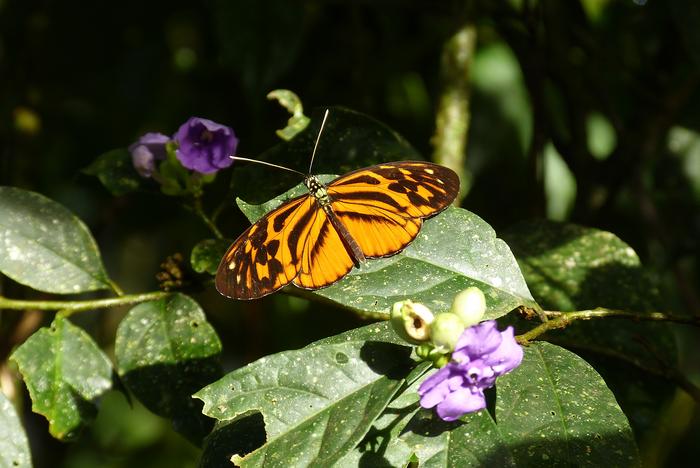
If evolution was originally depicted as a tree, with different species branching off as new blooms, then new research shows how the branches may actually be more entangled. In “Hybrid speciation driven by multilocus introgression of ecological traits,” published in Nature, Harvard researchers show that hybrids between species of butterflies can produce new species that are genetically distinct from both parent species and their earlier forebears.
Credit: Andrew Neild
If evolution was originally depicted as a tree, with different species branching off as new blooms, then new research shows how the branches may actually be more entangled. In “Hybrid speciation driven by multilocus introgression of ecological traits,” published in Nature, Harvard researchers show that hybrids between species of butterflies can produce new species that are genetically distinct from both parent species and their earlier forebears.
Writing to Charles Darwin in 1861, naturalist Henry Walter Bates described brightly colored Heliconius butterflies of the Amazon as “a glimpse into the laboratory where Nature manufactures her new species.” More than 160 years later, an international team of researchers led by biologists Neil Rosser, Fernando Seixas, James Mallet, and Kanchon Dasmahapatra also focused on Heliconius to document the evolution of a new species.
Using whole-genome sequencing, the researchers have shown that a hybridization event some 180,000 years ago between Heliconius melpomene and the ancestor of today’s Heliconius pardalinus produced a third hybrid species, Heliconius elevatus. Although descended from hybrids, H. elevatus is a distinct butterfly species with its own individual traits, including its caterpillar’s host plant and the adult’s male sex pheromones, color pattern, wing shape, flight, and mate choice. All three species now fly together across a vast area of the Amazon rainforest.
“Historically hybridization was thought of as a bad thing that was not particularly important when it came to evolution,” said Rosser, an associate of entomology at the Museum of Comparative Zoology and formerly a postdoctoral fellow both in Mallet’s lab at Harvard and in Dasmahapatra’s lab in York, UK. Rosser handled the genetic mapping with co-first author Seixas, another postdoctoral fellow. “But what genomic data have shown is that actually hybridization among species is widespread.”
The implications may alter how we view species. “A lot of species are not intact units,” said Rosser. “They’re quite leaky, and they’re exchanging genetic material.” Historically, hybridization has been thought to inhibit the creation of new species. Yet in this case, the researchers say, hybridization is not only happening in these butterfly species, but has also driven the evolution of a new species in itself.
“So the species that are evolving are constantly exchanging genes, and the consequence of this is that it can actually trigger the evolution of completely new lineages,” said Rosser.
Mallet, professor of organismic and evolutionary biology and co-author on the research, said: “Normally, species are thought to be reproductively isolated. They can’t produce hybrids that are reproductively fertile.” While there is now evidence of hybridization between species, what was difficult to confirm was that this hybridization is, in some way, involved in speciation. As Mallet put it: “The question is: How can you collapse two species together and get a third species out of that collapse.”
The new research provides a next step in understanding how hybridization and speciation work. “Over the last 10 or 15 years, there’s been a paradigm shift in terms of the importance of hybridization and evolution,” explained Rosser.
This research has the potential to play a role in the current biodiversity crisis. Understanding something as basic as “what we mean by a species,” said Mallet, “is important for saving species and for conservation,” particularly in the Amazon, he noted. In addition, such work may prove useful in understanding carriers of disease. Multiple species of mosquito, for example, can carry malaria. Although these mosquitos are closely related, “almost nothing is known about how they interact, and whether they hybridize with each other,” he noted.
The international crew of researchers included Lucie M. Queste, Bruna Cama, Ronald Mori-Pezo, Dmytro Kryvokhyzha, Michaela Nelson, Rachel Waite-Hudson, Matt Goringe, Mauro Costa, Marianne Elias, Clarisse Mendes Eleres de Figueiredo, André Victor Lucci Freitas, Mathieu Joron, Krzysztof Kozak, Gerardo Lamas, Ananda R.P. Martins, W. Owen McMillan, Jonathan Ready, Nicol Rueda-Muñoz, Camilo Salazar, Patricio Salazar, Stefan Schulz, Leila T. Shirai, and Karina L. Silva-Brandão.
Journal
Nature
DOI
10.1038/s41586-024-07263-w
Method of Research
Data/statistical analysis
Subject of Research
Animals
Article Title
Hybrid speciation driven by multilocus introgression of ecological traits
Article Publication Date
17-Apr-2024