• HOME
  • NEWS
  • EXPLORE
    • CAREER
      • Companies
      • Jobs
    • EVENTS
    • iGEM
      • News
      • Team
    • PHOTOS
    • VIDEO
    • WIKI
  • BLOG
  • COMMUNITY
    • FACEBOOK
    • INSTAGRAM
    • TWITTER
Monday, October 5, 2026
BIOENGINEER.ORG
No Result
View All Result
  • Login
  • HOME
  • NEWS
  • EXPLORE
    • CAREER
      • Companies
      • Jobs
        • Lecturer
        • PhD Studentship
        • Postdoc
        • Research Assistant
    • EVENTS
    • iGEM
      • News
      • Team
    • PHOTOS
    • VIDEO
    • WIKI
  • BLOG
  • COMMUNITY
    • FACEBOOK
    • INSTAGRAM
    • TWITTER
  • HOME
  • NEWS
  • EXPLORE
    • CAREER
      • Companies
      • Jobs
        • Lecturer
        • PhD Studentship
        • Postdoc
        • Research Assistant
    • EVENTS
    • iGEM
      • News
      • Team
    • PHOTOS
    • VIDEO
    • WIKI
  • BLOG
  • COMMUNITY
    • FACEBOOK
    • INSTAGRAM
    • TWITTER
No Result
View All Result
Bioengineer.org
No Result
View All Result
Home NEWS Science News Health

Alzheimer’s disease protein links plaques to cell death in mice

Bioengineer by Bioengineer
June 6, 2019
in Health
Reading Time: 2 mins read
0
IMAGE
Share on FacebookShare on TwitterShare on LinkedinShare on RedditShare on Telegram

IMAGE

Credit: RIKEN

A new protein involved in Alzheimer’s disease (AD) has been identified by researchers at the RIKEN Center for Brain Science (CBS). CAPON may facilitate the connection between the two most well-known AD culprits, amyloid plaques and tau pathology, whose interactions cause brain cell death and symptoms of dementia. This latest finding from the Takaomi Saido group at RIKEN CBS uses a novel mouse model of AD. The study was published in Nature Communications on June 3.

Alzheimer’s disease is a complex and devastating condition characterized by plaques of amyloid-β and neurofibrillary tangles, also known as tau pathology, in the brain. Investigating the connection between these features, the research team identified CAPON, a protein that binds to tau. The CAPON gene is a known risk for other psychiatric disorders, and because AD can be accompanied by psychiatric symptoms, the team guessed that CAPON could form a link between these conditions. Indeed, when they examined one type of AD mouse, they found accumulation of CAPON in the hippocampus, an important memory center in the brain. Furthermore, CAPON accumulation was even greater in the presence of amyloid-β pathology.

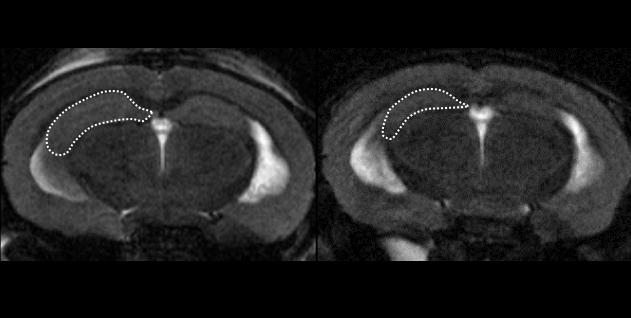
After creating another type of AD mouse model using a novel App/MAPT double knock-in process, the team inserted CAPON DNA into the brain, which resulted in CAPON overexpression. These mice exhibited significant neurodegeneration, elevated tau, and hippocampal shrinkage. “The implication is that accumulating CAPON increases AD-related pathology,” says lead author Shoko Hashimoto of RIKEN CBS. “Although cell death resulting from CAPON can occur through many different pathways, we definitely think this protein is a facilitator between neuroinflammation and tau pathology.” This is the first study to use App/MAPT double knock-in mice, which are engineered to have human-like MAPT and App genes containing pathogenic mutations.

If CAPON accumulation exacerbates AD pathology, the team reasoned that CAPON deficiency could have the opposite effect. For this test, the team knocked out CAPON in another type of AD model mouse that typically has increased tau pathology. They found that CAPON deficiency led to less tau, less amyloid-β, less neurodegeneration, and less brain atrophy. Thus, reducing CAPON levels in AD mice effectively reduced many of the physiological AD symptoms.

“Neurodegeneration is complex but we think CAPON is an important mediator between amyloid-β, tau, and cell death. Breaking this link with drugs is a promising avenue for treating AD,” says Saido. “The App/MAPT double knock-in mice developed by our lab are an improved tool for the entire Alzheimer’s research field.”

###

Reference:

Hashimoto et al. (2019) Tau binding protein CAPON induces tau aggregation and neurodegeneration. Nature Communications. doi: 10.1038/s41467-019-10278-x

Media Contact
Adam Phillips
[email protected]

Related Journal Article

http://dx.doi.org/10.1038/s41467-019-10278-x

Tags: AlzheimerBiologyMolecular Biologyneurobiology
Share12Tweet8Share2ShareShareShare2

Related Posts

Silent Brain Attack: Common Autoimmune Dementia Mimic Caught in Largest Study Yet

Silent Brain Attack: Common Autoimmune Dementia Mimic Caught in Largest Study Yet

October 5, 2026
Long COVID Trial Finds No Added Benefit from Pro-Resolving Supplement Over Placebo

Long COVID Trial Finds No Added Benefit from Pro-Resolving Supplement Over Placebo

October 5, 2026

Carbapenemase Genes in Catheter Urinary Infections Traced to ICU Stays and Antibiotic Overuse

October 5, 2026

Young Women in Ghana Co-Design New Paths to HIV Testing and Prevention

October 5, 2026
Please login to join discussion

POPULAR NEWS

  • Alloys That Shrink Their Own Grains: New PIX Mechanism Refines Metals With Heat Alone

    Alloys That Shrink Their Own Grains: New PIX Mechanism Refines Metals With Heat Alone

    29 shares
    Share 12 Tweet 7
  • Endurance Exercise Reshapes the Liver in Males and Females Through Distinct Molecular Routes

    29 shares
    Share 12 Tweet 7
  • Single Transcription Factor PU.1 Rapidly Converts Fibroblasts into Macrophage-Lineage Cells

    29 shares
    Share 12 Tweet 7
  • New Scale Measures How Ready Nurse Educators Really Are for the AI Era

    29 shares
    Share 12 Tweet 7

About

We bring you the latest biotechnology news from best research centers and universities around the world. Check our website.

Follow us

Recent News

Alloys That Shrink Their Own Grains: New PIX Mechanism Refines Metals With Heat Alone

Endurance Exercise Reshapes the Liver in Males and Females Through Distinct Molecular Routes

Single Transcription Factor PU.1 Rapidly Converts Fibroblasts into Macrophage-Lineage Cells

Subscribe to Blog via Email

Success! An email was just sent to confirm your subscription. Please find the email now and click 'Confirm' to start subscribing.

Join 85 other subscribers
  • Contact Us

Bioengineer.org © Copyright 2023 All Rights Reserved.

Welcome Back!

Login to your account below

Forgotten Password?

Retrieve your password

Please enter your username or email address to reset your password.

Log In
No Result
View All Result
  • Homepages
    • Home Page 1
    • Home Page 2
  • News
  • National
  • Business
  • Health
  • Lifestyle
  • Science

Bioengineer.org © Copyright 2023 All Rights Reserved.