• HOME
  • NEWS
  • EXPLORE
    • CAREER
      • Companies
      • Jobs
    • EVENTS
    • iGEM
      • News
      • Team
    • PHOTOS
    • VIDEO
    • WIKI
  • BLOG
  • COMMUNITY
    • FACEBOOK
    • INSTAGRAM
    • TWITTER
Tuesday, October 6, 2026
BIOENGINEER.ORG
No Result
View All Result
  • Login
  • HOME
  • NEWS
  • EXPLORE
    • CAREER
      • Companies
      • Jobs
        • Lecturer
        • PhD Studentship
        • Postdoc
        • Research Assistant
    • EVENTS
    • iGEM
      • News
      • Team
    • PHOTOS
    • VIDEO
    • WIKI
  • BLOG
  • COMMUNITY
    • FACEBOOK
    • INSTAGRAM
    • TWITTER
  • HOME
  • NEWS
  • EXPLORE
    • CAREER
      • Companies
      • Jobs
        • Lecturer
        • PhD Studentship
        • Postdoc
        • Research Assistant
    • EVENTS
    • iGEM
      • News
      • Team
    • PHOTOS
    • VIDEO
    • WIKI
  • BLOG
  • COMMUNITY
    • FACEBOOK
    • INSTAGRAM
    • TWITTER
No Result
View All Result
Bioengineer.org
No Result
View All Result
Home NEWS Science News Chemistry

Always on beat: ultrashort flashes of light under optical control

Bioengineer by Bioengineer
October 17, 2019
in Chemistry
Reading Time: 2 mins read
0
IMAGE
Share on FacebookShare on TwitterShare on LinkedinShare on RedditShare on Telegram

Scientists from the University of Bayreuth and the University of Göttingen have discovered a new method
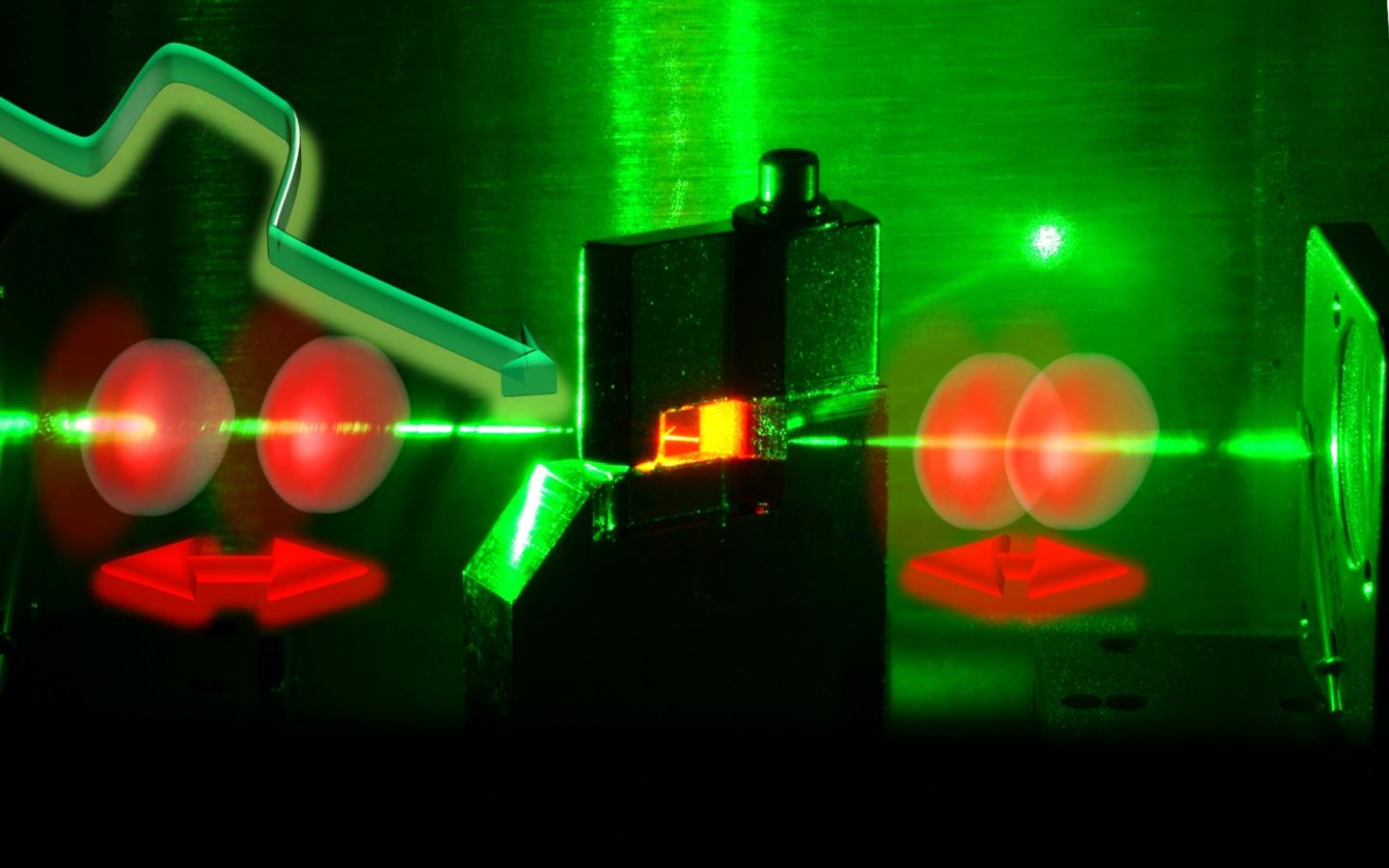
IMAGE

Credit: University of Bayreuth

Ultrashort laser pulses have enabled scientists and physicians to carry out high-precision material analyses and medical procedures. Physicists from the Universities of Bayreuth and Göttingen have now discovered a new method for adjusting the extremely short time intervals between laser flashes with exceptional speed and precision. The intervals can be increased or decreased as needed, all at the push of a button. Potential applications range from laser spectroscopy to microscopy and materials processing. The results were published in Nature Photonics.

Laser pulses have long been utilized in research laboratories, industrial production, and medical therapies. In these applications it is often crucial that the pulses – also known as optical solitons – occur at certain intervals. Using a special high-speed measurement technique, the researchers were able to show how a short-pulse laser widely applied in research can be made to automatically generate pairs of light pulses separated by the desired interval. All that is required are small disturbances in the green “pump beam” (which generates the laser pulses) triggered by electric signals.

The new process centres on the targeted manipulation of solitons, wave packets that can occur in pairs in ultrashort laser pulses. “The resonance excitation and the short disturbance of soliton pairs trigger effects that can be used to specifically control ultrashort laser pulses. This opens up an exciting new area of research with a yet unforeseeable range of possible applications,” said Professor Georg Herink from the University of Bayreuth, corresponding author of the new study.

“At the right frequency, a tiny external modulation of the laser is all you need, and ultrashort laser pulses are set into reciprocal, resonant oscillation. Similar phenomena can be observed in water molecules heated in the microwave,” added lead author Felix Kurtz from the University of Göttingen. The newly published findings show that in the future, ultra-short pulse lasers will not only be considered as a tool, but also remain a fascinating object of research.

###

F. Kurtz, C. Ropers. G. Herink: Resonant excitation and all-optical switching of femtosecond soliton molecules. Nature Photonics (2019). https://doi.org/10.1038/s41566-019-0530-3

Contact:

Professor Georg Herink

Experimental Physics VIII

University of Bayreuth

Phone: +49 (0)921 / 55-3161

E-mail: [email protected]

Professor Claus Ropers

IV. Physical Institute

University of Göttingen

Email: [email protected]

Felix Kurtz

IV. Physical Institute

University of Göttingen

Email: [email protected]

Media Contact
Georg Herink
[email protected]
49-092-15531

Original Source

http://www.uni-goettingen.de/en/3240.html?id=5651

Related Journal Article

http://dx.doi.org/10.1038/s41566-019-0530-3

Tags: Chemistry/Physics/Materials Sciences
Share12Tweet8Share2ShareShareShare2

Related Posts

Why Ripe Chili Peppers Smell Fruitier: Ripening Links Heat and Aroma

Why Ripe Chili Peppers Smell Fruitier: Ripening Links Heat and Aroma

October 5, 2026
Electric Vehicle Fires, Wildfire Smoke and 3D Printing Take Center Stage as Exposure Scientists Gather in Vancouver

Electric Vehicle Fires, Wildfire Smoke and 3D Printing Take Center Stage as Exposure Scientists Gather in Vancouver

October 5, 2026

Greener HPLC Method Tracks Leukemia Drug and Anti-Nausea Partner in Blood Plasma

October 5, 2026

Linseed Oil and Cardanol Yield Isocyanate-Free Polyurethane Coatings

October 5, 2026
Please login to join discussion

POPULAR NEWS

  • Alloys That Shrink Their Own Grains: New PIX Mechanism Refines Metals With Heat Alone

    Alloys That Shrink Their Own Grains: New PIX Mechanism Refines Metals With Heat Alone

    29 shares
    Share 12 Tweet 7
  • Endurance Exercise Reshapes the Liver in Males and Females Through Distinct Molecular Routes

    29 shares
    Share 12 Tweet 7
  • Single Transcription Factor PU.1 Rapidly Converts Fibroblasts into Macrophage-Lineage Cells

    29 shares
    Share 12 Tweet 7
  • New Scale Measures How Ready Nurse Educators Really Are for the AI Era

    29 shares
    Share 12 Tweet 7

About

We bring you the latest biotechnology news from best research centers and universities around the world. Check our website.

Follow us

Recent News

Alloys That Shrink Their Own Grains: New PIX Mechanism Refines Metals With Heat Alone

Endurance Exercise Reshapes the Liver in Males and Females Through Distinct Molecular Routes

Single Transcription Factor PU.1 Rapidly Converts Fibroblasts into Macrophage-Lineage Cells

Subscribe to Blog via Email

Success! An email was just sent to confirm your subscription. Please find the email now and click 'Confirm' to start subscribing.

Join 85 other subscribers
  • Contact Us

Bioengineer.org © Copyright 2023 All Rights Reserved.

Welcome Back!

Login to your account below

Forgotten Password?

Retrieve your password

Please enter your username or email address to reset your password.

Log In
No Result
View All Result
  • Homepages
    • Home Page 1
    • Home Page 2
  • News
  • National
  • Business
  • Health
  • Lifestyle
  • Science

Bioengineer.org © Copyright 2023 All Rights Reserved.