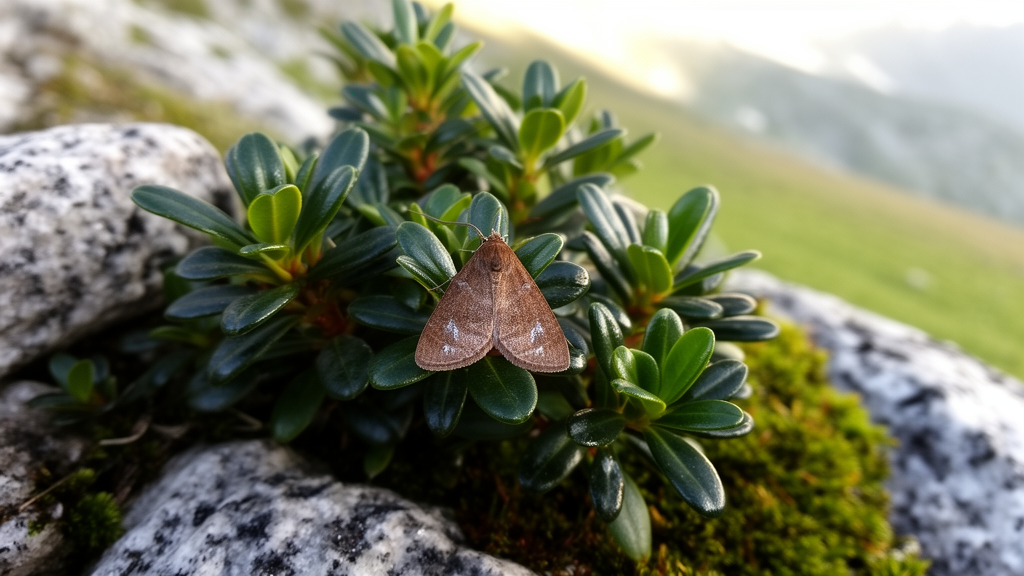
A tiny white moth has turned up in the Swiss Alps feeding on a plant it was never supposed to touch. Lyonetia ledi, a microlepidopteran long regarded as a boreal peat-bog specialist, has been discovered mining the leaves of Rhododendron ferrugineum, the Alpenrose, in the Lower Engadine of Graubünden. The find, reported in the journal Alpine Entomology, is the first record of an obligatory leaf-mining insect on this iconic alpine shrub and suggests the species survived in the Alps since the end of the last ice age after switching host plants.
The discovery came about almost by accident. On 29 July 2021, during surveys for Biodiversity Monitoring Switzerland, occupied leaf mines of an unidentified species were noticed on Alpenrose in the Lower Engadine and subsequently confirmed by the researchers. The observation was immediately surprising, because no specialized leaf-miners had previously been known from this plant, which is why lepidopterists usually overlook it. An initial suspicion that the mines belonged to a member of the family Nepticulidae was rejected on the basis of the larvae’s habits: the final instar larva left its mine and spun a silken construction typical of the genus Lyonetia, with the pupa suspended by threads. The moths that later emerged were identified as Lyonetia ledi both by their external morphology and by DNA barcoding.
Lyonetia ledi was previously known in the Alps only from a single specimen collected in Carinthia, Austria, a record whose origin had seemed questionable. The known host plants of the species, Rhododendron tomentosum (Ericaceae) and Myrica gale (Myricaceae), are absent from that area, leaving the Carinthian specimen unexplained. In Europe the species is otherwise regarded as a leaf-miner of Rhododendron tomentosum, formerly Ledum palustre, with regular additional records from the unrelated Myrica gale in the northern part of the continent. Both host plants are characteristic of peat bogs and show a circumpolar distribution, and following them the moth is widely distributed from northern Europe to the Far East, with an increasingly patchy pattern in northern Central Europe and isolated populations in the southern Czech Republic and northernmost Austria.
The Swiss population is highly isolated. It lies roughly 440 kilometres from the closest confirmed records of the moth in northern Lower Austria. However, records of the usual host plant Rhododendron tomentosum have been published from southern Germany’s Allgäu region, only about 100 kilometres from the Swiss site, and sub-recent observations place Rhododendron ferrugineum on the borders of peat bogs in the Allgäu district as well. This geographic juxtaposition underpins the authors’ hypothesis about how the moth came to feed on Alpenrose at all.
In total, 19 male and 6 female specimens from Switzerland were examined and are preserved in the research collection of the Tiroler Landesmuseum Ferdinandeum in Hall, Austria, and in the collection of Jürg Schmid in Ilanz, Switzerland. Identification rested first on phenotypic characteristics of the adults, including wing markings, colour and size, compared against collection specimens and online illustrations. Despite considerable individual variation, sometimes with complete reduction of the dark markings in the basal two-thirds of the forewing, the species cannot be confused with any of its European congeners. Genitalia were not examined in this study; their characteristics in both sexes had already been described and illustrated in earlier work.
The adults are small and striking: the head, thorax and eye-cap are glossy white, the wingspan is around 7 to 9 millimetres, and the glossy white forewings carry a short oblique dark brown streak from the tornus at half wing length, a longitudinal patch at about two-thirds, two dorsal streaks converging in the disc at three-quarters, and a large ochre-brown patch in the distal fifth, with four blackish strigulae on the costal ciliae and a large black apical dot followed by a black line and an apical scale-pencil. The hindwings are grey. Some expected marking elements, such as a short sub-basal streak below the fold or a complete medial streak, were not observed in the Swiss material, and in one specimen the medial and postmedial markings were entirely reduced.
Molecular evidence supports the identification and connects the alpine moths to populations far to the north. DNA barcodes of a 658 base-pair segment of the mitochondrial COI gene were obtained from three Swiss specimens, with recovered lengths of 586, 632 and 658 base pairs. These sequences, together with European populations and four Canadian specimens, formed a single cluster assigned to the Barcode Index Number BOLD:AAE8230 (n=14), with a mean intraspecific distance of 0.39 percent and a maximum divergence of 1.22 percent, but 2.24 percent to the nearest neighbour. Except for a single weakly deviating sequence from Lower Austria, all European specimens, including the Swiss samples, share the same haplotype, while the Canadian samples belong to a distinct haplotype. Two additional BINs, containing the Canadian nearest neighbour and a unique sequence from South Korea, hint at potential cryptic diversity within the species complex. The authors also note that the considerable intraspecific variability of 6.65 percent detected in the related Lyonetia clerkella in Europe should likewise be tested for hidden species. Across the studied genus, barcode distances to nearest neighbours range from roughly 6 to 12 percent, well above intraspecific divergence: L. clerkella shows 12.13 percent to L. ledi, L. ledi 8.76 percent to L. pulverulentella, and L. padifoliella and L. prunifoliella 5.75 percent to each other.
The life history of the moth on its new host was documented in detail. The egg is laid on the upper side of a leaf. The tunnel-mine first extends towards the base of the leaf, then turns and runs alongside the leaf rim towards the tip, where a spacious blotch mine forms. Only current-year leaves, recognisable by their green underside, are infested; older leaves with the plant’s name-giving rusty underside may contain only mines from previous years. The mine is hardly visible from below. Frass is first deposited in a continuous line that later fills the entire tunnel-mine, while in the blotch mine it lies in irregular patches. Based on earlier Japanese work, frass may also be ejected through semicircular lateral slits along the border of the blotch mine, and larvae may move to a new leaf to start a fresh mine, an observation not confirmed in the alpine habitat. The final instar larva is light yellow with a light brown head and a brownish mottled thoracic shield, about 4.8 millimetres long. On the underside of a nearby leaf it builds an X-shaped silken scaffold in which it pupates like a hammock; the pupa is about 4.4 millimetres long and can be found easily on mined or adjacent leaves.
Phenology and natural enemies round out the picture. First larvae were detected on 29 July 2021; two weeks later, on 12 August, only pupae were found, and in captivity adults emerged after about a week to ten days, between 6 and 21 August. These data suggest that the adults hibernate, as reported from Sweden, with a flight period from mid-August to October and again from April to May. The larvae appear to be regularly attacked by parasitic wasps, including Diadegma cf. semiclausum (barcoded) and an unidentified ichneumonid, whose empty cocoons were found in numbers. The habitat itself is remarkable. Lyonetia ledi is considered a tyrphobiontic species because it is restricted to peat bogs, but the Swiss site is entirely different: a north-facing subalpine Larici-Piceetum association dominated by Larix decidua and Picea abies, with Pinus cembra, Betula pendula and Alnus alnobetula nearby, situated in a steep avalanche gully where lingering snow persists into early summer and creates unique microclimatic conditions. The most heavily infested Alpenrose shrubs are often puny specimens growing in deep shade and unable to flower.
The authors propose a postglacial explanation for this unexpected alpine population. At the maximum of the last ice age some 22,000 years before present, the northern rim of the alpine glaciers extended over today’s Lake Constance and approached the site of modern Munich. It may be hypothesized that Rhododendron ferrugineum and R. tomentosum coexisted in the glacier’s foreland in that region, allowing the moth to switch hosts. Once adapted to Alpenrose, it could have followed the new host plant into the alpine valleys as the glaciers retreated, surviving to the present at very specific sites. Because the Lower Engadine became ice-free only around 14,000 years before present, the species was not isolated long enough to develop marked genetic differences from other European colonies, consistent with the shared European haplotype. Canadian populations, by contrast, already show several COI mutations, with 4 diagnostic and 33 partial characters and more than 1 percent divergence from European L. ledi, indicating a much longer separation. If the hypothesis holds, L. ledi belongs to a group of species, including Exaeretia allisella, Depressaria leucocephala and possibly Agonopterix subtakamukui, that colonized the northeastern Alps postglacially from northeastern glacial refugia and persist there in sparse, isolated colonies. A similar geographic switch in host plants has been recorded in other tyrphobiontic species, for example the geometrid moth Eupithecia gelidata. The new record also substantiates the probability of an autochthonous population in Carinthia, where the species was recently published as new to the Alps, and a single unexplained adult from the southern Alps, collected at light nearly 300 kilometres from the next known population in a stream bed with alpine limestone flora, may point to yet another alpine Rhododendron-feeding population, with R. hirsutum listed as a potential, though unchecked, host. In Asia the species has been recorded from a range of additional Rhododendron species and in North America from R. albiflorum, suggesting a broader host spectrum than the European records alone imply.
Subject of Research: First record of the leaf-mining moth Lyonetia ledi on Rhododendron ferrugineum in the Swiss Alps and its postglacial host-plant shift
Article Title: Relict populations of Lyonetia ledi Wocke, 1859 ( Lepidoptera , Lyonetiidae ) from the Alps indicate postglacial host-plant shift to the famous Alpenrose ( Rhododendron ferrugineum L.)
Article References: Huemer, P., & Schmid, J. (2021). Relict populations of Lyonetia ledi Wocke, 1859 (Lepidoptera, Lyonetiidae) from the Alps indicate postglacial host-plant shift to the famous Alpenrose (Rhododendron ferrugineum L.). Alpine Entomology, 5, 101-106. https://doi.org/10.3897/alpento.5.76930
Image Credits: AI Generated
Keywords: Lyonetia ledi, Lyonetiidae, Rhododendron ferrugineum, Alpenrose, leaf-miner, DNA barcoding, COI gene, postglacial, host-plant shift, Swiss Alps, tyrphobiontic species, Alpine Entomology
News Source: Gavin Prescott. (October 27, 2026). Alpine leaf-mining moth found on Alpenrose points to ancient postglacial host shift. Scienmag.