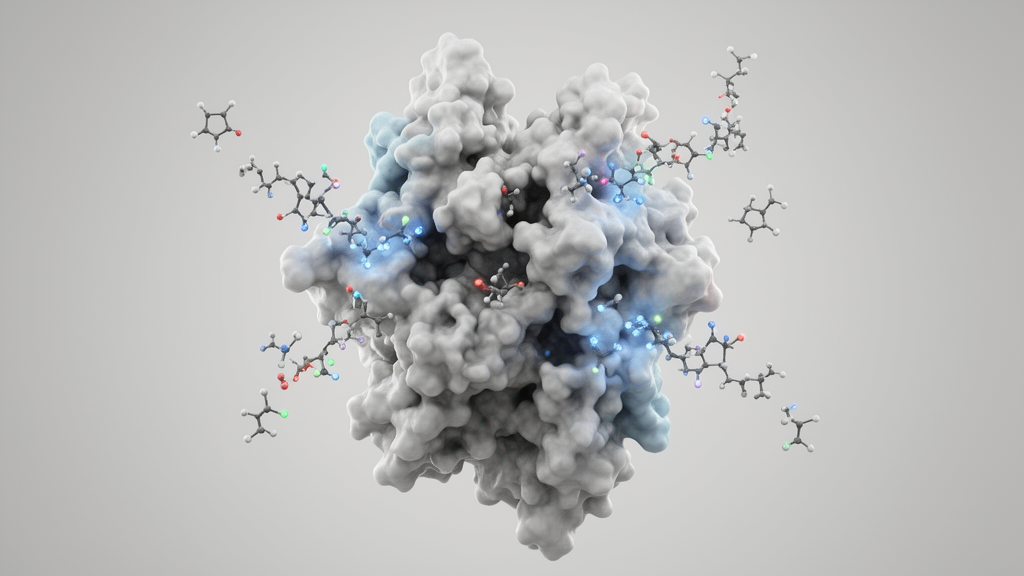
Computational structural analyses conducted with the artificial intelligence platform AlphaFold 3 have revealed distinct molecular mechanisms governing how common chemical enhancers modulate CRISPR/Cas12a ribonucleoprotein complexes. Published in Health Nanotechnology by an investigative team led by Lulu Pan, Aifeng Wang, Rui Sang, Xia Lu, Wenjie Chen, Yongcheng Ma, and Fei Deng, the study evaluates the conformational responses of Cas12a ribonucleoproteins, commonly termed RNPs, when exposed to different additive agents utilized to boost diagnostic performance. The researchers demonstrated that the reducing agent dithiothreitol, designated as DTT, stimulates Cas12a activity by instigating substantial spatial rearrangements across critical protein domains. In sharp contrast, simulations of complexes containing divalent metal cations, specifically magnesium and manganese ions, or bovine serum albumin indicated that these widely used chemical additives do not produce major structural remodeling within the assembled ribonucleoprotein framework. By applying predictive deep learning tools to macromolecular assemblies composed of protein, guide RNA, and target single-stranded DNA, the authors established a structural framework distinguishing conformational enhancers from additives that operate through non-structural stabilization or alternative biochemical pathways.
The CRISPR/Cas12a architecture serves as a cornerstone of modern molecular diagnostics due to its unique trigger-activated trans-cleavage activity, which operates by nonspecifically shredding nearby single-stranded nucleic acids once a specific target sequence is recognized. Discovered originally as an adaptive defensive system deployed by bacteria and archaea against invading viral pathogens, Cas proteins have been repurposed into rapid diagnostic platforms including DETECTR and HOLMES. In these detection platforms, Cas12a forms an active ribonucleoprotein with a complementary guide RNA, known as crRNA, which directs the complex to matching target DNA sequences. Mechanistically, Cas12a relies on specialized internal domains to execute this function, chiefly the nuclease, or NUC, domain and the RuvC domain. The RuvC segment governs target recognition and mediates specific strand cleavage, while the NUC domain orchestrates the spatial guidance of nucleic acid strands into the enzymatic active pocket. Because diagnostic assay sensitivity depends directly on maximizing trans-cleavage rates, identifying how chemical additives influence these protein domains represents a fundamental challenge in biosensor engineering.
Efforts to elucidate enhancer mechanisms have historically encountered substantial technical bottlenecks within experimental structural biology. High-resolution structural methodologies such as X-ray crystallography and cryogenic electron microscopy, commonly known as cryo-EM, have mapped foundational snapshots of Cas nucleases across various operational phases. Nevertheless, capturing dynamic conformational transitions remains experimentally challenging because flexible macromolecular assemblies are difficult to crystallize in uniform lattices, and cryo-EM procedures require substantial resource investments and complex sample preparation pipelines. These empirical constraints have elevated the utility of advanced computational modeling platforms capable of simulating multi-component biomolecular complexes. While AlphaFold uses deep learning to accurately predict three-dimensional protein structures, including 98.5 percent of human protein structures, previous computational approaches had limitations when handling complex assemblies. AlphaFold 3 represents a major technological leap by extending high-accuracy predictive capabilities beyond pure polypeptides, facilitating the unified modeling of intricate complexes comprising proteins, nucleic acid strands, ions, and chemical ligands, thereby presenting a viable methodology for dissecting Cas12a-enhancer interactions in silico.
To evaluate these biochemical phenomena computationally, the investigators implemented a standardized workflow using the AlphaFold Server, which runs AlphaFold 3, to simulate ribonucleoprotein structures of Lachnospiraceae bacterium Cas12a, designated as LbCas12a. The modeling inputs incorporated distinct structural columns specifying the molecular identities of the protein components, the guide RNA sequence, and the single-stranded DNA trigger, accompanied by divalent ions where appropriate. Stoichiometric ratios were rigorously standardized, assigning single-copy quantities to the protein, RNA, and DNA molecules, while incorporating two copies each for magnesium or manganese ions when simulating cation-assisted states. In silico structural jobs were submitted utilizing an automated random seed generation setting. The researchers monitored statistical metrics generated by the server, focusing on the predicted template modeling score, or pTM, where values exceeding 0.5 denote high confidence that the global predicted fold mirrors authentic macromolecular geometry. Additionally, the team monitored the interface-predicted template modeling score, or ipTM, where values exceeding 0.8 reflect high prediction confidence regarding the relative spatial orientations established among interacting subunits within the multi-chain molecular complex.
Comparative structural assessments between simulated models and experimental configurations deposited in the Protein Data Bank, abbreviated as PDB, were carried out via the PyMOL Molecular Graphics System version 2.6. Global structural variance was quantified by computing the root mean square deviation, or RMSD, between aligned atomic coordinates, with values surpassing 2.0 angstroms serving as the recognized threshold denoting statistically significant conformational divergence. Furthermore, because Cas12a trans-cleavage activity relies critically upon functional reorientations of its catalytic machinery, the researchers tracked spatial distances between two marker amino acid residues: valine at position 377, residing in the REC2 domain, and glutamine at position 1136, situated within the active NUC domain. In the baseline inactive crystal structure, cataloged as PDB 6NME, the REC2 region sits close to the catalytic NUC core, whereas trigger binding induces an outward displacement of REC2 that separates these two domains. Residue distances on generated model-0.cif structural coordinates were simulated and measured within Visual Studio Code version 1.91.1 equipped with a specialized three-dimensional macromolecular viewer.
Prior to interrogating chemical additive interactions, the researchers validated AlphaFold 3 by comparing its predictive simulations against experimentally verified structural coordinates of inactivated and activated Cas12a complexes. Direct alignment between empirical crystal structures from the Protein Data Bank—representing inactivated Cas12a RNP under accession 6NME and activated Cas12a RNP under accession 5XUS—yielded an RMSD value of 2.567 angstroms, reflecting pronounced activation-induced conformational shifts. In these empirical models, the distance between Val377 and Gln1136 shifted from 24.59 angstroms in the dormant state to 30.13 angstroms following activation. When AlphaFold 3 was tasked with simulating the identical sequence sets, the generated models accurately captured this global reorganization, exhibiting an RMSD of 2.953 angstroms between dormant and active complexes, with the Val377-to-Gln1136 separation expanding from 24.22 angstroms in the simulated inactive complex to 30.86 angstroms in the activated assembly. To test simulation versatility across distinct nucleic acid environments, an alternate set of guide RNA and trigger sequences was modeled, revealing an RMSD of 3.133 angstroms and a distance increase from 24.22 to 32.55 angstroms upon activation, verifying the computational tool’s robustness.
Having validated the computational system, the research team investigated dithiothreitol, a potent reducing agent widely documented to enhance Cas12a trans-cleavage activity by cleaving non-native disulfide linkages that constrain conformational movement. Because small synthetic reducing molecules like DTT cannot be directly represented within AlphaFold 3 input pipelines, the researchers deployed a rational mutational proxy strategy. Using the Design v2.13 computational server, the authors confirmed that none of the nine endogenous cysteine residues present throughout LbCas12a participate in natural intramolecular disulfide bonds. Drawing upon cellular studies demonstrating that replacing cysteines with serines elevates AsCas12a nuclease performance, the investigators generated an in silico mutant termed mutCas12a, wherein all nine cysteine residues were converted to serine residues. Because serine closely mimics cysteine stereochemistry while lacking the capacity to form covalent disulfide crosslinks, mutCas12a simulated the permanently reduced state elicited by DTT exposure without destabilizing the fundamental tertiary fold of the unactivated ribonucleoprotein complex.
Structural comparisons between the simulated activated wild-type Cas12a RNP and the activated mutCas12a complex revealed striking conformational remodeling induced by the simulated reducing agent. Superimposing the two molecular models produced an RMSD value of 2.082 angstroms, exceeding the 2.0 angstrom significance threshold and demonstrating notable structural deviation. Concurrently, the calculated distance separating residue Val377 in the REC2 domain from residue Gln1136 in the NUC domain underwent an expansive shift, extending from 32.55 angstroms in the standard activated wild-type RNP to 42.87 angstroms in the cysteine-to-serine mutCas12a assembly. This massive spatial widening demonstrates that DTT-induced enhancements stem from marked structural rearrangements that unlock the spatial orientation of the catalytic nuclease domain relative to surrounding regulatory domains. The authors noted that this observation aligns with reports of DTT action and suggested that mutCas12a could be utilized in experimental settings to increase Cas nuclease trans-cleavage activity, even in the absence of DTT or other reducing agents.
In marked contrast to the extensive structural remodeling observed in reducing agent simulations, computational evaluations of divalent metal cations demonstrated an absence of substantial backbone alterations. Divalent cations, including magnesium and manganese, represent indispensable cofactors routinely added to diagnostic buffers to stimulate enzymatic cleavage and promote guide RNA stability. The authors simulated activated Cas12a RNPs incorporating two divalent ions based on crystallographic binding positions. Aligning the magnesium-bound activated Cas12a RNP with the standard activated complex yielded an RMSD of only 0.064 angstroms, accompanied by an inter-residue distance of 32.80 angstroms between Val377 and Gln1136, closely matching the 32.55 angstrom baseline. Similarly, modeling the incorporation of two manganese ions produced an RMSD of 0.063 angstroms and a residue distance of 32.69 angstroms. When the investigators simulated LbCas12a in the absence of guide RNA, manganese induced an RMSD shift of 1.910 angstroms—approaching the 2.0 angstrom boundary—which supports previous laboratory findings that manganese uniquely promotes crRNA-independent DNase activity. Overall, however, within fully assembled ribonucleoproteins, divalent cations appear to facilitate enzymatic trans-cleavage by stabilizing crRNA conformations rather than driving large-scale spatial reorganizations of the protein backbone.
Simulations evaluating bovine serum albumin further corroborated that chemical enhancement does not universally require gross structural alterations. When the activated Cas12a RNP was simulated in conjunction with BSA, structural alignment against the unenhanced active complex yielded an RMSD of 0.384 angstroms and a Val377-to-Gln1136 separation of 33.19 angstroms, demonstrating that BSA does not modify the complex’s core geometry. The simulation produced a pTM score of 0.68 and an ipTM score of 0.65, indicating reliable fold predictions alongside modest variability regarding subunit interface contacts. Based on these findings, the authors concluded that BSA enhances Cas12a assay sensitivity through non-structural biochemical phenomena, including the physical stabilization of macromolecular structures, the neutralization of trace chemical inhibitors introduced during sample purification, or the facilitation of proper protein refolding through solvent modulation. Collectively, the study illustrates both the power and boundaries of predictive structural modeling: while AlphaFold 3 successfully differentiates between conformational remodeling and non-structural enhancement mechanisms, current server constraints—such as the inability to incorporate ambient water molecules like hexaaquamagnesium complexes or directly calculate small organic reducing molecules—underscore the continued necessity of integrating computational predictions with direct laboratory validation.
Subject of Research: AlphaFold 3 structural modeling of chemical enhancer effects on CRISPR-Cas12a ribonucleoproteins
Article Title: AlphaFold 3 sheds insights into chemical enhancer-induced structural changes in Cas12a RNPs
Article References: Pan, L., Wang, A., Sang, R., Lu, X., Chen, W., Ma, Y., & Deng, F. (2025). AlphaFold 3 sheds insights into chemical enhancer-induced structural changes in Cas12a RNPs. Health Nanotechnology, 1(1), Article 1. https://doi.org/10.1186/s44301-024-00003-z
Image Credits: AI Generated
DOI: 10.1186/s44301-024-00003-z
Keywords: AlphaFold 3, CRISPR-Cas12a, Ribonucleoprotein, Dithiothreitol, Trans-Cleavage Activity, Biosensing Systems, Protein Structure Prediction, Root Mean Square Deviation, Nuclease Domain, Divalent Cations, Bovine Serum Albumin, LbCas12a, DETECTR, Molecular Modeling, Nucleic Acid Detection, Structural Biology
News Source: Sylvia Mullen. (November 20, 2026). AlphaFold 3 Models Reveal How Chemical Enhancers Alter Cas12a Biosensor Structures. Scienmag.