• HOME
  • NEWS
  • EXPLORE
    • CAREER
      • Companies
      • Jobs
    • EVENTS
    • iGEM
      • News
      • Team
    • PHOTOS
    • VIDEO
    • WIKI
  • BLOG
  • COMMUNITY
    • FACEBOOK
    • INSTAGRAM
    • TWITTER
Monday, October 5, 2026
BIOENGINEER.ORG
No Result
View All Result
  • Login
  • HOME
  • NEWS
  • EXPLORE
    • CAREER
      • Companies
      • Jobs
        • Lecturer
        • PhD Studentship
        • Postdoc
        • Research Assistant
    • EVENTS
    • iGEM
      • News
      • Team
    • PHOTOS
    • VIDEO
    • WIKI
  • BLOG
  • COMMUNITY
    • FACEBOOK
    • INSTAGRAM
    • TWITTER
No Result
View All Result
Bioengineer.org
No Result
View All Result
Home NEWS Science News

Allen Cell Types Database updated with new data and models

Bioengineer by Bioengineer
March 17, 2017
in Science News
Reading Time: 2 mins read
0
Share on FacebookShare on TwitterShare on LinkedinShare on RedditShare on Telegram
IMAGE

Credit: Allen Institute

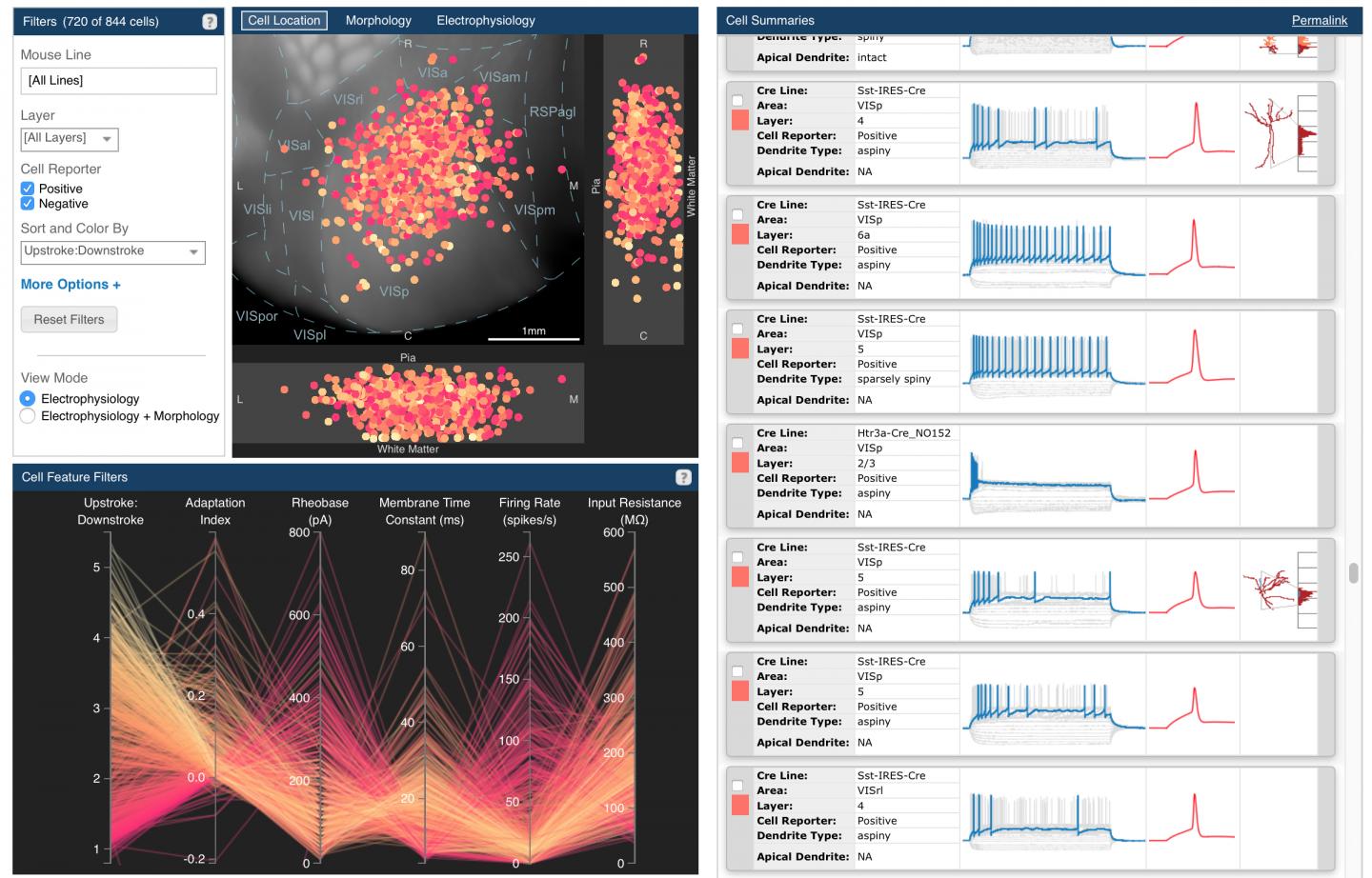
The Allen Institute for Brain Science has released additional data and computer models of cell activity for inclusion in the Allen Cell Types Database: a publicly available tool for researchers to explore and understand the building blocks of the brain.

"Comprehensive coverage of hundreds to thousands of cells will be crucial for scientists who want to explore the diversity of nerve cells in the brain, and provides a base from which we can parse cells into meaningful types," says Lydia Ng, Ph.D., Senior Director of Technology at the Allen Institute for Brain Science. "This release is one more step in building a fundamental framework to help make advancements in neuroscience."

Models serve as a critical link between observed data and theories about how cells work, enabling scientists to understand the mechanisms that give rise to neuron function. Two types of models have been added and updated as part of this release. The first set are models that reduce the complexity of neurons and use cell measurements to "predict" the activity and function of those cells, which are now available for 633 neurons in the database.

Additionally, more sophisticated neuronal models based on cell shape, morphology and subcellular components are now available for hundreds of neurons via an interactive web browser.

The Allen Cell Types Database contains detailed descriptive features gathered from individual neurons in the mouse brain, including location, electrical activity and shape. For this release, electrophysiological recordings from an additional 130 cells from the cortex have been added to the database.

The Allen Cell Types Database (celltypes.brain-map.org) is a fundamental resource of the Allen Institute's ten-year plan to understand how activity in the brain leads to perception, decision-making and action. Understanding cell types–the brain's building blocks–is critical to making sense of both how the healthy brain functions and what goes wrong in diseases such as autism, Alzheimer's and Parkinson's.

Additional updates to Allen Brain Atlas resources are planned for June and October of 2017.

###

About the Allen Institute for Brain Science

The Allen Institute for Brain Science is a division of the Allen Institute, an independent, 501(c)(3) nonprofit medical research organization dedicated to accelerating the understanding of how the human brain works in health and disease. Using a big science approach, the Allen Institute generates useful public resources used by researchers and organizations around the globe, drives technological and analytical advances, and discovers fundamental brain properties through integration of experiments, modeling and theory. Launched in 2003 with a seed contribution from founder and philanthropist Paul G. Allen, the Allen Institute is supported by a diversity of government, foundation and private funds to enable its projects. Given the Institute's achievements, Mr. Allen committed an additional $300 million in 2012 for the first four years of a ten-year plan to further propel and expand the Institute's scientific programs, bringing his total commitment to date to $500 million. The Allen Institute's data and tools are publicly available online at http://www.brain-map.org.

Media Contact

Rob Piercy
[email protected]
206-548-8486
@Allen_Institute

Allen Institute

############

Story Source: Materials provided by Scienmag

Share12Tweet8Share2ShareShareShare2

Related Posts

From Painkillers to Sunscreens: How Everyday Chemicals Are Hitting the Microscopic Engines of Aquatic Ecosystems

From Painkillers to Sunscreens: How Everyday Chemicals Are Hitting the Microscopic Engines of Aquatic Ecosystems

October 5, 2026
New Inflammation-Nutrition Index Shows Promise and Limits in COVID-19 Severity Assessment

New Inflammation-Nutrition Index Shows Promise and Limits in COVID-19 Severity Assessment

October 5, 2026

Dynamic Clustering Meets Borda Count to Rank China’s Top Scenic Spots

October 5, 2026

Cell Death Debris Turns Out to Be a Master Regulator of Bone Renewal

October 5, 2026
Please login to join discussion

POPULAR NEWS

  • Alloys That Shrink Their Own Grains: New PIX Mechanism Refines Metals With Heat Alone

    Alloys That Shrink Their Own Grains: New PIX Mechanism Refines Metals With Heat Alone

    29 shares
    Share 12 Tweet 7
  • Endurance Exercise Reshapes the Liver in Males and Females Through Distinct Molecular Routes

    29 shares
    Share 12 Tweet 7
  • Single Transcription Factor PU.1 Rapidly Converts Fibroblasts into Macrophage-Lineage Cells

    29 shares
    Share 12 Tweet 7
  • New Scale Measures How Ready Nurse Educators Really Are for the AI Era

    29 shares
    Share 12 Tweet 7

About

We bring you the latest biotechnology news from best research centers and universities around the world. Check our website.

Follow us

Recent News

Alloys That Shrink Their Own Grains: New PIX Mechanism Refines Metals With Heat Alone

Endurance Exercise Reshapes the Liver in Males and Females Through Distinct Molecular Routes

Single Transcription Factor PU.1 Rapidly Converts Fibroblasts into Macrophage-Lineage Cells

Subscribe to Blog via Email

Success! An email was just sent to confirm your subscription. Please find the email now and click 'Confirm' to start subscribing.

Join 85 other subscribers
  • Contact Us

Bioengineer.org © Copyright 2023 All Rights Reserved.

Welcome Back!

Login to your account below

Forgotten Password?

Retrieve your password

Please enter your username or email address to reset your password.

Log In
No Result
View All Result
  • Homepages
    • Home Page 1
    • Home Page 2
  • News
  • National
  • Business
  • Health
  • Lifestyle
  • Science

Bioengineer.org © Copyright 2023 All Rights Reserved.