Credit: Biqiang Jiang, Zhen Hao, Yafei Ji, Yueguo Hou, Ruixuan Yi, Dong Mao, Xuetao Gan and Jianlin Zhao
Silica optical fibers exhibit intrinsic features such as ultralow loss, a high damage threshold, and a small mode field, enabling the possibility of long-haul communications and sensing, and have greatly changed our daily living and working styles. The advance of fibers also gives birth to nonlinear fiber optics due to the long interaction length and high power density in the fiber core. However, the lowest-order nonlinear effects in optical fibers originate from the third-order nonlinear susceptibility, which requires extremely high peak power. In nonlinear optics, second-order nonlinear responses are the primary alternative, relying on much higher susceptibility, which will greatly reduce the pump power of nonlinear optical effect. Unfortunately, the centrosymmetric nature of silica fibers precludes the possibility of wavelength conversion based on their second-order nonlinearity. To improve it, considerable efforts have already been made by scientists. However, for the wavelength conversion, a high-intensity pulsed laser, complex post-processing or harsh fabrication conditions of the fibers are still required. Thus, the conversion operations with low-power consumption in a wide wavelength region are hence scientists’ pursuits and visions for extensive and practical applications.
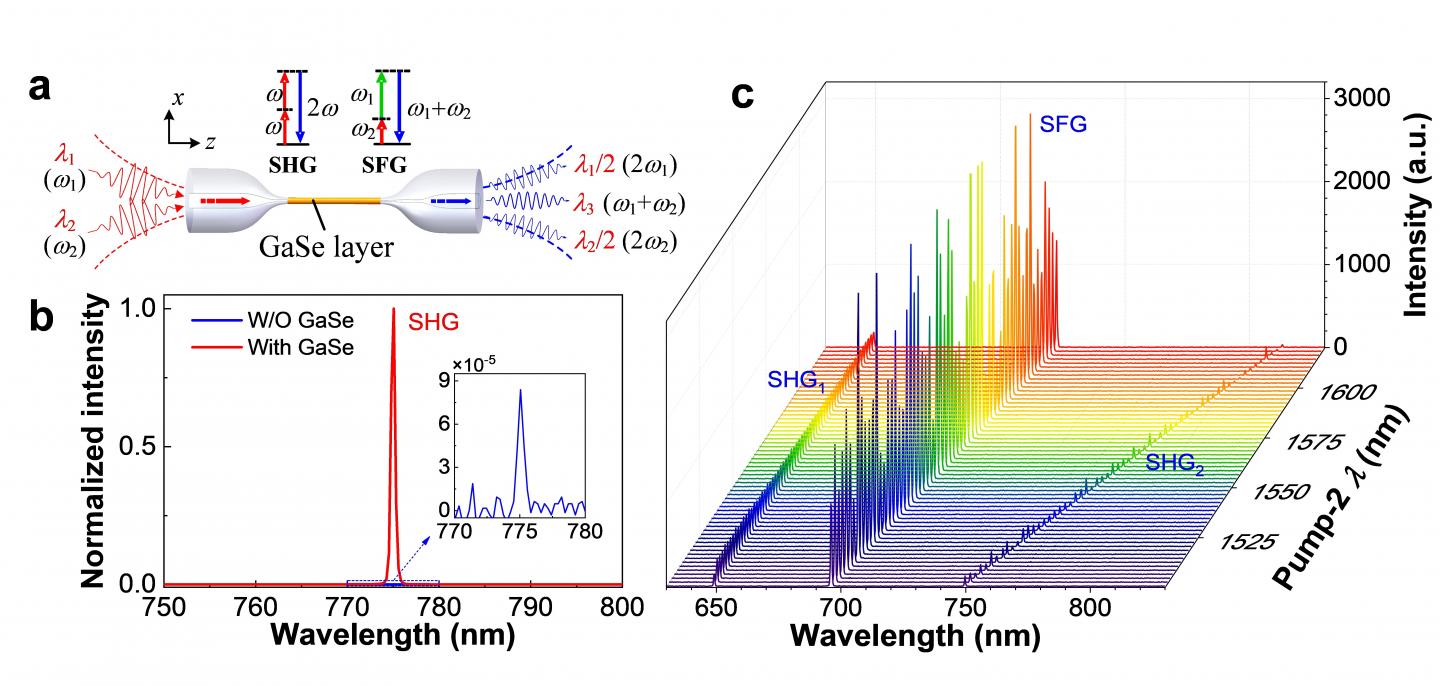
Recently, a new paper published in Light: Science & Applications, Scientists from Northwestern Polytechnical University, China, proposed and developed an all-fiber wavelength converter assisted by few-layer gallium selenide (GaSe) nanoflakes. Attributed to the strong evanescent field of the microfiber and ultrahigh second-order nonlinearity of the GaSe nanoflakes, the efficiency of wavelength conversion from the GaSe-integrated microfiber is enhanced by more than four orders of magnitude in comparison with that from a pristine microfiber. The high efficiency wavelength conversion therefore offers the possibility of continuous-wave (CW) laser pump. In practical application, CW-pumped nonlinear fiber optics with simple, low-power and low-cost light sources, such as semiconductor laser diodes, would be highly desirable. More importantly, the researchers found that the conversion of wavelength can be operated in a wide wavelength range covering the whole C and L telecom bands as well as the O band. Also, the generations of new wavelengths only require a sub-milliwatt CW laser.
The all-fiber wavelength converter is based on the second-order nonlinear process such as second-harmonic generation (SHG) and sum-frequency generation (SFG). They are two common optical phenomena in nonlinear optics, while not easy to be excited, especially in silica fiber devices. The scientists give key points in their schemes of all-fiber wavelength converter.
“To obtain the enhanced conversion efficiency, we control the diameter of the microfiber for satisfying the phase-matching condition, according to the theory and simulation results. Also, we have to optimize the integration technique and reduce scattering loss of the microfiber introduced by the GaSe integration, by improving the performance of GaSe nanosheets, such as uniformity, thickness and size.”
“Of course, the efficiency of the wavelength conversion can be further enhanced by using a direct chemical vapor deposition growth technique for the perfect coating of 2D materials, which could facilitate a strong and tunable light-matter interaction” they added.
“The proposed CW pumped all-fiber wavelength converter is easy to integrate with current telecom infrastructures, and will promote many new applications, such as all-fiber all-optical signal processing, new light source generations at awkward wavelengths, and so on” the scientists forecast.
“This hybrid fiber device, by integrating other atomic layered materials, will pave the way for achieving high-performance wavelength or frequency modulation and manipulation in an all-fiber structure.” they also believe.
###
Media Contact
Xuetao Gan
[email protected]
Related Journal Article
http://dx.