


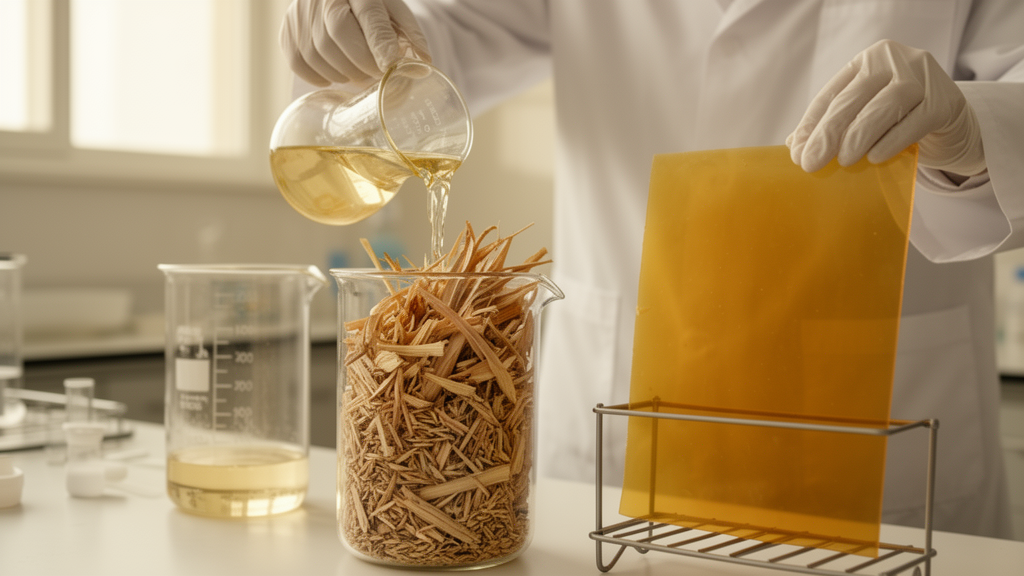
Agricultural residues such as rice husk, wheat straw, and sugarcane bagasse are usually burned, lost during collection, or left to decompose, releasing greenhouse gases and particulate matter while degrading soil. A mini review published in Biotechnology for Sustainable Materials argues that a single, simple chemical step—alkaline treatment with hydroxides such as sodium hydroxide or potassium hydroxide—can redirect this waste stream into two valuable products at once: bioadsorbents that pull pollutants out of wastewater, and purified cellulose precursors for biopolymers such as cellulose nanofibers and regenerated cellulose films. The review, which synthesises studies published between 2015 and 2025, frames this dual-function strategy as a circular economy approach to two growing problems at once: mounting agricultural waste and rising demand for sustainable materials and water purification technologies.
The chemistry behind the transformation centres on the nucleophilic hydroxide ion. Alkaline treatment saponifies ester bonds in lignin–carbohydrate complexes and on hemicellulose chains, a deacetylation step that liberates hemicellulose and generates in situ surfactants that improve wettability. At the same time, hydroxide ions cleave ether bonds—particularly the abundant β-O-4 linkages—fragmenting the lignin polymer into smaller phenolic compounds. Evidence from corn cob studies cited in the review shows an alkaline extraction step broke the ester and ether bonds between lignin and cellulose, achieving 73.76% lignin extraction efficiency after hemicellulose removal. The net effect is delignification: increased surface area, porosity, and, crucially, accessibility of the cellulose fraction that remains behind.
Those structural changes are what unlock the first pathway, water remediation. Removing lignin and hemicellulose acts as a kind of chemical etching, carving voids and channels into the biomass. In apricot shells, sodium hydroxide treatment reduced hemicellulose content from 19.2% to 3.5%, while converting native carboxylic acid groups into their anionic sodium salts. That conversion pre-loads the surface with exchangeable sodium ions and creates a more negatively charged interface. For heavy metal cations such as lead and copper, the review describes a two-step mechanism: rapid ion exchange, in which pre-loaded sodium ions are displaced by target metal ions, followed by stronger chemisorption through coordinate covalent bonds with electron-donating groups on the surface—a sequence often confirmed by pseudo-second-order kinetics.
Quantified performance figures illustrate how far this can go. Alkali-modified biomass ash showed increased adsorption capacity for copper, cadmium, and lead ions, linked to a 3.26-fold increase in surface area and the creation of new binding sites. A potassium permanganate-modified walnut shell biochar achieved capacities of 70.37 mg/g for lead and 58.96 mg/g for zinc in mono-metal solutions, with competitive adsorption in multi-metal systems following the affinity order Pb²⁺ > Cu²⁺ > Zn²⁺ > Cd²⁺. More sophisticated grafting pushes capacity higher still: lettuce leaves modified with alginate and the chelating agent DTPA reached 168.35 mg/g for lead, driven by the formation of specific Pb²⁺–DTPA complexes. For cationic dyes such as methylene blue, alkaline treatment raises the point of zero charge, creating a persistently negative surface that strongly attracts positively charged dye molecules, though anionic dyes like Congo red may be repelled by that same surface charge.
Emerging contaminants are a newer frontier. A case study on alkaline-treated pineapple leaf fibre reported removal of 89.7% for ciprofloxacin, 88.5% for paracetamol, and 77.1% for ibuprofen from pharmaceutical wastewater, with pseudo-second-order kinetics and a regeneration efficiency of 85.9% after five cycles. The review is candid about the limits: most studies in this area are conducted in simulated wastewater, and performance can decline sharply in real industrial effluents where competing organic matter and ions interfere. The diversity of pharmaceutical compounds, each with distinct chemical properties, also makes a universal biosorbent unlikely. Magnetic composites—iron oxides embedded in the biomass matrix—offer one practical answer for scale-up, enabling spent adsorbent to be separated from treated water with a magnet.
The second pathway flows from the same chemistry. As lignin and hemicellulose dissolve, cellulose microfibrils are liberated from their rigid network, and the cellulose can even shift from the native cellulose I allomorph to the more thermodynamically stable cellulose II upon regeneration. The purified fraction can then be disintegrated into cellulose nanocrystals, typically produced by strong acid hydrolysis into short, stiff, highly crystalline rods, or cellulose nanofibrils, obtained by intensive mechanical treatment into long, flexible fibrils suited to strong films and aerogels. Alternatively, bulk cellulose can be dissolved in solvents such as ionic liquids—which disrupt the hydrogen-bonding network under relatively mild conditions—and regenerated in an anti-solvent like water to be recast as films, fibres, and hydrogels. A third route is chemical derivatisation, exemplified by carboxymethyl cellulose, whose water solubility and tunable degree of substitution make it valuable from food packaging to pharmaceuticals.
Material properties depend heavily on the processing route. Composites reinforced with nanocellulose can achieve more than an 80% increase in tensile strength, and nanocellulose films can reach high transparency because their constituent particles are far smaller than the wavelength of visible light. Regenerated cellulose films, by contrast, typically show more moderate mechanical properties unless specific processing such as stretch-coagulation is applied, though they offer good gas barrier properties. All these cellulose-derived materials are inherently biodegradable, but the rate and extent depend on chemistry and morphology: compact crystalline nanocrystals degrade more slowly than amorphous regions, and blending in polylactic acid enhances water resistance while moderating the biodegradation profile. Rice straw–polylactic acid blends produced via pilot-scale extrusion represent a pragmatic middle path, using agricultural residues as low-cost filler in rigid packaging such as trays.
The review’s central integrative claim is that the same pretreatment variables—alkali concentration, temperature, reaction time, and biomass type—govern both outcomes, and that they interact rather than act independently. Concentration effects are biomass-specific: 3% NaOH yielded superior results for Washingtonia robusta fibres, while NaOH outperformed lime on both corn cob and sweet sorghum bagasse, though the degree of success depended on each biomass’s inherent composition. Corn cob, rich in hemicellulose at 33–35%, responded well to alkaline pretreatment, whereas sweet sorghum bagasse, with higher lignin content at 29.34%, proved more recalcitrant. Temperature and time are linked: banana stem pretreatment at 95 °C reduced lignin by 43.26% and increased cellulose by 60.68%, and in hay biomass, extending reaction time from 2 to 8 hours at 80 °C offered no significant improvement, whereas time mattered greatly at ambient temperature. There is also a genuine trade-off between the two pathways: extensive delignification suits high-purity biopolymer production, but residual lignin can provide additional hydrophobic binding sites for pollutant removal, meaning a single pretreatment condition cannot optimise both simultaneously.
Scaling up remains the decisive unresolved question. The review identifies persistent bottlenecks: the saponification reaction generates soluble salts and organic byproducts, creating wastewater with high chemical oxygen demand and necessitating costly alkali recovery; alkaline pretreatment produces phenolic compounds and other soluble aromatics that inhibit enzymatic hydrolysis and microbial fermentation, requiring detoxification steps; and mechanical fibrillation for nanocellulose remains energy-intensive. Hybrid approaches show promise—an optimised wet alkaline mechanical pretreatment achieved a 91.9% glucose yield from corn stover using only 3% NaOH with 10 minutes of ball milling, removing 44.4% of lignin while retaining 86.6% of cellulose, with NaOH concentration exerting nearly 30 times greater impact on glucose yield than milling time. Yet the review stresses that comprehensive life-cycle assessment and techno-economic analysis are largely missing for integrated systems, and that current assessment practices often fail to address burden shifting between life cycle stages. Its conclusion is measured: alkaline-treated agricultural residues are a versatile resource with emerging but not yet fully validated roles in sustainable materials and wastewater remediation, and future progress depends on systematic optimisation, standardised reporting, and pilot-scale demonstrations rather than on laboratory results alone.
Subject of Research: Alkaline treatment of agricultural residues for dual-function bioadsorbents and biopolymer precursors
Article Title: Harnessing alkaline-treated agricultural residues for dual-function bioadsorbents and biopolymer precursors
Article References: Mkilima, T. (2025). Harnessing alkaline-treated agricultural residues for dual-function bioadsorbents and biopolymer precursors. Biotechnology for Sustainable Materials, 2(1), Article 26. https://doi.org/10.1186/s44316-025-00050-1
Image Credits: AI Generated
DOI: 10.1186/s44316-025-00050-1
Keywords: alkaline treatment, agricultural residues, bioadsorbents, biopolymers, delignification, cellulose nanofibers, water purification, heavy metals, dye removal, circular economy, biorefinery, lignocellulosic biomass
News Source: Alan Morgan. (October 30, 2026). Alkaline-Treated Farm Waste Doubles as Water Cleaner and Bioplastic Feedstock. Scienmag.



