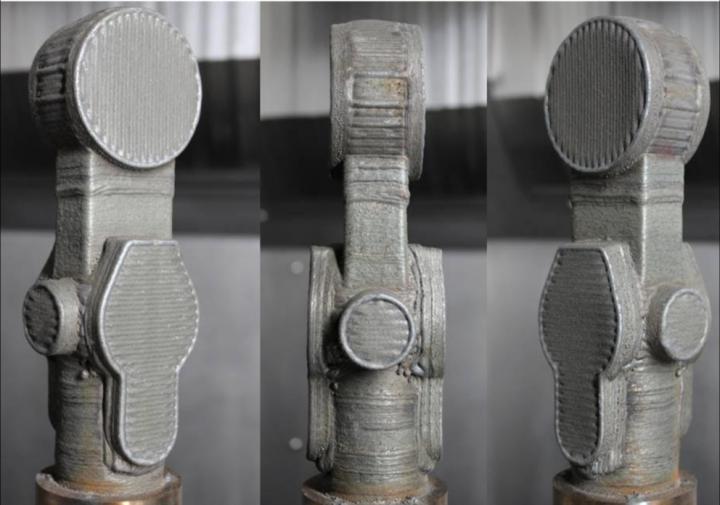
Credit: Xinyi Xiao, Penn State
Additive manufacturing (AM) machinery has advanced over time, however, the necessary software for new machines often lags behind. To help mitigate this issue, Penn State researchers designed an automated process planning software to save money, time and design resources.
Newer, five-axis machines are designed to move linearly along an x, y and z plane and rotate between the planes to allow the machine to change an object’s orientation. These machines are an advancement on the traditional three-axis machines that lack rotation capabilities and require support structures.
Such a machine can potentially lead to large cost and time savings; however, five-axis AM lacks the same design planning and automation that three-axis machines have. This is where the creation of planning software becomes critical.
“Five-axis AM is a young area, and the software isn’t there yet,” said Xinyi Xiao, a summer 2020 Penn State doctoral recipient in industrial engineering, now an assistant professor in mechanical and manufacturing engineering at Miami University in Ohio. “Essentially, we developed a methodology to automatically map designs from CAD — computer-aided design — software to AM to help cut unnecessary steps. You save money by taking less time to make the part and by also using less materials from three-axis support structures.”
Xiao conducted this work as part of her doctoral program in the Penn State Harold and Inge Marcus Department of Industrial and Manufacturing Engineering under the supervision of Sanjay Joshi, professor of industrial engineering. Their research was published in the Journal of Additive Manufacturing.
“We want to automate the decision process for manufacturing designs to get to ‘push button additive manufacturing,'” Joshi said. “The idea of the software is to make five-axis AM fully automated without the need for manual work or re-designs of a product. Xinyi came to me when she needed guidance or had questions, but ultimately, she held the key.”
The software’s algorithm automatically determines a part’s sections and the sections’ orientations. From this, the software designates when each section will be printed, and in which orientation within the printing sequence. Through a decomposition process, the part’s geometry boils down into individual sections, each printable without support structures. As each piece is made in order, the machine can rotate throughout its axes to reorient the part and continue printing. Xiao compared it to working with Lego building blocks.
The algorithm can help inform a designer’s process plan to manufacture a part. It allows designers opportunities to make corrections or alter the design before printing, which can positively affect cost. The algorithm can also inform a designer how feasible a part may be to create using support-free manufacturing.
“With an algorithm, you don’t really need the expertise from the user because it’s in the software,” Joshi said. “Automation can help with trying out a bunch of different scenarios very quickly before you create anything on the machine.”
Xiao said she intends to continue this research as some of the major application areas of this technology are aerospace and automobiles.
“Large metal components, using traditional additive manufacturing, can takes days and waste lots of materials by using support structures,” Xiao said. “Additive manufacturing is very powerful, and it can make a lot of things due to its flexibility; however, it also has its disadvantages. There is still more work to do.”
###
Media Contact
A’ndrea Elyse Messer
[email protected]
Related Journal Article
http://dx.