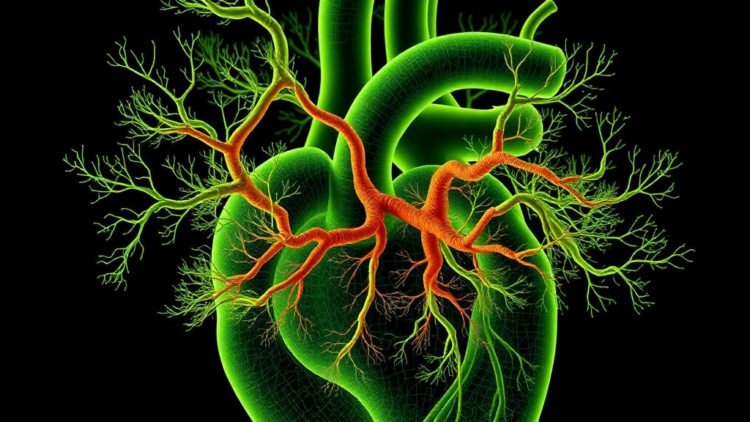
Every year, millions of people undergo computed tomography scans of the heart, and every year those scans reveal the same frustrating blind spot. Clinical imaging can resolve the large coronary arteries that run along the surface of the heart, but the vast network of vessels threading through the heart wall itself, down to the tiniest arterioles, remains far below the resolution of any scanner. Now, a team of biomedical engineers has developed a computational framework that closes this gap, generating complete, subject-specific coronary arterial trees that extend seamlessly from what a CT scan can actually see into the hidden microvascular world beyond it.
The new framework, called hierarchy-aware CT-driven constrained constructive optimization, or HCT-CCO, was developed by S. L. Vajire and Lik-Chuan Lee at Michigan State University together with Jenny S. Choy and Ghassan S. Kassab at the California Medical Innovations Institute. Writing in the Annals of Biomedical Engineering, the researchers describe how their method starts with a segmented epicardial coronary network, the visible large vessels such as the left anterior descending and left circumflex arteries, and grows a full arterial tree into the left ventricular myocardium, the thick muscular wall of the heart’s main pumping chamber. The result is a network spanning eleven hierarchical vessel orders, from vessels roughly three millimeters wide down to precapillary branches around eight micrometers in diameter.
The core idea builds on a decades-old technique known as constrained constructive optimization, or CCO, which grows synthetic vascular trees by repeatedly adding new terminal branches wherever they minimize the total hydraulic resistance of the network. Conventional CCO, however, has a fundamental limitation: it was designed for idealized geometric domains such as simple blocks or analytic shells, not for the complex, patient-specific anatomy of a real heart. When applied to a heart-shaped domain, conventional CCO fills the available space but produces vessels that bear little resemblance to the organized trunk-and-branch architecture of a genuine coronary tree. The generated hierarchies also vary wildly between repeated runs, making the method unreliable for physiological study.
The Michigan State and San Diego team attacked the problem from three directions. First, they anchored the entire growth process in real anatomy. The left ventricular wall segmented from CT images defines the admissible growth region, enforced through a Euclidean distance field that ensures every candidate vessel maintains a prescribed clearance from both the inner and outer surfaces of the heart wall. The segmented epicardial arteries serve as the proximal scaffold, so the algorithm does not regenerate what imaging already shows; it resumes growth directly from the imaged macrovasculature into the sub-resolution territory below.
Second, the researchers overhauled the local optimization that occurs every time a new branch is added. In conventional CCO, the bifurcation point where a new branch splits off is initialized at the geometric midpoint of the host segment with symmetric daughter radii, giving the nonlinear solver no physiological guidance. The new framework instead seeds each bifurcation with a flow-weighted position and daughter radii derived from a well-established coronary branching law with exponent 2.33, then refines the configuration by minimizing hydraulic resistance according to the Kamiya-Togawa optimality principle. This analytic initialization places the solver close to the true optimum from the start, accelerating convergence and preventing degenerate solutions under strong flow asymmetry.
The third and arguably most consequential innovation is the hierarchy-aware branching schedule. In conventional CCO, a new terminal segment can attach to any existing segment throughout growth. The HCT-CCO framework progressively restricts this choice in three stages tied to the fraction of target terminals reached. During the first ten percent of growth, branching is unrestricted, allowing coherent densification of intermediate vessel generations. From ten to thirty-five percent, new branches may attach only to terminal segments and a limited band of their ancestors. Beyond thirty-five percent, branching is confined to terminal segments and their immediate parents. This progressive narrowing mirrors how real coronary trees behave: proximal vessels show broadly distributed connectivity, while distal arterioles branch in an increasingly localized fashion.
To judge whether the synthetic trees are physiologically credible, the team turned to the gold-standard benchmark in the field: the detailed morphometric measurements of the pig coronary arterial tree published by Kassab and colleagues in 1993. Using the diameter-defined Strahler ordering scheme, which classifies vessels by both topology and diameter to reduce overlap between adjacent orders, they compared their generated networks against the experimental data across multiple measures. The results were striking. Across ten independent stochastic realizations on the same heart geometry, the HCT-CCO framework achieved a connectivity F1 score of 0.95 against the experimental order-to-order connectivity matrix, compared with 0.85 for conventional CCO. The diameter-order deviation from the porcine benchmark was 0.034 on a logarithmic scale for the new framework, corresponding to agreement within roughly eight percent, versus nearly a full order of magnitude for conventional CCO. Statistical testing showed complete separation between the two methods, with every HCT-CCO realization outperforming every conventional realization.
The researchers then applied the framework to five subject-specific CT-derived pig heart geometries plus one synthetic case. In every case, the generated trees reached the full eleven-order hierarchy, with mean vessel diameters increasing monotonically and quasi-exponentially with order, closely tracking the experimental curves. The transmural distribution of terminal vessels, those located in the inner versus outer halves of the heart wall, came out nearly balanced, with a slight epicardial predominance of about 52 percent versus 48 percent, a pattern qualitatively consistent with reported higher microvascular density near the outer wall, though the authors caution that the epicardial starting scaffold may contribute to this bias.
Crucially, the networks are not just geometrically plausible; they are hemodynamically workable. The team solved a representative generated network as a steady-state resistive model, calibrating total flow to a physiological vasodilated perfusion density of 3.5 milliliters per minute per gram of tissue under a 100 millimeter mercury inlet pressure. The computed wall shear stress remained approximately uniform across vessel calibers, with a median of 11 dynes per square centimeter, squarely within the physiological range that real coronary vessels maintain. Segment flows followed the expected power-law relationship with diameter. Generating a complete network of roughly 40,000 vessel segments took about twenty hours on a single processor with a modest 50 megabytes of memory, faster than comparable image-based methods that report multi-day generation times.
The implications extend well beyond an elegant piece of computational engineering. Subject-specific coronary trees of this fidelity could serve as substrates for simulating myocardial perfusion, studying ischemia mechanisms, computing fractional flow reserve, and testing therapies for coronary artery disease in settings where microcirculatory measurements are impossible to obtain in living patients. The team acknowledges limitations: the current pipeline relies on manual segmentation, terminal flows are prescribed uniformly rather than drawn from perfusion imaging, and validation rests on porcine rather than human morphometry. They are already developing a deep-learning pipeline to automate preprocessing directly from human CT angiography volumes, and the growth machinery itself is species-agnostic, ready to be re-parameterized with human reference data. The source code has been released openly on GitHub, inviting the broader cardiovascular modeling community to build on a framework that finally connects what scanners can see with what physiologists need to model.
Subject of Research: CT-driven constrained constructive optimization for generating subject-specific coronary arterial tree networks
Article Title: Hierarchy Aware CT-Driven Constrained Constructive Optimization: A Framework for Coronary Network Generation
Article References: Vajire, S. L., Choy, J. S., Kassab, G. S., & Lee, L.-C. (2026). Hierarchy Aware CT-Driven Constrained Constructive Optimization: A Framework for Coronary Network Generation. Annals of Biomedical Engineering. https://doi.org/10.1007/s10439-026-04383-4
Image Credits: AI Generated
DOI: 10.1007/s10439-026-04383-4
Keywords: coronary arterial tree, constrained constructive optimization, computed tomography, cardiovascular modeling, myocardial perfusion, Strahler ordering, coronary morphometry, hemodynamics, left ventricle, microvasculature, biomedical engineering, synthetic vascular networks
Cite Scienmag News
APA
MLA
Chicago
Ophelia Keating. (September 30, 2026). Algorithm Grows Complete Coronary Trees From CT Scans, Matching Real Heart Anatomy. Scienmag. https://scienmag.com/algorithm-grows-complete-coronary-trees-from-ct-scans-matching-real-heart-anatomy/
Ophelia Keating. “Algorithm Grows Complete Coronary Trees From CT Scans, Matching Real Heart Anatomy.” Scienmag, 30 September 2026, https://scienmag.com/algorithm-grows-complete-coronary-trees-from-ct-scans-matching-real-heart-anatomy/. Accessed 30 September 2026.
Ophelia Keating. “Algorithm Grows Complete Coronary Trees From CT Scans, Matching Real Heart Anatomy.” Scienmag. September 30, 2026. https://scienmag.com/algorithm-grows-complete-coronary-trees-from-ct-scans-matching-real-heart-anatomy/
Copy citation
Download RIS
Tags: advanced CT scan analysis for cardiologybiomedical engineeringbiomedical engineering for coronary vasculaturecardiovascular modelingcomputational algorithms for heart anatomycomputed tomographyconstrained constructive optimizationconstrained constructive optimization in medical imagingcoronary arterial treecoronary artery segmentation and modelingcoronary artery tree reconstruction from CT scanscoronary morphometryheart tissue microvasculature mappingheart wall microvasculature extension techniqueshemodynamicshierarchy-aware coronary tree generationleft ventriclemicrovascular coronary network modelingmicrovascular heart vessel visualizationmicrovasculaturemyocardial perfusionStrahler orderingsubject-specific cardiac imagingsynthetic vascular networks