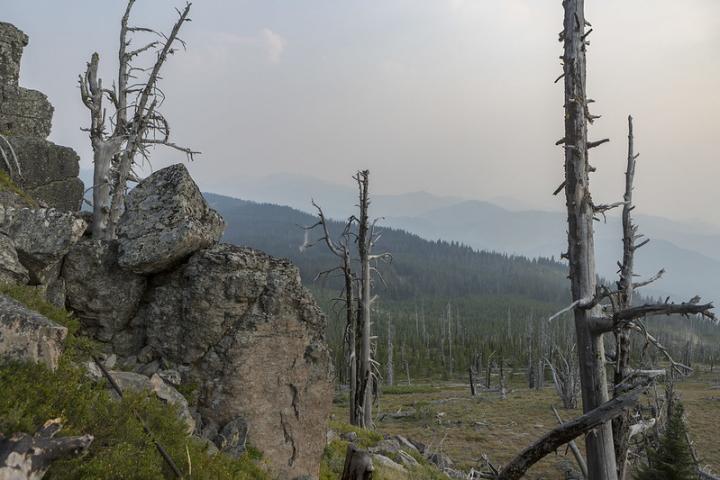
As smoky air becomes more common during Washington’s wildfire season, many wildlife enthusiasts wonder: What happens to the birds?
Few studies have looked at wildfire smoke impacts on animals, let alone birds. And as Washington and the larger West Coast continue to experience more massive wildfires and smoke-filled air, understanding how birds are affected by smoke — and how air pollution may influence our ability to detect birds — are important factors for bird conservation.
Researchers from the University of Washington now provide a first look at the probability of observing common birds as air pollution worsens during wildfire seasons. They found that smoke affected the ability to detect more than a third of the bird species studied in Washington state over a four-year period. Sometimes smoke made it harder to observe birds, while other species were actually easier to detect when smoke was present. The results were published June 29 in the journal Ornithological Applications.
The researchers combined data from eBird, an online citizen-science program managed by the Cornell Lab of Ornithology, with publicly available data from an extensive network of air quality monitors across Washington state. They were able to analyze how fine particulate matter, known as PM2.5 and a marker of smoke pollution, affected the probability of observing 71 common bird species during the wildfire seasons of 2015 to 2018. Higher concentrations of smoke affected the chances of observing 37%, or 26, of the bird species included in the study.
Sixteen of the bird species were harder to observe with more wildfire smoke, the study found. These include turkey vultures, Canada geese, two gull species, bald eagles and several other birds of prey. Many of these birds are observed circling high above the ground, so it’s not surprising that people would have a harder time detecting them on smoky days, the authors said. However, 10 additional species were easier to observe when smoke concentrations were higher. These include three types of warblers, cedar waxwing, spotted towhee and California quail.
“These behavioral changes are all hypotheticals, and we very much hope that researchers follow up on them because we have a lot to learn about how smoke affects wildlife,” Sanderfoot said.
Conservation and management efforts rely on the ability to observe animals in the wild, and it’s no different for birds. Air pollution clearly plays a role in detecting animals, and this paper makes the case that it should be considered alongside other factors like time of day, temperature and precipitation that all can influence observations of animals.
“If we see or hear birds more or less frequently because of smoke, that also impacts bigger inferences we make in terms of how certain bird populations are doing,” said senior author Beth Gardner, an associate professor in the School of Environmental and Forest Sciences. “We want to get that part right, so we first need to understand the effect of air pollution on how we’re seeing birds in the wild.”
The researchers chose a four-year study period that included some summers where wildfire smoke was heavy in parts of the state, and other summers where smoke was negligible. All of the species included in the study had to have had at least 750 observations recorded for the first year (2015), and all observations used were within about 20 miles (32 kilometers) of an air quality monitor in Washington.
Data from the catastrophic 2020 wildfire season was not part of this analysis, although air quality during that period was worse than in any of the years in the study. As extreme wildfire seasons like 2020 become more common, it’s important to consider the influence of events like these in future studies, the researchers said.
###
This research was funded by the National Science Foundation and the McIntire-Stennis Cooperative Forestry Research Program from the USDA National Institute of Food and Agriculture.
Interactive map: https:/
Interactive graph of affected birds: https:/
Media Contact
Michelle Ma
[email protected]
Related Journal Article
http://dx.