• HOME
  • NEWS
  • EXPLORE
    • CAREER
      • Companies
      • Jobs
    • EVENTS
    • iGEM
      • News
      • Team
    • PHOTOS
    • VIDEO
    • WIKI
  • BLOG
  • COMMUNITY
    • FACEBOOK
    • INSTAGRAM
    • TWITTER
Saturday, June 6, 2026
BIOENGINEER.ORG
No Result
View All Result
  • Login
  • HOME
  • NEWS
  • EXPLORE
    • CAREER
      • Companies
      • Jobs
        • Lecturer
        • PhD Studentship
        • Postdoc
        • Research Assistant
    • EVENTS
    • iGEM
      • News
      • Team
    • PHOTOS
    • VIDEO
    • WIKI
  • BLOG
  • COMMUNITY
    • FACEBOOK
    • INSTAGRAM
    • TWITTER
  • HOME
  • NEWS
  • EXPLORE
    • CAREER
      • Companies
      • Jobs
        • Lecturer
        • PhD Studentship
        • Postdoc
        • Research Assistant
    • EVENTS
    • iGEM
      • News
      • Team
    • PHOTOS
    • VIDEO
    • WIKI
  • BLOG
  • COMMUNITY
    • FACEBOOK
    • INSTAGRAM
    • TWITTER
No Result
View All Result
Bioengineer.org
No Result
View All Result
Home NEWS Science News Chemistry

Aiming at the industrial use of clay column chromatography for optical resolution

Bioengineer by Bioengineer
March 14, 2024
in Chemistry
Reading Time: 2 mins read
0
An attempt to obtain industrially important compounds by clay column chromatography
Share on FacebookShare on TwitterShare on LinkedinShare on RedditShare on Telegram

A spherically shaped particle of synthetic hectorite (denoted as Na-HEC) was ion-exchanged with a divalent Cu(II) complex, [Cu(SS-oxa)]2+ (SS-oxa = SS-2,2′-isopropylidene-bis(4-phenyl-2-oxazoline)). The material is denoted as [Cu(SS-oxa)]2+/HEC. A column for high performance liquid chromatography (HPLC) was prepared by packing 4.0 g of [Cu(SS-oxa)]2+/HEC into a stainless tube (25 cm x 0.4 cm (i.d.)). When tris(acetylacetonato)cobalt(III) (denoted as [Co(acac)3]) was eluted by methanol at the flow rate of 0.2 mLmin-1at 4oC, the compound was separated to D- and L-enantiomers nearly to the baseline. Useful organic molecules with two hydroxyl groups such as 1,1’-binaphthyl-2,2’-diol were also partially resolved. With the help of theoretical simulation, it was concluded that the resolution was achieved by the occupation of the enantiomers in a cavity around a Cu(II) ion. The column also exhibited resolution ability toward an organic molecule with two hydroxyl groups indicating that the molecule binds with a Cu(II) ion in a stereoselective way through coordinating interactions.
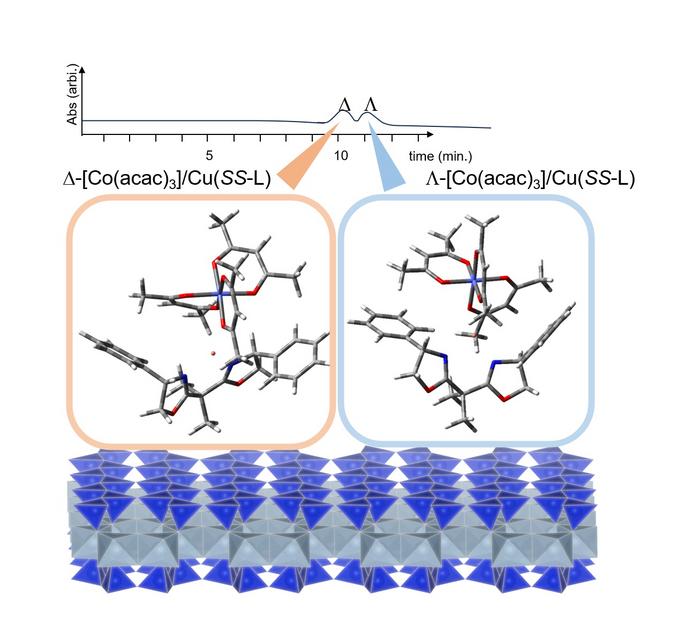
An attempt to obtain industrially important compounds by clay column chromatography

Credit: Hisako Sato

A spherically shaped particle of synthetic hectorite (denoted as Na-HEC) was ion-exchanged with a divalent Cu(II) complex, [Cu(SS-oxa)]2+ (SS-oxa = SS-2,2′-isopropylidene-bis(4-phenyl-2-oxazoline)). The material is denoted as [Cu(SS-oxa)]2+/HEC. A column for high performance liquid chromatography (HPLC) was prepared by packing 4.0 g of [Cu(SS-oxa)]2+/HEC into a stainless tube (25 cm x 0.4 cm (i.d.)). When tris(acetylacetonato)cobalt(III) (denoted as [Co(acac)3]) was eluted by methanol at the flow rate of 0.2 mLmin-1at 4oC, the compound was separated to D- and L-enantiomers nearly to the baseline. Useful organic molecules with two hydroxyl groups such as 1,1’-binaphthyl-2,2’-diol were also partially resolved. With the help of theoretical simulation, it was concluded that the resolution was achieved by the occupation of the enantiomers in a cavity around a Cu(II) ion. The column also exhibited resolution ability toward an organic molecule with two hydroxyl groups indicating that the molecule binds with a Cu(II) ion in a stereoselective way through coordinating interactions.

The results promised the practical utility of clay column chromatography for obtaining enantiomeric compounds in industries.


Journal

Applied Clay Science

DOI

10.1016/j.clay.2024.107290

Share12Tweet8Share2ShareShareShare2

Related Posts

Catalytic Endo-Stereoselective [2+2] Norbornadiene-Alkyne Cycloaddition — Chemistry

Catalytic Endo-Stereoselective [2+2] Norbornadiene-Alkyne Cycloaddition

June 6, 2026
Cyclophane Shields Singly Dispersed Graphene Nanoribbons — Chemistry

Cyclophane Shields Singly Dispersed Graphene Nanoribbons

June 6, 2026

Satellite X-ray Telescopes Set to Map Lunar Surface Chemistry Within Years

June 6, 2026

Divergent, Precise Alkaloid Remodelling via Few Reactions

June 5, 2026

POPULAR NEWS

  • ESMO 2025: mRNA COVID Vaccines Enhance Efficacy of Cancer Immunotherapy

    322 shares
    Share 129 Tweet 81
  • Multi-Hospital Study Reveals Long Covid Burden Is Twice as High as Current Estimates

    89 shares
    Share 35 Tweet 22
  • Saying Goodbye to PGY-6: Pediatric Fellowship Realities

    80 shares
    Share 32 Tweet 20
  • Common Food Preservatives Associated with Elevated Blood Pressure and Increased Heart Disease Risk

    57 shares
    Share 23 Tweet 14

About

We bring you the latest biotechnology news from best research centers and universities around the world. Check our website.

Follow us

Recent News

Ultradense Aligned Nanowires Boost Flexible Electronics

Frontal Aslant Tract Evolution Shapes Primate Speech

3D Transient Thermal Barcode Identifies Waste Plastic

Subscribe to Blog via Email

Enter your email address to subscribe to this blog and receive notifications of new posts by email.

Join 82 other subscribers
  • Contact Us

Bioengineer.org © Copyright 2023 All Rights Reserved.

Welcome Back!

Login to your account below

Forgotten Password?

Retrieve your password

Please enter your username or email address to reset your password.

Log In
No Result
View All Result
  • Homepages
    • Home Page 1
    • Home Page 2
  • News
  • National
  • Business
  • Health
  • Lifestyle
  • Science

Bioengineer.org © Copyright 2023 All Rights Reserved.