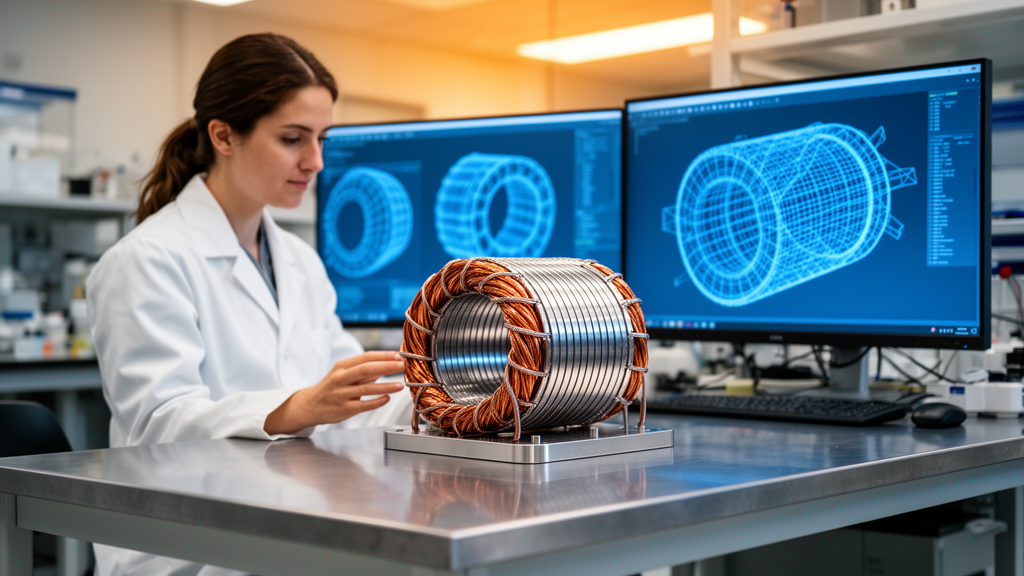
Designing a superconducting magnet for a particle accelerator is an exercise in managing complexity. Electromagnetism, mechanics, thermal analysis, cryogenics and materials science all interact, and the numerical simulations needed to capture these coupled behaviours can be computationally expensive. Engineers at CEA Paris-Saclay, an institution that has been designing, building and operating superconducting magnets since the 1960s for accelerators, detectors, fusion devices and MRI systems, have now laid out how artificial intelligence is changing that process. In a paper published in EPJ Research Infrastructures, they describe a new optimisation and data management platform, called alesia, together with a set of ongoing applications ranging from accelerator spin rotators to quench detection.
The authors argue that AI contributes to magnet design in three main ways. Surrogate, or reduced-order, models can cut the computational time and resources needed to explore a design. Machine learning and advanced optimisation techniques make it possible to search systematically for optimal configurations in high-dimensional parameter spaces. And AI methods open new possibilities for improving operational efficiency, anomaly detection and safety while magnets are running. The paper presents a broad overview of recent optimisation activities at CEA, with a particular focus on magnets for particle accelerators, while also covering applications beyond accelerators such as MRI magnets and electron cyclotron resonance ion sources.
Alesia, developed in Python and Cython, is the backbone of much of this work. The platform has been benchmarked on Windows, Linux and macOS systems as well as on high-performance computing clusters using job schedulers such as SLURM. It is structured into seven main modules, coordinated by a project manager that launches simulations selected by the optimisers and supports their parallel execution. Once an optimisation is started, alesia runs the simulations automatically without human supervision. Projects can generate enormous amounts of data: a thousand simulations with the opera 2D code can produce several terabytes if full meshed models are stored, so the platform retains only relevant outputs while archiving all scripts and input parameters so that simulations can be reproduced.
Project databases are stored in a single HDF5 file, following several of the FAIR principles of findability, accessibility, interoperability and reusability. A unified material properties database implemented in SQL stores magnetisation curves, elastic constants, thermal expansion coefficients, heat capacities, thermal conductivities, electrical resistivities and densities, along with references to the original data sources and critical current density fits for superconductors including Nb-Ti, Nb3Sn and high-temperature superconductors. Because every simulation code accesses the same consistent dataset through the platform’s interfaces, the authors note that the risk of modelling errors is reduced. Alesia currently interfaces with opera 2d and 3d, rat, ansys, cast3m and ibsimu, with a comsol interface under development, and the architecture means that once an optimisation method such as Bayesian optimisation or a grid search is implemented, it can be applied to any interfaced code.
The optimisation toolbox itself draws on evolutionary computation and active learning, including genetic algorithms, differential evolution, particle swarm optimisation, the Covariance Matrix Adaptation Evolution Strategy and Bayesian optimisation. These methods were benchmarked on an Nb-Ti magnet design that simultaneously involved electromagnetism, mechanics, materials, conductor behaviour and quench simulations, with the central challenge being the highly coupled interdependencies between numerous design parameters. Genetic algorithms had previously been employed for the FCC Flared-end Dipole Demonstrator project, a collaboration between CEA and CERN, and for the MADMAX axion experiment hosted at DESY. Custom algorithms have also been developed, including a parameter sweep over a uniform N-dimensional grid refined by bisection, and a Monte Carlo approach in which the parameters of a validated design are randomly perturbed to assess tolerances.
One of the flagship applications is the SPIN ROTATORS project, for which CEA is responsible for designing eight solenoid magnets for the Electron-Ion Collider at Brookhaven National Laboratory. These magnets will control the electron spin polarisation prior to collision and require an operative magnetic field of around 8 T together with large field integrals: 15.43 T·m for the 2.5-m-long magnet and 47.26 T·m for the 6.2-m-long magnet. Both Nb-Ti and Nb3Sn superconductors were considered. The full design workflow for an Nb3Sn solenoid chains magnetic simulations in opera 2d, Lorentz force calculations in cast3m, a secondary inductance evaluation, conductor design estimates, mechanical strain simulations and finally a quench simulation. Alesia automates and parallelises this loop, evaluating each design through a fitness score that measures the weighted difference between targets and obtained values. Using this methodology, several feasible Nb3Sn conductor solutions have been identified, and the complete workflow is described by 70 parameters.
The data generated by such workflows can then be reused to train surrogate models for rapid exploration of the design space. A deep residual neural network for multi-output regression, built with PyTorch, was trained on 8,524 simulations and evaluated on 2,131 test points not used during training. The model handles mixed categorical and continuous inputs and predicts quantities including the integrated magnetic field along the beam axis, the peak coil field, which reaches up to 18 T with an Nb3Sn conductor, the maximum von Mises stress in the coil windings, and the maximum hotspot temperature during a quench event. Because the models are fast, they allow new feasible regions of the parametric space to be identified quickly when project requirements change, without extensive additional simulations.
Beyond accelerators, the same tools are being applied to a strikingly diverse set of problems. Shim coils, which many detectors and MRI magnets need for active shielding and field homogeneity, define a large parametric space that is explored with Bayesian optimisation through alesia, with field simulations performed in opera 3d. A topology optimisation approach, derived from the SIMP method and solved with gradient-based optimisers, is being developed in 2D for ultra-high-field MRI electromagnets; it produced a cross-section for a highly homogeneous 11.7 T MRI magnet with a 1-metre bore and a maximum von Mises stress in the windings below 160 MPa, and runs in only a few minutes on a personal computer, making it useful for establishing magnet first drafts. In the FASUM project with CNRS LNCMI, CEA aims to develop a fully superconducting 40 T user magnet combining a 19 T LTS outsert from Quantum Design Oxford with a 21 T HTS insert, using parametric studies in alesia to reduce stress concentrations from screening currents. Alesia is also being deployed for the design of an 11.7 T MRI magnet similar to ISEULT using Bayesian optimisation.
The platform is likewise being tested on electron cyclotron resonance ion sources. It was first used for the superconducting magnet of the 28 GHz ASTERICS ion source, developed for the NEWGAIN project and to be installed on the SPIRAL2 linac at GANIL in Caen, where a parametric sensitivity analysis quantified how geometric misalignments affect the magnetic field topology and helped define acceptable assembly tolerances. Building on that work, CEA is investigating a next-generation 45 GHz ECRIS named TOUHTATIS based on REBCO high-temperature superconducting tapes, which allow operation at 20 K instead of 4 K, improving energy efficiency. For a short-model 18 GHz proof of concept, a supervised surrogate model trained on 1,400 randomly generated mechanical simulations from ansys, a fully connected deep neural network with four hidden layers, enabled rapid exploration of the response surface and identification of the dominant parameters governing contact pressure in the sextupole racetrack assemblies. Alesia is also coupled to the ibsimu beam dynamics code, where evolutionary algorithms and active learning iteratively refine electrode shapes for optimised, low-emittance beam extraction.
The final piece concerns safety. A quench is the rapid transition of a superconducting material to its resistive state, which can release very large stored energy into a small volume of conductor and cause irreversible damage. Quench detection is particularly difficult for recent high-temperature superconductors because their normal-zone propagation velocities are very slow. CEA is developing digital twins of superconducting systems trained on voltage data from REBCO pancake coils using in-house Partial Element Equivalent Circuit codes: classifiers based on decision trees and random decision forests judge whether an anomaly will lead to a rapid quench, a slow quench or a recovery state, while convolutional neural networks and long short-term memory models forecast the temporal evolution of voltages and magnetic fields at time scales from a few milliseconds to tens of milliseconds. In parallel, surrogate models are being investigated to estimate normal-zone propagation velocities, which are currently evaluated with computationally expensive magnetoresistive finite element simulations, and to feed a fast 3D adiabatic quench model called qaesar. The long-term goal, the authors note, is to enhance these models by integrating experimental data to improve their accuracy and reliability, as the platform itself continues to gain new physics interfaces and optimisation methods for magnets in accelerators, MRI and fusion.
Subject of Research: An AI-driven optimisation and data management platform for designing superconducting magnets
Article Title: Data-Driven Optimisation of Superconducting Magnets at CEA Paris-Saclay
Article References: Minenna, D. F. G., Dilasser, G., Penavaire, R., Calvelli, V., de Chabannes, T., Lecrevisse, T., Achard, T., Le Coz, J., Berriaud, C., Bolzon, B., Caunes, A., Fazilleau, P., Felice, H., Genot, C., Guinet, A., Jerance, N., Juster, F.-P., Lemercier, T., Lenoir, G., … Zgour, H. (2026). Data-Driven Optimisation of Superconducting Magnets at CEA Paris-Saclay. EPJ Research Infrastructures, 10(1), Article 35. https://doi.org/10.1007/s41781-026-00191-6
Image Credits: AI Generated
DOI: 10.1007/s41781-026-00191-6
Keywords: superconducting magnets, artificial intelligence, machine learning, optimisation, CEA Paris-Saclay, particle accelerators, MRI, HTS, quench detection, ECR ion sources, topology optimisation, alesia platform
News Source: Denise Maddox. (October 27, 2026). AI Platform Reshapes How Superconducting Magnets Are Designed at CEA. Scienmag.