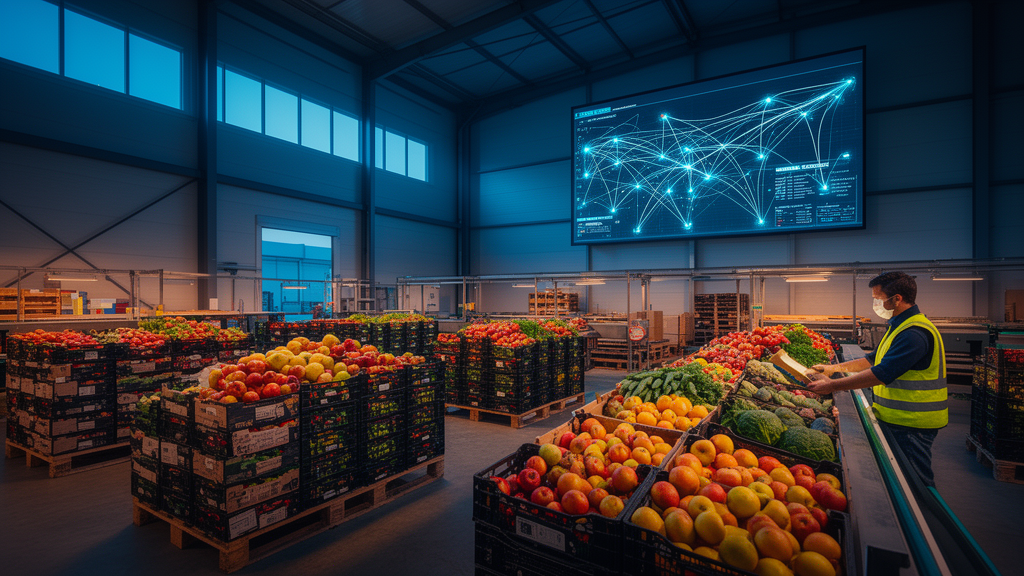
The global movement of fresh agricultural products is a complex logistical challenge that demands constant vigilance. Fruits, vegetables, and other perishable goods are highly sensitive to changes in temperature, humidity, and handling conditions throughout their journey from farm to table. Any disruption in this chain, whether caused by extreme weather, transportation delays, or infrastructure failures, can lead to significant quality degradation and product loss. As climate change and urbanization continue to stress these systems, the need for robust methods to assess and predict supply chain resilience has never been more urgent. A new study published in Scientific Reports offers a sophisticated framework to address this critical gap, combining advanced mathematical theories with modern machine learning techniques to provide a clearer picture of how these vital networks withstand and recover from shocks.
Traditional risk analysis methods in supply chain management have historically focused on the probability of adverse events occurring. While these approaches are useful for identifying potential threats, they often fall short in capturing the dynamic nature of resilience. Resilience is not merely about avoiding disruption; it is about the ability of a system to absorb impacts, adapt to changing conditions, and recover to a functional state. The research team, led by Shangbing Gao and colleagues from Huaian University and the Nanjing Hydraulic Research Institute, recognized that existing models did not adequately account for this adaptive capacity. Their work aims to bridge this methodological divide by developing a comprehensive evaluation framework that looks beyond simple probability to understand the full spectrum of supply chain performance under stress.
The proposed framework is structured around three fundamental dimensions of the fresh agricultural product supply chain: production, transportation, and consumption. By examining these three pillars, the model captures the entire lifecycle of the product, from the initial harvest to the final point of sale. This holistic approach ensures that no critical stage of the supply chain is overlooked. The study utilizes panel data from thirty-one provinces in China, spanning the period from 2009 to 2023. This extensive dataset provides a rich foundation for analyzing regional variations and temporal trends, allowing the researchers to observe how different areas respond to disruptions over time. The use of such a broad geographical scope is crucial for understanding the heterogeneity of supply chain resilience across diverse economic and climatic conditions.
At the core of the methodology is a hybrid modeling approach that integrates variable fuzzy set theory with machine learning. Variable fuzzy set theory is a mathematical tool that allows for the handling of uncertainty and imprecision in data. In the context of supply chains, where data can often be noisy or incomplete, this theory provides a robust way to assess resilience levels dynamically. The researchers employed this model to evaluate the current state of resilience, effectively categorizing different regions based on their ability to cope with disruptions. This assessment is not static; it is designed to reflect the changing conditions of the supply chain, providing a real-time snapshot of its health. The variable fuzzy recognition component is particularly valuable for distinguishing between different levels of resilience, offering a nuanced view that binary classifications cannot achieve.
Complementing the fuzzy set assessment is the use of a convolutional neural network, or CNN, for predictive modeling. While CNNs are traditionally associated with image processing, they have proven effective in analyzing sequential data, such as time series. In this study, the CNN is used to capture the temporal dynamics of the supply chain, identifying patterns and fluctuations that precede potential disruptions. The model is trained to recognize peak and off-peak variations in supply chain performance, allowing it to predict future resilience levels with high accuracy. This predictive capability is essential for proactive management, enabling stakeholders to anticipate problems before they escalate. The integration of CNNs with fuzzy set theory creates a powerful synergy, where the former provides predictive insight and the latter offers a robust assessment of current conditions.
Determining the relative importance of various indicators in the resilience assessment is a critical step in building a reliable model. The researchers employed a combined weighting method that integrates the Analytic Hierarchy Process, or AHP, with the CRITIC method. AHP is a structured technique for organizing and analyzing complex decisions, while CRITIC is an objective weighting method that considers the contrast intensity and correlation of indicators. By combining these two approaches, the study aims to balance subjective expert judgment with objective data-driven insights. This hybrid weighting scheme enhances the robustness and interpretability of the model, ensuring that the most relevant factors are given appropriate emphasis. The result is a more transparent and defensible assessment framework that can be trusted by policymakers and industry leaders.
The results of the study demonstrate the effectiveness of the proposed framework in distinguishing different resilience levels across regions. The model successfully identified areas with high resilience, which are better equipped to handle disruptions, and those with lower resilience, which are more vulnerable to shocks. This differentiation is crucial for targeted interventions, allowing resources to be allocated where they are most needed. Furthermore, the CNN model outperformed several baseline models, including Decision Tree, Random Forest, and Linear Regression, particularly in capturing nonlinear patterns and high-resilience cases. This superior performance highlights the advantage of using deep learning techniques for complex, dynamic systems like fresh agricultural supply chains. The model’s ability to handle noisy data and limited information further underscores its practical utility in real-world scenarios where perfect data is rarely available.
The implications of this research extend beyond academic interest, offering practical tools for early warning, risk mitigation, and decision-making in supply chain management. By providing a reliable means to assess and predict resilience, the framework empowers stakeholders to take proactive measures to protect the integrity of the food supply. This is particularly important in the face of increasing global uncertainties, from climate variability to geopolitical tensions. The study also highlights the importance of regional differences in resilience, suggesting that a one-size-fits-all approach to supply chain management is inadequate. Instead, tailored strategies that account for local conditions and vulnerabilities are necessary to ensure the stability of fresh agricultural product flows.
As the global food system continues to evolve, the integration of advanced computational methods into supply chain management will become increasingly vital. The work by Gao and colleagues represents a significant step forward in this direction, demonstrating the potential of combining fuzzy logic with deep learning to solve complex logistical challenges. The open access nature of the publication ensures that this knowledge is widely available, fostering further research and innovation in the field. By providing a robust and interpretable framework, the study contributes to a more resilient and sustainable food supply chain, ultimately benefiting consumers, producers, and the environment alike. The findings underscore the critical role of data-driven insights in navigating the complexities of modern agriculture and logistics.
Looking ahead, the application of such hybrid models could be expanded to other types of supply chains, including those for pharmaceuticals, electronics, and other sensitive goods. The principles of resilience assessment and prediction are universal, and the methodologies developed in this study can be adapted to various contexts. As machine learning techniques continue to advance, the potential for even more accurate and timely predictions grows. This research serves as a foundation for future work, inviting further exploration into the dynamics of supply chain resilience and the role of artificial intelligence in enhancing its management. In a world where the stability of food supplies is a matter of public health and economic security, such innovations are not just beneficial but essential.
Subject of Research: Resilience assessment and prediction of fresh agricultural product supply chains using variable fuzzy recognition and machine learning
Article Title: Resilience assessment and prediction of fresh agricultural product supply chains using variable fuzzy recognition and machine learning
Article References: Gao, S., Bai, A., Sun, X., Peng, A., Li, S., Zhao, W., & Ma, S. (2026). Resilience assessment and prediction of fresh agricultural product supply chains using variable fuzzy recognition and machine learning. Scientific Reports. https://doi.org/10.1038/s41598-026-75146-3
Image Credits: AI Generated
DOI: 10.1038/s41598-026-75146-3
Keywords: supply chain resilience, fresh agricultural products, machine learning, convolutional neural networks, fuzzy set theory, logistics, risk assessment, data analytics, food security, predictive modeling, Resilience, assessment
News Source: Blake Davidson. (October 18, 2026). AI Models Predict Fresh Food Supply Chain Resilience. Scienmag.