• HOME
  • NEWS
  • EXPLORE
    • CAREER
      • Companies
      • Jobs
    • EVENTS
    • iGEM
      • News
      • Team
    • PHOTOS
    • VIDEO
    • WIKI
  • BLOG
  • COMMUNITY
    • FACEBOOK
    • INSTAGRAM
    • TWITTER
Thursday, November 12, 2026
BIOENGINEER.ORG
No Result
View All Result
  • Login
  • HOME
  • NEWS
  • EXPLORE
    • CAREER
      • Companies
      • Jobs
        • Lecturer
        • PhD Studentship
        • Postdoc
        • Research Assistant
    • EVENTS
    • iGEM
      • News
      • Team
    • PHOTOS
    • VIDEO
    • WIKI
  • BLOG
  • COMMUNITY
    • FACEBOOK
    • INSTAGRAM
    • TWITTER
No Result
View All Result
Bioengineer.org
No Result
View All Result
Home NEWS Science News Health

AI Model Estimates Initial Sleep Apnea Therapy Parameters in Multicenter Retrospective Study

by
November 12, 2026
in Health, Technology
Reading Time: 2 mins read
0
AI Model Estimates Initial Sleep Apnea Therapy Parameters in Multicenter Retrospective Study

AI Model Estimates Initial Sleep Apnea Therapy Parameters in Multicenter Retrospective Study

Share on FacebookShare on TwitterShare on LinkedinShare on RedditShare on Telegram

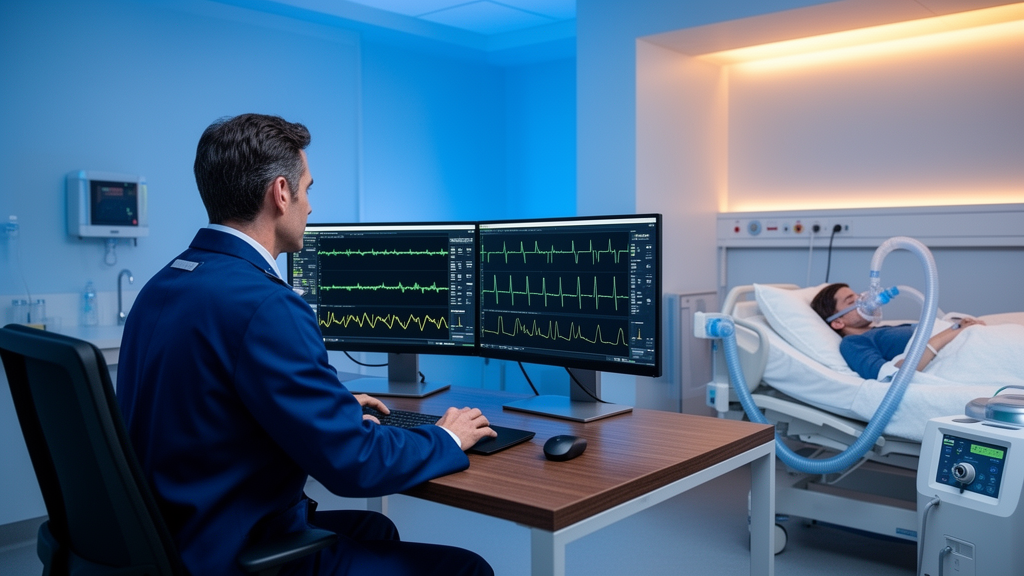
A cross-modal teacher–student artificial intelligence framework named FusionPAP can accurately recommend initial positive airway pressure settings for patients with obstructive sleep apnea, according to a retrospective study published in BMC Medical Informatics and Decision Making. Evaluated in a multicenter cohort featuring temporally separated external validation, the deployed student model predicted target therapeutic pressure with a mean absolute error of 1.14 cmH2O while achieving a 0.00 percent boundary violation rate. Investigators designed the multi-task model to help address the persistent clinical challenge of personalizing initial positive airway pressure configurations in routine clinical practice, using reference therapeutic pressures derived directly from attended, in-laboratory manual titration polysomnography examinations.

The targeted parameters include the prescribed therapeutic pressure range, the appropriate mask type, and the required humidification level for each individual patient.

To capture complex clinical decision-making across disparate data types, the investigators constructed a cross-modal teacher–student framework. The teacher model employs a multi-agent system driven by large language models to integrate structured clinical variables with pre-treatment free-text medical reports, directly emulating the multidisciplinary reasoning that clinicians apply when evaluating sleep apnea cases. During practical inference, the deployed student model operates without requiring any free-text inputs, relying exclusively on structured clinical data while retaining the multidisciplinary insights distilled from the multi-agent teacher.

The investigators evaluated the deployed student model in a multicenter retrospective cohort of 415 patients, incorporating temporally separated external validation to verify performance across distinct time periods. In validation testing, the student model achieved a target-pressure mean absolute error of 1.14 cmH2O, an area under the receiver operating characteristic curve of 0.869 for mask recommendation, and a quadratic weighted kappa of 0.807 for humidification settings. The model also recorded a 0.00 percent boundary violation rate, demonstrating strict adherence to clinically permissible parameter bounds. In direct comparisons, FusionPAP outperformed conventional tabular baseline models across these tasks while running efficiently on standard clinical hardware. The study authors concluded that FusionPAP represents a practical and scalable clinical decision-support tool for estimating titration-derived therapeutic pressure alongside associated initial positive airway pressure initialization parameters in obstructive sleep apnea.

Subject of Research: Machine learning for recommending initial positive airway pressure settings in obstructive sleep apnea

Article Title: FusionPAP: a cross-modal teacher-student framework for multi-task recommendation of initial PAP settings in obstructive sleep apnea

Article References: Zeng, Y., Nan, D., Song, A., Lin, H., Fan, J., Liu, D., Hu, J., Melibary, M., Du, X., Sun, W., Gao, Y., & Chen, L. (2026). FusionPAP: a cross-modal teacher-student framework for multi-task recommendation of initial PAP settings in obstructive sleep apnea. BMC Medical Informatics and Decision Making. https://doi.org/10.1186/s12911-026-03958-4

Image Credits: AI Generated

DOI: 10.1186/s12911-026-03958-4

Keywords: Obstructive sleep apnea, Positive airway pressure, FusionPAP, Teacher-student framework, Multi-task recommendation, Therapeutic pressure, Polysomnography, Manual titration, Mask recommendation, Humidification settings, Multi-agent systems, Large language models, Knowledge distillation, Multicenter retrospective cohort, Clinical decision support, External validation, Boundary violation rate, Medical informatics

News Source: Denise Maddox. (November 12, 2026). AI Model Estimates Initial Sleep Apnea Therapy Parameters in Multicenter Retrospective Study. Scienmag.


Tags: Boundary violation rateClinical decision supportexternal validationFusionPAPHumidification settingsknowledge distillationLarge Language ModelsManual titrationMask recommendationMedical Informaticsmulti-agent systemsMulti-task recommendationMulticenter retrospective cohortobstructive sleep apneapolysomnographypositive airway pressureteacher-student frameworkTherapeutic pressure
Share12Tweet7Share2ShareShareShare1

Related Posts

IVF-Weighted ALPS Diffusion Indices Show Stronger Correlations with Cognitive Test Scores

IVF-Weighted ALPS Diffusion Indices Show Stronger Correlations with Cognitive Test Scores

November 12, 2026
DNA Methylation Tracks Aging and Predicts Remaining Lifespan in Zebra Finches

DNA Methylation Tracks Aging and Predicts Remaining Lifespan in Zebra Finches

November 12, 2026

Gambling Co-Occurs Strongly With Alcohol and Tobacco in Certain UK Communities

November 12, 2026

Curtin University Launches Advanced Additive Manufacturing and Atom Probe Research Facilities

November 12, 2026

POPULAR NEWS

  • Computer Vision Gait Analysis Accurately Measures Acute Parkinson's Disease Treatment Responses

    Computer Vision Gait Analysis Accurately Measures Acute Parkinson’s Disease Treatment Responses

    29 shares
    Share 12 Tweet 7
  • Surrogate Insulin Resistance Indices Linked to Higher Papillary Thyroid Carcinoma Odds

    29 shares
    Share 12 Tweet 7
  • Structured Pediatric Vascular Access Consultation Model Improves Infant Catheter Insertion Success

    29 shares
    Share 12 Tweet 7
  • Researchers Propose Recovery Physiology Framework to Test Dynamic Functional Restoration

    29 shares
    Share 12 Tweet 7

About

We bring you the latest biotechnology news from best research centers and universities around the world. Check our website.

Follow us

Recent News

IVF-Weighted ALPS Diffusion Indices Show Stronger Correlations with Cognitive Test Scores

Lipase Alcoholysis Limits Butter Acid Value While Boosting Desirable Flavor Esters

DNA Methylation Tracks Aging and Predicts Remaining Lifespan in Zebra Finches

Subscribe to Blog via Email

Enter your email address to subscribe to this blog and receive notifications of new posts by email.

Join 86 other subscribers
  • Contact Us

Bioengineer.org © Copyright 2023 All Rights Reserved.

Welcome Back!

Login to your account below

Forgotten Password?

Retrieve your password

Please enter your username or email address to reset your password.

Log In
No Result
View All Result
  • Homepages
    • Home Page 1
    • Home Page 2
  • News
  • National
  • Business
  • Health
  • Lifestyle
  • Science

Bioengineer.org © Copyright 2023 All Rights Reserved.