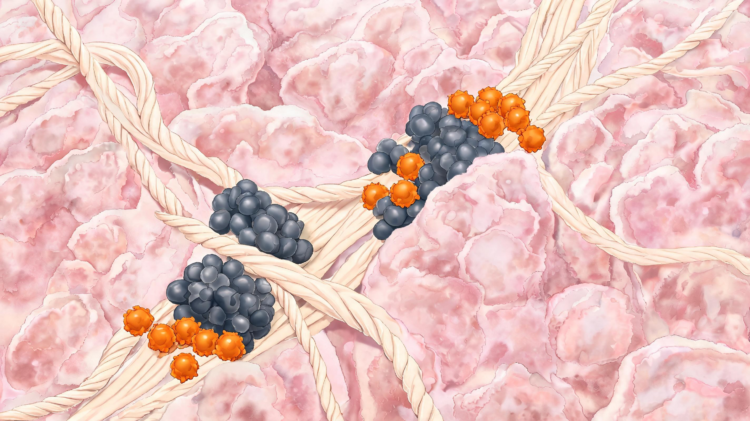
Pancreatic ductal adenocarcinoma remains one of the most lethal human malignancies, with a five-year survival rate of roughly thirteen percent across all stages and only about three percent among patients whose disease has spread. Immunotherapies that have transformed outcomes in melanoma and several blood cancers have largely failed against pancreatic tumors, and researchers have long suspected that the answer lies in the tumor’s notoriously hostile microenvironment. A new study published in Molecular Systems Biology now delivers an unprecedented, quantitatively rigorous account of exactly how pancreatic tumors physically and cellularly sabotage therapeutic T cells, using a computational platform that turns live imaging data into a predictive map of immune suppression.
The research team, led by investigators at the University of Minnesota, developed a pipeline called TME-CARTographer, or TME-CART, which integrates multiphoton microscopy of living tumor tissue with graph theory, behavioral analysis, and interpretable deep learning. Rather than studying T cells in simplified culture dishes, the scientists imaged therapeutic T cells navigating intact slices of autochthonous pancreatic tumors from the KPC mouse model, a genetically engineered system that faithfully recapitulates human pancreatic cancer, including its dense fibrotic stroma and abundant immunosuppressive myeloid cells. Second harmonic generation imaging revealed the fibrillar collagen network while fluorescent reporters labeled carcinoma cells, CD11b-positive myeloid cells, and the T cells themselves, allowing the team to track every moving player across four dimensions of space and time.
The first major finding concerns collagen, the structural protein that dominates the desmoplastic stroma of pancreatic tumors. The team discovered that collagen fibers act as high-affinity microscopic highways. T cells traveling through the tumor overwhelmingly remain colocalized with collagen-rich regions at every time point measured, and even in carcinoma-dense zones lacking prominent collagen signal, T cells were largely absent. Aligned fibers promote rapid, directional, almost ballistic migration, but this guidance comes at a steep price. The researchers quantified a phenomenon they call migration anisotropy, showing that once a T cell engages with the fiber network, deviation from the fiber axis becomes physically unfavorable. Using nanopatterned substrates that mimic tumor collagen spacing, they measured a median migration anisotropy coefficient of 0.32, indicating a strong directional bias parallel to the underlying texture.
To translate this behavior into a spatial map, the team built an algorithm called MechanoTrack, which computes mechanoconductance, the mathematical inverse of mechanoresistance, for every pixel of the tumor terrain. The resulting topology resembles a landscape of ridges and valleys: T cells preferentially travel along high-conductance ridges corresponding to collagen fibers and rarely descend into low-conductance valleys where carcinoma cells reside. Critically, the analysis showed that T cells predominantly engaged in mono-sampling, exploring only one mechanoconductance region rather than cross-sampling between high and low regions. Once a T cell commits to the collagen network, it effectively becomes trapped on that path, gliding past or around its targets instead of seeking them out. This creates what the authors term physical immunosuppression, immune exclusion zones dictated purely by the geometry of the extracellular matrix.
Collagen, however, tells only half the story. The team found that CD11b-positive myeloid cells, comprising tumor-associated macrophages and myeloid-derived suppressor cells that together account for more than ninety-five percent of CD11b-positive cells in these tumors, colocalize with collagen fibers at a striking rate exceeding ninety-four percent. These myeloid cells migrate ten to twenty times more slowly than T cells, which suggests they function as nearly immobile roadblocks stationed along the collagen highways. When the researchers introduced mesothelin-specific engineered T cells, a therapeutic T cell receptor that prolongs survival in this model, they observed that the cells remained confined within collagen-myeloid-rich territories and rarely dispersed through the tumor volume over time.
At the single-cell level, the team categorized four distinct T cell behaviors: migration, sensing with protrusive probing, repulsion after contact with myeloid cells, and sequestration, in which the T cell stops moving entirely and rounds up. Their PhenoTrack algorithm, which classifies behavior from velocity, circularity, and colocalization data across time, revealed that embedding myeloid cells within three-dimensional collagen matrices dramatically shifted the behavioral balance. Migration events fell while sequestration events surged, confirming that immunosuppressive myeloid cells not only chemically impair T cell function but can physically halt effective movement through direct contact. Graph-theoretic modeling and Monte Carlo simulations reinforced the picture: treating the collagen network as a weighted graph showed that myeloid-laden fibers fragment the network, reduce path availability from seventy-six percent under simulated myeloid depletion to twenty-five percent in controls, and force T cells into tortuous detours measured as the ratio between actual path length and straight-line distance.
The therapeutic implications of these encounters were tested directly. Blocking major histocompatibility class I presentation on myeloid cells had modest effects, but immune checkpoint blockade against PD-1 significantly increased the number of migrating T cells and relieved myeloid sequestration, indicating that PD-1 and PD-L1 signaling at the contact interface between T cells and myeloid cells is a potent suppressive mechanism. The team then trained an eleven-layer deep neural network on a twenty-three-dimensional feature space extracted from the imaging data. The models achieved testing accuracies above ninety-two percent with area under the receiver operating characteristic curves exceeding 0.97, and post hoc explanation methods, including SHAP, LIME, and partial dependence plots, ranked collagen signal, distance to collagen, distance to myeloid cells, and mechanoresistance among the most influential drivers of T cell suppression.
The interpretability analysis yielded surprises that conventional statistics would likely have missed. Partial dependence plots revealed nonlinear, biphasic relationships between mechanoresistance and T cell behavior, and two-variable plots showed that the combination of effective collagen distance with myeloid proximity or T cell acceleration produced the largest shifts in model predictions, exposing synergistic interactions between matrix architecture, cellular neighborhood, and mechanical force exertion. Perhaps most compelling, the deep learning framework accurately predicted how immunosuppression would change following myeloid depletion. When mice were treated with a CCR2 inhibitor for two weeks, residual myeloid cells correlated positively with local T cell suppression, while more complete depletion produced far less suppression. In tumor slices treated with liposomal clodronate, near-uniform myeloid depletion allowed mesothelin-specific T cells to disperse throughout imaged tumor volumes, spend significantly more time in non-suppressed states, and substantially improve tumor sampling as confirmed by entropy-based dispersity analysis.
The authors emphasize that TME-CART is built around generic biophysical and behavioral features rather than pancreatic-specific biology, meaning the platform accepts standard multiphoton or confocal inputs and should apply to any desmoplastic solid tumor, including cancers of the breast, prostate, ovary, lung, and colon. From a translational standpoint, the work clarifies why T cell therapies have struggled in fibrotic tumors and argues for combination strategies that simultaneously disrupt the collagen architecture, deplete or reprogram suppressive myeloid cells, and engineer T cells that are physically optimized for navigation through dense tissue. The dual obstacle of fibrotic highways lined with cellular roadblocks is not an insurmountable one, the study suggests, but defeating it will require treating the tumor microenvironment as an interconnected mechanical and immunological system rather than a collection of independent barriers. With the analysis pipeline and source code publicly available, the team anticipates that TME-CART will serve as a discovery and screening tool for designing the next generation of cell-based immunotherapies for solid tumors.
Beyond its immediate findings, the study addresses a long-standing debate in pancreatic cancer biology about whether collagen should be viewed as friend or foe. Earlier work had suggested that dense stroma might, in some contexts, restrain tumor progression, complicating efforts to simply destroy fibrotic tissue. The present findings reconcile this tension by showing that collagen’s effects on immunity are spatially organized: the same fibers that structure the tumor also channel immune cells along paths that bypass malignant cells, meaning stroma-targeting strategies must consider not just how much collagen is present but how it is aligned and where myeloid cells are positioned along it.
The choice of imaging modality was central to the work. Multiphoton microscopy allows deeper penetration into living tissue than conventional confocal approaches while causing less photodamage, and second harmonic generation provides label-free visualization of fibrillar collagen, so the matrix architecture can be quantified without altering it. Capturing these dynamics in ex vivo tumor slices preserved the native stromal architecture that two-dimensional cultures cannot reproduce, which is precisely where prior studies of T cell migration have fallen short.
The engineered T cells used in the model recognize mesothelin, an antigen frequently expressed in pancreatic tumors, and had previously been shown to prolong survival without eliminating disease. The new analysis explains that partial success mechanistically: the cells infiltrate better than endogenous T cells but remain confined to matrix-defined corridors, leaving substantial tumor volume unsampled. This reframes the engineering challenge for next-generation cell therapies, suggesting that motility, persistence, and resistance to checkpoint-mediated arrest deserve the same design attention as antigen specificity.
More broadly, the work exemplifies a growing movement in cancer biology toward interpretable machine learning, where predictive models are paired with explanation tools so that biologists can extract testable hypotheses rather than opaque accuracy statistics. By validating its predictions with pharmacologic myeloid depletion, the platform demonstrates a closed loop of prediction and experimental confirmation that could accelerate combination therapy testing across desmoplastic malignancies.
Subject of Research: Spatiotemporal analysis of fibrotic and myeloid-mediated immunosuppression of therapeutic T cells in live pancreatic ductal adenocarcinoma
Article Title: Decoding spatiotemporal fibrotic and cellular immunosuppression of therapeutic T cells in live pancreatic ductal adenocarcinoma
Article References: Qian, G., Zhang, H., Stromnes, I. M., Eliceiri, K. W., & Provenzano, P. P. (2026). Decoding spatiotemporal fibrotic and cellular immunosuppression of therapeutic T cells in live pancreatic ductal adenocarcinoma. Molecular Systems Biology. https://doi.org/10.1038/s44320-026-00243-4
Image Credits: AI Generated
DOI: 10.1038/s44320-026-00243-4
Keywords: pancreatic cancer, T cells, tumor microenvironment, collagen, myeloid cells, deep learning, multiphoton microscopy, immunotherapy, TME-CART, immune exclusion, migration anisotropy, checkpoint blockade
Cite Scienmag News
APA
MLA
Chicago
Nathaniel Bowman. (September 10, 2026). AI maps collagen highways and myeloid roadblocks that trap T cells in pancreatic cancer. Scienmag. https://scienmag.com/ai-maps-collagen-highways-and-myeloid-roadblocks-that-trap-t-cells-in-pancreatic-cancer/
Nathaniel Bowman. “AI maps collagen highways and myeloid roadblocks that trap T cells in pancreatic cancer.” Scienmag, 10 September 2026, https://scienmag.com/ai-maps-collagen-highways-and-myeloid-roadblocks-that-trap-t-cells-in-pancreatic-cancer/. Accessed 10 September 2026.
Nathaniel Bowman. “AI maps collagen highways and myeloid roadblocks that trap T cells in pancreatic cancer.” Scienmag. September 10, 2026. https://scienmag.com/ai-maps-collagen-highways-and-myeloid-roadblocks-that-trap-t-cells-in-pancreatic-cancer/
Copy citation
Download RIS
Tags: checkpoint blockadecollagencollagen network in tumor stromacomputational tumor microenvironment mappingdeep learningdeep learning for tumor analysisimmune exclusionimmune suppression in pancreatic tumorsImmunotherapymigration anisotropymultiphoton microscopymultiphoton microscopy in cancer researchmyeloid cell barriers in cancermyeloid cellspancreatic cancerpancreatic cancer microenvironmentpancreatic ductal adenocarcinoma immunotherapyT cell infiltration in pancreatic cancerT CellsTME-CARTTME-CARTographer tumor imagingTumor immune evasion mechanismstumor microenvironmenttumor microenvironment structural analysis