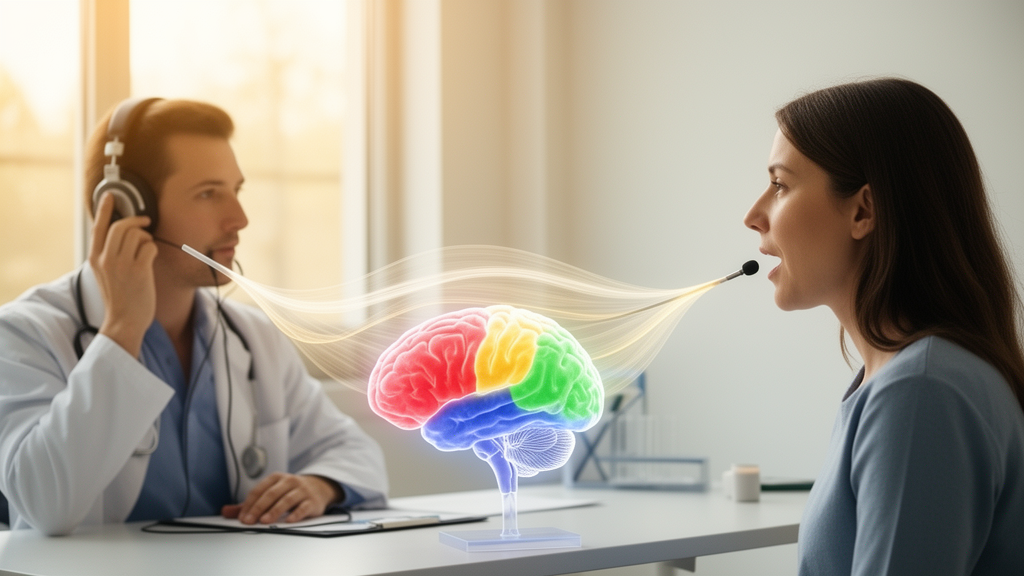
A single conversation can betray the earliest fingerprints of a neurological illness. A hesitant pause after a question, a word swapped for its near neighbor, a sentence that trails off mid-clause — each pattern carries clinical meaning, and trained specialists spend years learning to read them. Now researchers in South Korea have built an artificial intelligence system that listens to spontaneous speech and distinguishes between five different neurological language disorders at the same time, while also estimating how severe the impairment is, finding similar patients, and tracking whether a person is recovering. The system, described in a study published in Scientific Reports, achieved just over ninety-one percent accuracy on held-out test data, a level of performance that its developers say could make speech-based screening a scalable complement to clinical assessment.
The work, carried out by Byounghwa Lee, Hwa Jeon Song, and Byung Ok Kang at the Electronics and Telecommunications Research Institute in Daejeon, addresses a stubborn fragmentation in the field of automated speech analysis. Most existing machine learning models for detecting disordered language are trained on a single dataset and tuned to a single diagnosis: one model for aphasia, another for Alzheimer’s disease, a third for mild cognitive impairment. That pipeline works well enough in the lab, but it mirrors nothing in the clinic, where a clinician encountering a patient with unclear speech must consider an entire differential — stroke-induced aphasia, neurodegenerative dementia, the aftereffects of traumatic brain injury, or damage to the brain’s right hemisphere, each of which leaves a different signature in language. The Korean team’s model, by contrast, was trained on five heterogeneous corpora drawn from TalkBank, a public archive of clinically annotated speech, encompassing 1,638 samples across aphasia, Alzheimer’s disease, mild cognitive impairment, traumatic brain injury, right hemisphere damage, and healthy controls.
At the heart of the system is a technical choice that will be familiar to followers of modern multimodal artificial intelligence: the Q-Former, a cross-attention module originally popularized in large vision-language models. In this application, the Q-Former acts as a translator and integrator, pulling together three very different kinds of evidence — the transcript text, the acoustic signal of the speech itself, and tabular metadata about the speaker — and compressing them into a single shared representation. Rather than asking a rule about which modality matters most, the cross-attention mechanism lets the model learn dynamically, for each patient, whether the most diagnostic information lives in a hesitating voice, a syntactically broken sentence, or a demographic and clinical profile. The fused representation then feeds two destinations: a main classifier that decides which of the six classes the speaker belongs to, and three auxiliary heads that perform clinically meaningful side tasks.
Those auxiliary heads are where the architecture moves beyond a simple sorting machine. The first performs regression on the Western Aphasia Battery Aphasia Quotient, a standard clinical severity measure, and the model’s severity estimates landed within the measurement error of the instrument itself — meaning the AI’s judgment of how badly aphasia has impaired a speaker is about as precise as the clinical scale can support. The second head performs disease-similarity retrieval, identifying other patients in the database with the same disorder, a capability that could support case-matching for research cohorts or clinical decision support. The third tracks longitudinal progression, following changes in a speaker’s performance over time and thereby offering a computational read on recovery. Together, the heads mean one forward pass of the model yields a diagnosis, a severity score, a set of similar cases, and a trajectory — a bundle of information that would otherwise require multiple assessments by multiple specialists.
The performance numbers, averaged over five random training seeds to guard against a lucky run, are striking for a task of this complexity. The model reached 90.98 percent test accuracy with a Macro-F1 score of 86.19 percent, outperforming every baseline the team compared against. Macro-F1 matters here because the six classes are not equally represented; a model could score well on accuracy by favoring large groups while failing on rare disorders, and the macro average penalizes exactly that. The researchers report that ablation experiments — systematically removing components to see what the system loses — identified two ingredients as the principal drivers of performance: the Q-Former fusion module itself, and a class-frequency-weighted sampling strategy that prevents the model from neglecting underrepresented disorders during training.
Perhaps the most scientifically interesting analysis in the paper concerns which disorders the model confuses, and why. An inter-disorder correlation analysis showed that the dominant error was confusion between mild cognitive impairment and healthy controls — unsurprising to clinicians, since MCI is by definition a subtle, borderline state between normal aging and dementia, and the speech markers that separate them are faint. More intriguingly, the analysis recovered a grouping of disorders by etiology: conditions with shared underlying causes clustered together in the model’s internal representation, suggesting that the network was not merely memorizing dataset quirks but learning something about the genuine structure of neurological language impairment. The researchers also found that paralinguistic features — the acoustic properties of speech beyond its verbal content, such as rhythm, tempo, and voice quality — ranked among the top discriminators, reinforcing a growing body of evidence that how something is said can be as diagnostically rich as what is said.
The study is candid about its limits, and one of those limits is itself a finding. In Leave-One-Corpus-Out evaluation, the researchers removed an entire corpus from training and asked the model to classify samples it had never seen from any recording setup — a test of zero-shot generalization to both new data and, in some configurations, entirely unseen disease classes. The result: generalizing to genuinely novel disorders remains fundamentally challenging. This is an honest acknowledgment that the model’s impressive accuracy depends on having seen examples of each disorder during training. A model that can distinguish five disorders it knows does not automatically recognize a sixth it does not, and the dream of a single universal speech-based screener for the full landscape of neurological disease remains out of reach for now.
The methodological provenance of the data is also worth noting. Because the study relied exclusively on existing, publicly available, de-identified recordings from TalkBank, the researchers state that no institutional review board approval was required — and the reliance on shared data is a double-edged virtue. On one hand, it makes the work reproducible and avoids exposing new patients to research risk. On the other, it means the model inherits whatever population biases and recording conventions are baked into the archive, and clinical deployment would demand careful validation on fresh, prospectively collected speech from the target population. The authors declare no competing interests, and the work was funded by grants from the Korean government’s Ministry of Science and ICT through the National Research Council of Science and Technology and from the Electronics and Telecommunications Research Institute itself.
The clinical vision underlying the effort is straightforward and, if realized, consequential. Assessment of neurological language disorders today is labor-intensive, requiring trained specialists, standardized instruments, and considerable time per patient — resources that are scarce outside major medical centers. Spontaneous speech, by contrast, can be collected cheaply, almost anywhere, even remotely with a microphone, and analyzed by software in seconds. A validated multimodal model of the kind described here could serve as a first-line screening tool, flagging individuals who need full clinical workup, or as a monitoring instrument that tracks a patient’s language trajectory between clinic visits with a sensitivity no human rater could sustain. The auxiliary outputs matter for that vision: a screening tool that also quantifies severity and progression gives clinicians actionable information, not just a binary alarm.
What makes the study a milestone is less any single number than the combination it achieves for the first time: multimodal input, multi-corpus training, and multi-task output spanning five distinct neurological language disorders plus healthy controls. Earlier systems demonstrated pieces of this puzzle — speech features that detect dementia, classifiers that spot aphasia, models that predict severity — but nobody had bound them into one architecture trained across heterogeneous datasets. The remaining hurdles are clear from the authors’ own analysis: closing the MCI-versus-control gap, and extending generalization beyond the disorders a model has already seen. But the direction of travel is unmistakable. The sounds of disordered speech, once readable only by the trained ear, are becoming data — and data, increasingly, can be read by machines at a scale that could bring neurological screening to millions of people who would otherwise never be assessed.
Subject of Research: Automated multimodal speech analysis for simultaneous classification of five neurological language disorders
Article Title: Simultaneous multi-task assessment of five neurological language disorders via cross-corpus multimodal learning
Article References: Lee, B., Song, H. J., & Kang, B. O. (2026). Simultaneous multi-task assessment of five neurological language disorders via cross-corpus multimodal learning. Scientific Reports. https://doi.org/10.1038/s41598-026-76495-9
Image Credits: AI Generated
DOI: 10.1038/s41598-026-76495-9
Keywords: neurological language disorders, multimodal learning, spontaneous speech analysis, Q-Former, aphasia, Alzheimer's disease, mild cognitive impairment, traumatic brain injury, right hemisphere damage, cross-corpus generalization, clinical NLP, TalkBank
News Source: Cassandra Pierce. (October 19, 2026). AI Listens to Speech to Tell Five Brain Disorders Apart in One Go. Scienmag.