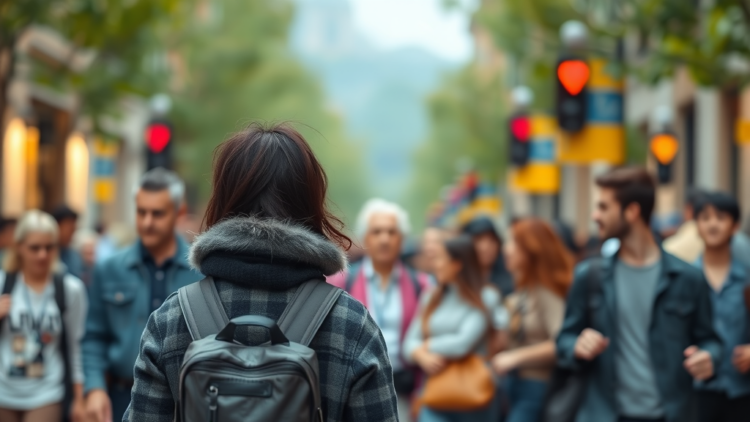
Every person walks in a way that is subtly, unmistakably their own. The rhythm of a stride, the swing of an arm, the way weight shifts from heel to toe—these patterns form a behavioral fingerprint that can be read from a distance, without the subject ever knowing. Gait recognition, the biometric technology built on this idea, has long promised a form of identification that works at ranges where faces blur and fingerprints are useless. A new study published in the International Journal of Machine Learning and Cybernetics pushes that promise closer to reality, describing a neural network called CDGaitFusion that keeps recognizing people accurately even when clothing, lighting, and camera angles conspire to disguise them.
The research, led by Siwei Wei, Qi Shi, Feifei Wei, and Chunzhi Wang of Hubei University of Technology and Hubei University of Economics in Wuhan, tackles a problem that has dogged gait recognition since its earliest days. In laboratory conditions, where subjects walk the same route in the same clothes under the same lights, algorithms can identify individuals with near-perfect accuracy. Move those algorithms into the real world and performance collapses. A person wearing a heavy coat instead of a T-shirt looks different to a camera. A corridor lit by fluorescent tubes produces different silhouettes than a sunlit plaza. A camera positioned low and to the side captures a fundamentally different image of the same walking body than one mounted overhead and facing forward.
These complications are known in the field as covariate variations, and they attack the very foundation of gait-based identification: the assumption that the features extracted from a walking person remain stable over time and across conditions. When a baggy coat hides the motion of the legs, or a change in viewpoint distorts the apparent geometry of the body, the features that once distinguished one walker from another become noisy, unreliable, or simply wrong. The result is a technology that works beautifully in benchmark tests and disappointingly on the street—a gap that has kept gait recognition from fulfilling its potential in public security and intelligent monitoring, the applications where its non-contact, long-range nature makes it most valuable.
CDGaitFusion’s answer is built on a deceptively simple insight: not all information in a walking body is equally fragile. Some patterns—the broad rhythm of a stride, the coordinated motion of the whole body—tend to be shared across people and survive changes in clothing and viewpoint. Other patterns—the distinctive way a particular person moves their knees, or the specific asymmetry in their arm swing—are highly individual but easily obscured. The new framework explicitly separates these two kinds of information and processes them differently, rather than forcing a single network to learn everything at once.
Technically, the system rests on two interlocking modules. The first, called the Multimodal Hierarchical Mechanism, directs the network’s attention hierarchically toward the body regions where motion information is richest. Rather than treating every pixel of a walking figure as equally important, the mechanism learns to prioritize the moving parts—legs, arms, torso—where the discriminative dynamics actually live. This hierarchical focus sharpens the network’s perception of local detail, allowing it to extract fine-grained motion cues that a more uniform analysis would wash out. The second module, the Commonality–Difference Feature Extraction module, does the conceptual heavy lifting: it captures the traits that walkers share across a population and, crucially, the differences that set each individual apart. By modeling both simultaneously, the module strengthens the dynamic feature representation at the heart of the system.
The interaction between the two modules is where the design earns its name. Commonality patterns provide a stable backbone of understanding—what walking looks like in general—which anchors the representation against the distortions introduced by covariate changes. Differential features supply the individual specificity needed to tell one person from another. The network fuses these streams so that global semantic understanding and local motion distinctiveness reinforce rather than compete with each other. In effect, the system learns to say: this is a human walking, in this general way, and the deviations from that general pattern belong to this particular individual.
The results, reported across three widely used benchmarks, suggest the approach works. On SUSTech1K, a dataset captured with LiDAR point clouds, CDGaitFusion achieved a Rank-1 accuracy of 83.1 percent, meaning the correct identity was the top match in more than four out of five identification attempts. On Gait3D, a large-scale dataset of real-world 3D walking sequences, the figure was 78.7 percent. On GREW, one of the largest in-the-wild gait benchmarks, the system reached 87.9 percent. The authors note that these results compare favorably with most existing methods, and ablation analyses—experiments in which individual components are removed to measure their contribution—confirmed that both the multimodal fusion and the motion-aware modeling earn their place in the architecture.
The choice of datasets matters as much as the numbers. All three benchmarks were designed specifically to test gait recognition under realistic, challenging conditions, with variations in clothing, carrying conditions, viewpoint, and sensing modality. SUSTech1K in particular represents a frontier for the field, since LiDAR point clouds offer a three-dimensional view of the walking body that is immune to some lighting problems but introduces its own challenges of sparse, noisy geometry. A framework that performs strongly across silhouette-based, point-cloud, and mixed-modality benchmarks demonstrates a robustness that single-modality approaches have struggled to match.
Multimodality itself is a growing theme in gait research, and CDGaitFusion sits within a rapidly expanding family of fusion-based systems. Earlier work has combined silhouettes with optical flow, skeletons with silhouettes, and pose estimates with graph-structured representations. What distinguishes the new framework is its explicit decomposition of the feature space into common and differential components—a strategy that speaks directly to the covariate problem rather than simply throwing more data streams at it. The authors position the system as both reliable and extensible, a foundation on which future work can build as sensing hardware and datasets continue to evolve.
The implications reach well beyond the benchmark leaderboards. Gait recognition is attractive precisely because it requires no cooperation from the subject: no one needs to look at a camera, hold still, or present an identifier. That makes it valuable for security screening, forensic investigation, and smart environments that adapt to the people moving through them. It also makes it a technology that raises familiar questions about surveillance and consent, questions that become more urgent as accuracy improves in uncontrolled settings. The work was supported in part by the National Natural Science Foundation of China, and the authors report no conflicts of interest. For now, CDGaitFusion stands as evidence that the hardest problems in gait recognition—the coats, the shadows, the awkward camera angles—are not fundamental barriers but engineering challenges, and that the walk you cannot hide may soon be readable from farther away than ever before.
Subject of Research: Multimodal gait recognition using fusion of commonality patterns and differential features for robust human identification
Article Title: CDGaitFusion: a multimodal gait recognition network based on the fusion of commonality patterns and differential features
Article References: CDGaitFusion: a multimodal gait recognition network based on the fusion of commonality patterns and differential features. (n.d.). https://doi.org/10.1007/s13042-026-03307-x
Image Credits: AI Generated
DOI: 10.1007/s13042-026-03307-x
Keywords: gait recognition, biometrics, multimodal fusion, computer vision, pattern recognition, deep learning, neural networks, human identification, SUSTech1K, Gait3D, GREW, dynamic feature fusion
Cite Scienmag News
APA MLA Chicago
Blake Davidson. (September 23, 2026). AI Learns to Spot You by Your Walk, Even in a Crowd. Scienmag. https://scienmag.com/ai-learns-to-spot-you-by-your-walk-even-in-a-crowd/
Blake Davidson. “AI Learns to Spot You by Your Walk, Even in a Crowd.” Scienmag, 23 September 2026, https://scienmag.com/ai-learns-to-spot-you-by-your-walk-even-in-a-crowd/. Accessed 23 September 2026.
Blake Davidson. “AI Learns to Spot You by Your Walk, Even in a Crowd.” Scienmag. September 23, 2026. https://scienmag.com/ai-learns-to-spot-you-by-your-walk-even-in-a-crowd/
Copy citation Download RIS
Tags: behavioral fingerprint identificationbiometric identification beyond facial recognitionbiometric identification from walking patternsBiometricsCDGaitFusion neural networkchallenges in gait-based identificationclothing and lighting invariance in gait recognitioncomputer visioncrowd surveillance using gait patternsdeep learningdynamic feature fusiongait recognitionGait recognition technologyGait3DGREWhuman identificationmachine learning in biometric systemsmultimodal fusionneural networksneural networks for gait analysisPattern Recognitionreal-world application of gait recognitionSUSTech1Kwalking pattern analysis in security