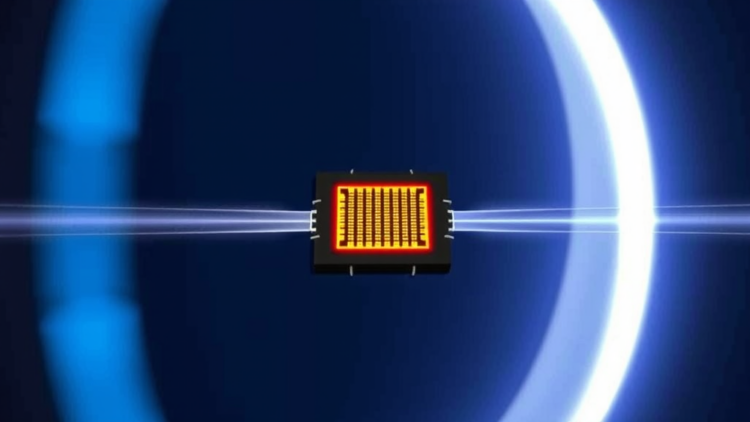
Quantum technologies have long been limited by an awkward mismatch: the wavelengths where quantum light sources work best are rarely the wavelengths where detectors, fibres, and atmospheric conditions perform best. Now, a team of researchers has designed a family of silicon waveguides that can generate pairs of quantum-correlated photons with one partner deep in the mid-infrared and the other comfortably in the telecom C-band, promising to connect two worlds that have until now remained stubbornly separate. The study, published in Results in Optics, presents a quantitative, experimentally validated model of photon-pair generation in silicon-on-insulator waveguides, and proposes three distinct designs aimed at gas sensing and satellite-based quantum key distribution.
The work, carried out by Abhishek Kumar Pandey, Deepak Jain, and Catherine Baskiotis, exploits spontaneous four-wave mixing, a nonlinear optical process in which two pump photons at the same frequency are annihilated to create a correlated pair of photons at two very different frequencies. Energy conservation forces the sum of the two new frequencies to equal twice the pump frequency, while momentum conservation, known as the phase-matching condition, dictates which frequency combinations can actually occur. In a waveguide, the phase-matching condition can be engineered by shaping the geometry of the silicon core, allowing the generated signal and idler photons to be tuned with remarkable precision across a wide spectral range.
What makes the new designs remarkable is the sheer distance between the two photons. The flagship design, targeted at atmospheric quantum key distribution, produces a signal photon at 3.905 micrometres, deep inside a mid-infrared atmospheric transparency window, while its idler partner lands at 1.541 micrometres in the telecom C-band. That separation of roughly 2,364 nanometres is dramatically larger than the record of about 1,125 nanometres theoretically reported in earlier all-solid silicon waveguide studies. Crucially, the design achieves this in the true quantum regime, where at most one photon pair is produced per pump pulse, rather than relying on the high pump powers used in classical demonstrations.
This distinction matters. Previous experiments with air-clad silicon waveguides demonstrated large signal-idler separations of about 2,058 nanometres, but only by using pump peak powers around 20 watts to achieve phase matching. In the quantum regime, pump power must be kept low to suppress multi-pair emission, and with those earlier designs the phase-matched separation collapsed to 1,780 nanometres, placing the mid-infrared photon outside any atmospheric transmission window. The new all-solid designs sidestep this problem by building the phase matching into the waveguide geometry itself, so that it holds even at the milliwatt pump levels required for single-pair emission.
The choice of an all-solid, fully oxide-clad structure is itself strategic. Air-clad waveguides suffer from significant scattering losses caused by sidewall roughness, because the optical mode interacts strongly with the etched surfaces. By surrounding the silicon core with fused silica cladding and a buried oxide layer, the proposed waveguides reduce the modal overlap with etched sidewalls, mitigating fabrication-induced scattering. The team’s calculations show that even at the longest signal wavelength, where silica is nominally opaque, the majority of the optical power remains confined to the silicon core, keeping total material attenuation over the 2-centimetre waveguide to acceptable levels.
To give their predictions quantitative teeth, the researchers adopted a model for the probability of photon-pair generation per pulse and validated it against published experimental data from photon-pair generation in photonic crystal fibre. By modelling the fibre as a simple step-index structure and feeding in the experimental parameters, they computed photon-pair rates that closely matched the measured values across a range of pump powers, outperforming the original theoretical treatment of those experiments. Because the model takes as inputs only the modal properties, the nonlinear index, and the operating conditions, the authors argue that the validation is generic and applies equally to the silicon waveguide geometries, whose modal fields they computed independently using full-vectorial finite element simulations.
Each of the three proposed waveguides is tailored to a specific application. Two designs generate signal photons at 3.265 and 3.461 micrometres, which coincide with absorption bands of methane and nitrogen dioxide respectively, the fingerprint region where these gases reveal their presence. Paired with telecom-band idlers, these sources could power schemes for sensing with undetected light, in which the mid-infrared photon probes the gas while only the telecom photon is ever detected, allowing the entire measurement to be performed with cheap, mature silicon-compatible detectors. The third design, optimised for atmospheric quantum key distribution, places the signal photon at 3.905 micrometres, where atmospheric transmission is dramatically better than at the 1.55-micrometre wavelength used in current daylight quantum communication experiments.
The shift to the mid-infrared could be transformative for free-space quantum communication. At 3 to 4 micrometres, the atmosphere exhibits reduced Rayleigh scattering, lower solar background noise, and greater resistance to weather-related variations, all of which translate into more reliable quantum links and an improved ability to operate in daylight. Shrinking the photon-pair source onto a chip also addresses a critical constraint for satellite payloads, where every gram of mass and cubic centimetre of volume counts. Silicon-on-insulator fabrication is cheap, scalable, and compatible with existing CMOS foundries, making the prospect of flight-qualified quantum sources considerably more realistic than with bulk nonlinear crystals.
The team also addressed the practical obstacles that have plagued mid-infrared quantum optics in silicon. Spontaneous Raman scattering, which can contaminate photon-pair spectra, is predicted to be negligible because the generated photons lie more than 330 Raman linewidths away from the silicon Raman gain peak, placing the Raman gain at the signal frequencies at the level of one part in a million. Two-photon absorption, the bane of silicon nonlinear optics at telecom wavelengths, falls off sharply for pump wavelengths above 1.9 micrometres, and the chosen pump wavelengths between 2.1 and 2.21 micrometres sit in a sweet spot combining strong Kerr nonlinearity with suppressed carrier generation. Numerical tolerance studies further showed that small fabrication imperfections of plus or minus 10 nanometres in the core dimensions cause only slight wavelength drifts that can be compensated by tuning the pump laser.
The predicted operating points are within reach of existing technology. Each design targets a probability of photon-pair generation per pulse of about 0.05, a value considered a practical compromise between source brightness and multi-pair suppression, and achieves this with peak pump powers between 9.2 and 32.2 milliwatts from 5-picosecond pulses. Such pump powers are already delivered by mature thulium and holmium-doped solid-state lasers around 2 micrometres, while integrated 2-micrometre laser sources continue to advance toward the required output levels. With mid-infrared single-photon detectors, including superconducting nanowire devices and frequency-upconversion schemes, progressing rapidly, the authors argue that their chip-scale sources could soon move from simulation to experiment, opening a path toward quantum communication and sensing that spans from the fingerprint region of the molecules to the heart of the telecom infrastructure.
Subject of Research: Silicon waveguide design for quantum-correlated photon-pair generation bridging mid-infrared and telecom bands via spontaneous four-wave mixing
Article Title: Quantitative study of silicon waveguides for the generation of quantum correlated photon pairs bridging mid-infrared and telecom bands
Article References: Pandey, A. K., Jain, D., & Baskiotis, C. (2026). Quantitative study of silicon waveguides for the generation of quantum correlated photon pairs bridging mid-infrared and telecom bands. Results in Optics, 25, Article 101158. https://doi.org/10.1016/j.rio.2026.101158
Image Credits: AI Generated
DOI: 10.1016/j.rio.2026.101158
Keywords: silicon photonics, quantum optics, photon pairs, four-wave mixing, mid-infrared, telecom C-band, quantum key distribution, gas sensing, silicon-on-insulator, phase matching, Raman scattering, integrated photonics
Cite Scienmag News
APA MLA Chicago
Katie Riggs. (September 23, 2026). Chip-Sized Silicon Waveguides Generate Quantum Light Linking Mid-Infrared and Telecom Bands. Scienmag. https://scienmag.com/chip-sized-silicon-waveguides-generate-quantum-light-linking-mid-infrared-and-telecom-bands/
Katie Riggs. “Chip-Sized Silicon Waveguides Generate Quantum Light Linking Mid-Infrared and Telecom Bands.” Scienmag, 23 September 2026, https://scienmag.com/chip-sized-silicon-waveguides-generate-quantum-light-linking-mid-infrared-and-telecom-bands/. Accessed 23 September 2026.
Katie Riggs. “Chip-Sized Silicon Waveguides Generate Quantum Light Linking Mid-Infrared and Telecom Bands.” Scienmag. September 23, 2026. https://scienmag.com/chip-sized-silicon-waveguides-generate-quantum-light-linking-mid-infrared-and-telecom-bands/
Copy citation Download RIS
Tags: four-wave mixinggas sensinggas sensing applicationsintegrated photonicsmid-infraredmid-infrared quantum light sourcesnonlinear optical processesphase matchingphase-matching in waveguidesphoton pair generationphoton pairsquantum communication technologyquantum key distributionquantum opticsQuantum photonicsRaman scatteringsatellite-based quantum key distributionsilicon photonicssilicon waveguidessilicon-on-insulatorsilicon-on-insulator photonicsspontaneous four-wave mixingtelecom band photon generationtelecom C-band