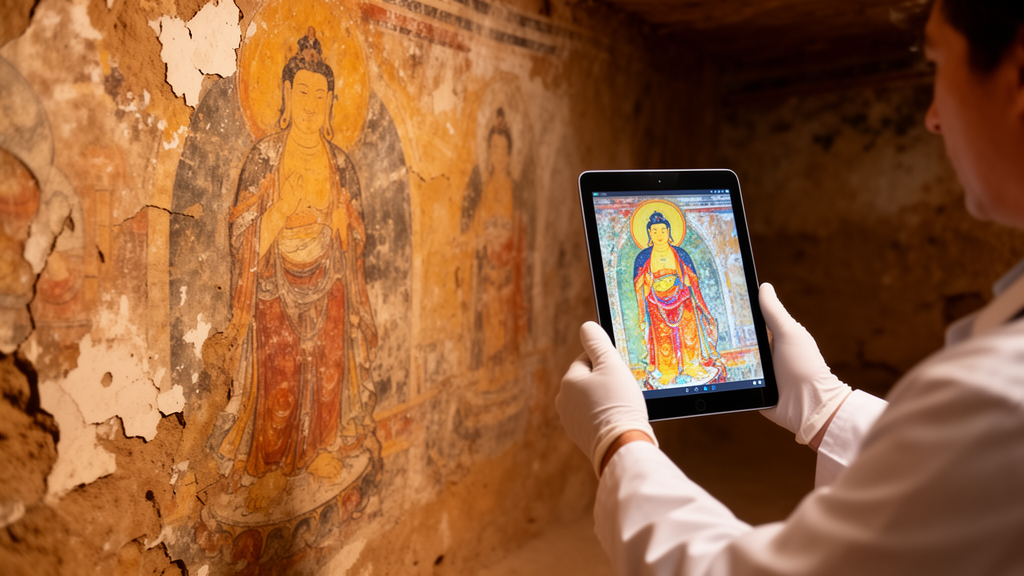
Deep in the Mogao Grottoes of northwestern China, a millennium of Buddhist art is slowly vanishing. The Dunhuang murals, painted over centuries along the Silk Road, have endured harsh desert conditions, fluctuating humidity, and centuries of human contact, leaving their once-vivid pigments faded, flaked, and fragmented. Now, researchers Shiyue Zhang and Yongru Guo of Yili Normal University have unveiled an artificial intelligence framework that does something most digital restoration tools cannot: it restores these treasures while obeying the artistic rules of the ancient painters themselves. Their system, called GECST (GAN-Enhanced Cultural Style Transfer), was described in the journal Discover Artificial Intelligence.
The central problem the team confronted is subtle but profound. Existing deep learning models for image restoration are remarkably good at filling in missing pixels and smoothing out damage, but they treat a mural like any other photograph. They optimize for pixel-level similarity and structural resemblance, and they have no concept of what a celestial musician’s halo should look like, how a lotus mandala’s symmetry ought to unfold, or why the spatial hierarchy of a Buddhist scene places certain figures above others. The result is often a technically plausible image that, to an art historian’s eye, feels symbolically hollow or even culturally wrong.
GECST addresses this by embedding cultural knowledge directly into the machine learning pipeline. The framework operates in four stages. First, a preprocessing phase cleans the degraded input: Gaussian filtering removes noise and crack artifacts, histogram equalization stretches the tonal range of unevenly faded regions, and Sobel gradient operators trace the structural contours of figures, ornaments, and calligraphic lines that must be preserved. Next, a hierarchical multi-scale convolutional encoder extracts features at multiple levels of detail, capturing fine brushstroke textures at small scales and the sweeping symmetry of entire compositions at large scales. These features are stacked into a multidimensional vector that serves as the raw material for reconstruction.
The third stage is where the magic happens. A generative adversarial network, built around an augmented U-Net generator and a PatchGAN discriminator, fills in missing or faded regions. In a standard GAN, the generator produces images and the discriminator tries to tell fakes from real samples, forcing the generator toward increasingly convincing outputs. GECST adds a crucial twist: graph-guided cultural constraints are injected into the training loop, penalizing outputs that violate three classical composition principles: symmetry preservation, spatial hierarchy consistency, and motif balance. The total loss function combines adversarial, perceptual, style-consistency, and cultural fidelity terms, with the cultural fidelity loss explicitly decomposed into these three components. In effect, the generator is not merely learning what Dunhuang murals look like; it is learning the grammar of how they were composed.
Finally, a refinement stage polishes the output. Linear tone mapping corrects centuries of pigment fading while keeping colors within historically plausible Dunhuang palettes. Unsharp masking enhances fine details such as halo outlines and architectural edges, with the sharpening factor carefully tuned to avoid artificial halos. The blended final image balances the generative creativity of the GAN with the stabilizing corrections of post-processing, producing museum-quality digital restorations.
The team evaluated GECST on the Dunhuang Grottoes Painting Dataset and Benchmark, derived from high-resolution scans in the Digital Dunhuang repository managed by the Dunhuang Academy. The dataset spans 3,000 images across five representative mural categories, including Flying Apsara panels, lotus mandalas, and Buddhist sutra friezes. Because real murals cannot be damaged for testing, the researchers simulated deterioration using crack patterns, noise, color fading, and occlusion masks that mimic natural degradation. The model was trained on an NVIDIA RTX 4090 GPU in roughly 6.4 hours over 100 epochs, and inference takes just 0.12 seconds per 512 by 512 pixel image, fast enough to process entire grotto collections in parallel.
The quantitative results are striking. GECST achieved a peak signal-to-noise ratio of 33.82 dB and a structural similarity index of 0.956, both higher than the structure-guided inpainting network SGDIN, the classification framework EICF, and the multimodal retrieval system DFMVS used as baselines under identical training conditions. Its Fréchet Inception Distance, which measures how closely generated images match the statistical distribution of real ones, came in at 16.84, the lowest among all tested methods, indicating the most visually realistic outputs. Color differences measured in Delta E units were also the smallest, meaning restored palettes hewed closest to the verified reference scans. Bootstrapped confidence intervals and paired statistical tests with Holm-Bonferroni corrections confirmed the improvements were significant at the 0.05 level.
Perhaps most telling were the human judgments. Five experts in Dunhuang art and mural conservation independently scored GECST restorations on a five-point scale, yielding an overall cultural authenticity rating of 4.81 out of 5, with historical style fidelity scoring highest at 4.85. A separate panel of thirty non-expert viewers rated the outputs highest on visual realism and aesthetic appeal in blind pairwise comparisons. An ablation study confirmed the design logic: removing the graph-guided cultural constraints produced the largest drop in performance, demonstrating that the cultural rules, not just the generative machinery, drive the system’s success.
The researchers are candid about limitations. The cultural constraints are tailored to Dunhuang’s specific artistic canon, so applying GECST to other heritage traditions would require redesigning those rules. Training relied on simulated degradation, which may not fully capture the complexity of real-world decay, and restored colors reflect high-quality digital scans rather than guaranteed historical accuracy. Severe structural damage and artistic styles absent from the training data remain challenging. Future work will target automated damage detection, broader mural datasets spanning more historical periods, prompt-based incorporation of textual and historical context, and integration of attention-enhanced diffusion models for finer texture coherence.
Even with those caveats, the work signals a meaningful shift in how technology can serve cultural heritage. Rather than treating restoration as a purely computational problem of pixel prediction, GECST demonstrates that algorithms can be taught to respect the compositional wisdom of ancient artists, bridging the gap between automated digital tools and historically aware conservation. The restored images are intended for digital archives, education, conservation planning, and creative reinterpretation, offering a scalable, non-invasive way to ensure that even as the physical walls of Mogao continue to crumble, the visual culture they embody endures in vivid, culturally faithful digital form.
Subject of Research: AI-based restoration of Dunhuang murals using generative adversarial networks and cultural composition constraints
Article Title: A visual design method for Dunhuang murals based on deep learning and graphical algorithms
Article References: Zhang, S., & Guo, Y. (2026). A visual design method for Dunhuang murals based on deep learning and graphical algorithms. Discover Artificial Intelligence, 6(1), Article 1194. https://doi.org/10.1007/s44163-026-02064-8
Image Credits: AI Generated
DOI: 10.1007/s44163-026-02064-8
Keywords: Dunhuang murals, generative adversarial networks, cultural heritage, deep learning, image restoration, style transfer, Mogao Grottoes, computer vision, digital preservation, graph algorithms, Silk Road art, GAN
News Source: Blake Davidson. (October 19, 2026). AI Learns Ancient Art Rules to Bring Fading Dunhuang Murals Back to Life. Scienmag.