• HOME
  • NEWS
  • EXPLORE
    • CAREER
      • Companies
      • Jobs
    • EVENTS
    • iGEM
      • News
      • Team
    • PHOTOS
    • VIDEO
    • WIKI
  • BLOG
  • COMMUNITY
    • FACEBOOK
    • INSTAGRAM
    • TWITTER
Thursday, June 25, 2026
BIOENGINEER.ORG
No Result
View All Result
  • Login
  • HOME
  • NEWS
  • EXPLORE
    • CAREER
      • Companies
      • Jobs
        • Lecturer
        • PhD Studentship
        • Postdoc
        • Research Assistant
    • EVENTS
    • iGEM
      • News
      • Team
    • PHOTOS
    • VIDEO
    • WIKI
  • BLOG
  • COMMUNITY
    • FACEBOOK
    • INSTAGRAM
    • TWITTER
  • HOME
  • NEWS
  • EXPLORE
    • CAREER
      • Companies
      • Jobs
        • Lecturer
        • PhD Studentship
        • Postdoc
        • Research Assistant
    • EVENTS
    • iGEM
      • News
      • Team
    • PHOTOS
    • VIDEO
    • WIKI
  • BLOG
  • COMMUNITY
    • FACEBOOK
    • INSTAGRAM
    • TWITTER
No Result
View All Result
Bioengineer.org
No Result
View All Result
Home NEWS Science News

AI goes underground: root crop growth predicted with drone imagery

Bioengineer by Bioengineer
June 17, 2020
in Science News
Reading Time: 3 mins read
0
IMAGE
Share on FacebookShare on TwitterShare on LinkedinShare on RedditShare on Telegram

Using machine learning, scientists can analyze drone images shot above the soil to understand how root crops respond to drought or heat beneath the soil. The Pheno-i platform relays real-time data to scientists, to breed more climate-resilient crops
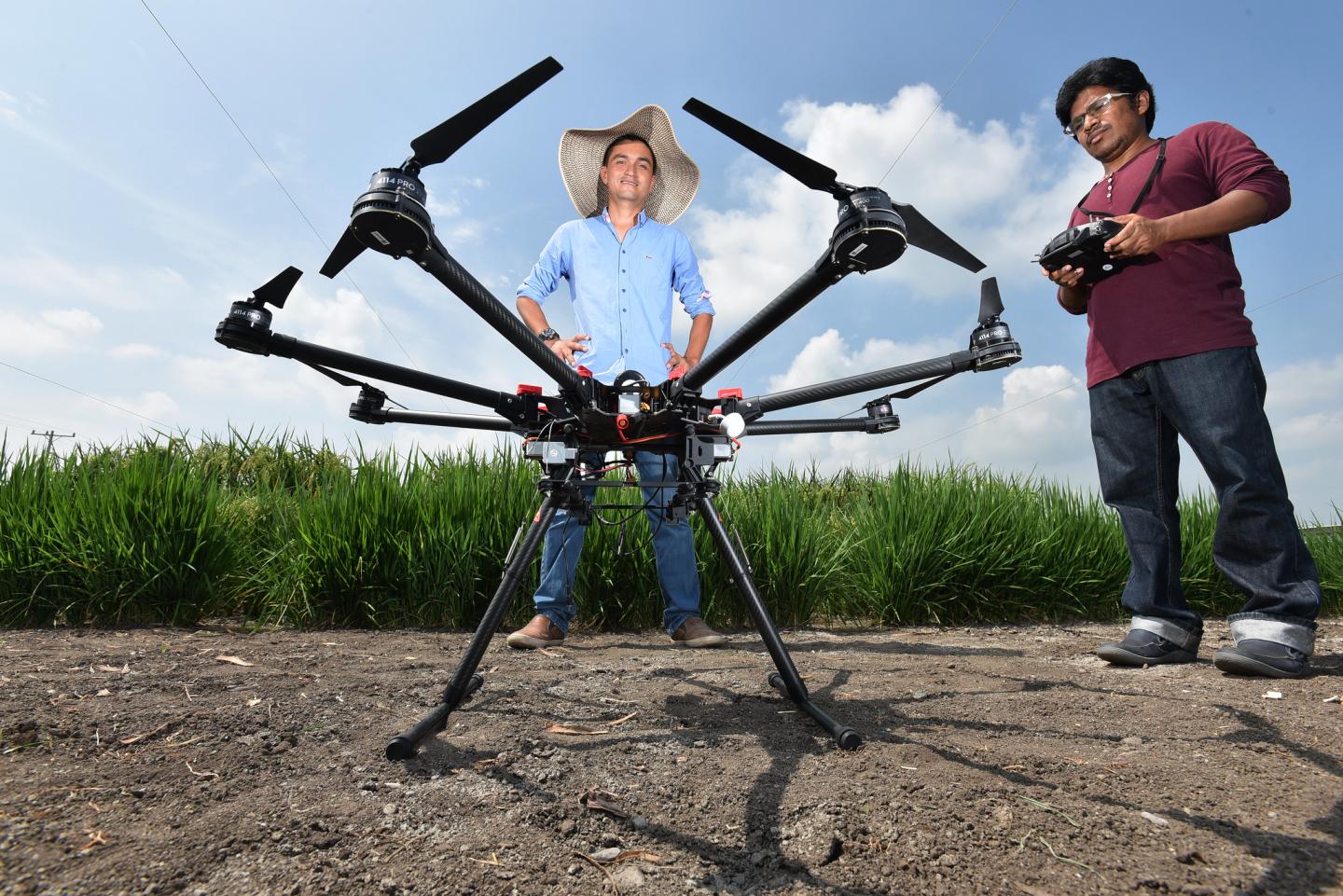
IMAGE

Credit: Neil Palmer / CIAT

Root crops like cassava, carrots and potatoes are notoriously good at hiding disease or deficiencies which might affect their growth. While leaves may look green and healthy, farmers can face nasty surprises when they go to harvest their crops.

This also poses problems for plant breeders, who have to wait months or years before knowing how crops respond to drought or temperature changes. Not knowing what nutrients or growing conditions the crop needs early on also hinder crop productivity.

New research using machine learning and to help predict root growth and health with aboveground imagery was published June 14 in Plant Methods.

“One of the great mysteries for plant breeders is whether what is happening above the ground is the same as what’s happening below,” said Michael Selvaraj, a co-author from Alliance of Bioversity International and the CIAT.

“That poses a big problem for all scientists. You need a lot of data: plant canopy, height, other physical features that take a lot of time and energy, and multiple trials, to capture what is really going on beneath the ground and how healthy the crop really is,” said Selvaraj, a crop physiologist.

While drones are getting cheaper, and hardware for capturing physical images through crop trials has become easier, a major bottleneck has been in analyzing vast quantities of visual information. And, distilling it into useful data that breeders can make use of.

Using drone images, the Pheno-i platform can now merge data from thousands of high-resolution images, analyzing them through machine learning to produce a spreadsheet. This shows scientists exactly how plants are responding to stimuli in the field in real-time.

Using the technology, breeders can now respond immediately, applying fertilizer if a particular nutrient is lacking, or water. The data also allows scientists to quickly discover which crops are more resistant to climate shocks, so they can advise farmers to grow more drought or heat-resilient varieties.

“We’re helping breeders to select the best root crop varieties more quickly, so they can breed higher-yielding, more climate-smart varieties for farmers,” said Gomez Selvaraj.

“The drone is just the hardware device, but when linked with this precise and rapid analytics platform, we can provide useful and actionable data to accelerate crop productivity.”

The technology holds promise for other crops.

“Automated image analytical software and machine learning models developed from this study is promising and could be applied to other crops than cassava to accelerate digital phenotyping work in the alliance research framework,” said Joe Tohme, the Alliance research director for Crops for Nutrition and Health.

###

About the Alliance

The Alliance of Bioversity International and the International Center for Tropical Agriculture (CIAT) delivers research-based solutions that harness agricultural biodiversity and sustainably transform food systems to improve people’s lives. Alliance solutions address the global crises of malnutrition, climate change, biodiversity loss, and environmental degradation. The Alliance is part of CGIAR, a global research partnership for a food-secure future. http://www.bioversityinternational.org http://www.ciat.cgiar.org http://www.cgiar.org

Media Contact
Sean Mattson
[email protected]

Related Journal Article

http://dx.doi.org/10.1186/s13007-020-00625-1

Tags: Agricultural Production/EconomicsAgricultureClimate ChangeDeveloping CountriesFertilizers/Pest ManagementFood/Food SciencePlant SciencesSocioeconomicsTechnology/Engineering/Computer Science
Share12Tweet8Share2ShareShareShare2

Related Posts

New UK Study Reveals Plant-Based Alternatives Have Twice the Additives Compared to Animal Products

June 25, 2026

FDA Approves New Treatment for HR+, HER2+ Advanced Breast Cancer Following Promising Results from the PATINA Trial by Alliance Foundation

June 25, 2026

New Study Uncovers Key Factors Driving Water Chemistry in Nanoscale Environments

June 25, 2026

Post-COVID Surge: Obesity Inequalities in England Widen, with Sharpest Rise Among Young Adults

June 25, 2026
Please login to join discussion

POPULAR NEWS

  • Saying Goodbye to PGY-6: Pediatric Fellowship Realities

    103 shares
    Share 41 Tweet 26
  • Multi-Hospital Study Reveals Long Covid Burden Is Twice as High as Current Estimates

    92 shares
    Share 36 Tweet 23
  • Detection of EDCs in Breast Milk and Infant Urine Up to Six Months Highlights Early Exposure Risks

    77 shares
    Share 31 Tweet 19
  • New Drug Candidate Developed at McMaster Shows Potential for Treating Brain Cancer

    58 shares
    Share 23 Tweet 15

About

We bring you the latest biotechnology news from best research centers and universities around the world. Check our website.

Follow us

Recent News

New UK Study Reveals Plant-Based Alternatives Have Twice the Additives Compared to Animal Products

FDA Approves New Treatment for HR+, HER2+ Advanced Breast Cancer Following Promising Results from the PATINA Trial by Alliance Foundation

New Study Uncovers Key Factors Driving Water Chemistry in Nanoscale Environments

Subscribe to Blog via Email

Enter your email address to subscribe to this blog and receive notifications of new posts by email.

Join 82 other subscribers
  • Contact Us

Bioengineer.org © Copyright 2023 All Rights Reserved.

Welcome Back!

Login to your account below

Forgotten Password?

Retrieve your password

Please enter your username or email address to reset your password.

Log In
No Result
View All Result
  • Homepages
    • Home Page 1
    • Home Page 2
  • News
  • National
  • Business
  • Health
  • Lifestyle
  • Science

Bioengineer.org © Copyright 2023 All Rights Reserved.