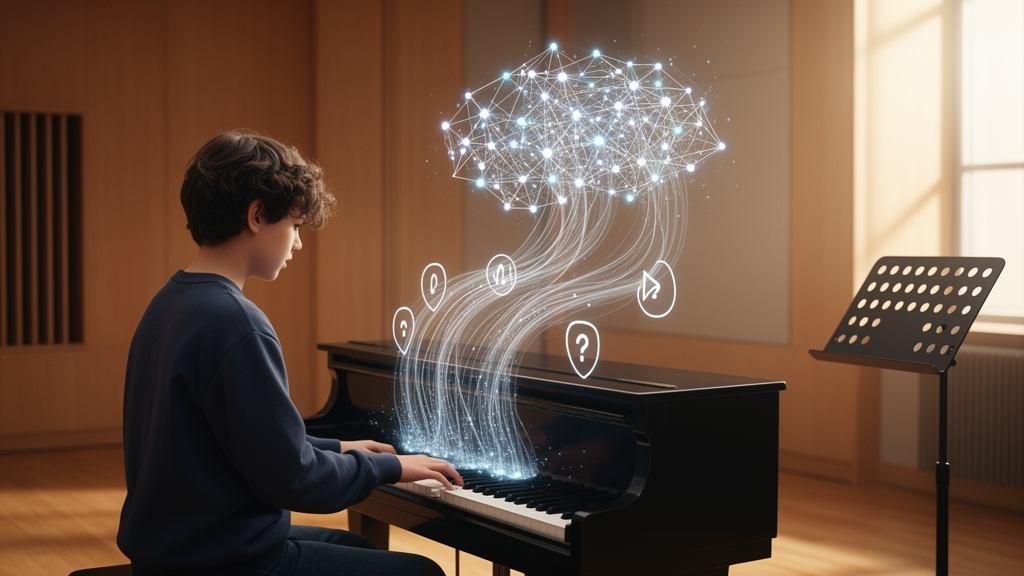
An adaptive artificial-intelligence framework that predicts music learners’ skill levels and recommends individualized training activities achieved strong performance on a public benchmark dataset, according to a study published in 2026. The Adaptive Performance-Driven Training System, or APDTS, combines a convolutional neural network for performance prediction with a hybrid reinforcement-learning and evolutionary-optimization method for selecting training actions. On the Music Learner Performance Dataset, the system reported an area under the receiver operating characteristic curve of 0.953, accuracy of 0.975, precision of 0.970, recall of 0.972 and an F1 score of 0.984. These results concern prediction on recorded data; the study did not test whether the recommendations improved learning outcomes in a live classroom.
The dataset contained 8,867 learner-session records from 1,245 learners, with multiple records describing successive practice cycles. Its three annotated skill categories were beginner, representing 38.2% of the records; intermediate, representing 34.7%; and advanced, representing 27.1%. Each session included learner and instrument information, practice duration, skill level, and performance measures such as pitch accuracy, tempo accuracy, rhythm accuracy and expressiveness. The researchers used 70% of the records for training, 10% for validation and 20% for testing. They also evaluated the complete system with five-fold cross-validation, in which each of five equal subsets served once as the test set.
Before model training, missing numerical values were replaced by means calculated for the relevant class or data group. Missing values accounted for less than 3% of the dataset and were concentrated mainly in practice duration, pitch accuracy and rhythm consistency. The researchers then applied Z-score standardization, expressed as Y_new = (Y − μ)/σ, so that numerical features had zero mean and unit standard deviation. Categorical variables, including instrument and learner level, were label-encoded. Additional features represented practice consistency and session-level performance, giving the model a longitudinal view of how learner records changed over time rather than treating each session as an unrelated observation.
At the center of APDTS is a convolutional neural network that jointly learns features and predicts learner performance. Those predictions become part of the state used by the recommendation system. Each state includes the learner’s age, practice duration, pitch accuracy, rhythm accuracy, expressiveness score and predicted skill level. Candidate actions correspond to training interventions such as rhythm exercises, pitch-correction exercises, tempo-stabilization practice, expressiveness work and mixed technical exercises. The system formalizes adaptation as a finite Markov decision process, with chronological session records providing transitions from one learner state to the next.
The recommendation component, called A2DQN-REA, combines an Adaptive Double Deep Q-Network with a Resilient Enzyme Action Algorithm. The double-network structure uses evaluation and target networks to estimate action values, while the enzyme-inspired optimizer searches for promising training strategies. The authors describe the latter as a nature-inspired extension of an enzyme action optimizer, with sinusoidal adaptive control intended to balance exploration and exploitation, randomized enzyme concentration to preserve candidate diversity, generation of both exploratory and exploitation-oriented solutions, and lightweight local refinement. The two components operate in a closed loop: reinforcement learning selects actions using predicted performance and reward feedback, while evolutionary optimization refines the learner-state representation and candidate exercise sequences.
Several design choices target instability and sparse feedback in adaptive tutoring. To reduce abrupt changes in action estimates, the framework averages target-network Q-values from the previous K iterations rather than relying on a single target estimate. It also redistributes reward by adding discounted future rewards to the immediate reward, producing denser feedback when successful or failed activities are separated by long sequences. In the more detailed session-level reward scheme, a weighted combination of changes in pitch accuracy, rhythm accuracy and expressiveness generates a positive reward when improvement exceeds a threshold, a neutral reward when performance remains stable, and a negative reward when performance deteriorates. Reward-prioritized replay further favors informative experiences when the replay buffer fills.
Evaluation compared the hybrid system with retrained CNN and attention-gated recurrent convolutional neural network baselines using the same preprocessing, training strategy, hyperparameters and evaluation protocol. In the main MSE and ROC-AUC comparison, A2DQN-REA produced an MSE of 0.029, compared with 0.032 for the CNN baseline, while its ROC-AUC was 0.953. The full system also recorded accuracy of 0.975, precision of 0.970, recall of 0.972 and F1 score of 0.984. An ablation analysis indicated that adding adaptive reinforcement learning increased accuracy from 94.8% to 95.9% and reduced MSE from 5.21% to 4.37%; subsequent additions of evolutionary optimization and reward prioritization yielded the complete system’s reported accuracy of 97.5% and MSE of 2.90%. The paper’s conclusion reports MSE as 0.025, a numerical difference from the 0.029 given in the principal comparison and ablation description.
The authors used a paired t-test across the five validation folds to compare A2DQN-REA with the A-GRCNN baseline. The reported t-value was 24.67 with p < 0.001, which the study interprets as a statistically significant performance difference. However, the paper acknowledges that it did not provide detailed degrees of freedom and exact test formulations, limiting the reproducibility of that statistical analysis. Reward curves rose rapidly during initial policy exploration and later stabilized, indicating convergence within the experimental setup. Other visualizations described nonlinear performance transitions and moderate temporal correlations among variables, but these were model and dataset visualizations rather than evidence from a prospective educational trial.
The framework also includes an APDTS dashboard intended to turn model outputs into an operational interface. Its displays combine predicted skill level with pitch accuracy, tempo deviation, practice consistency, session metadata and the next recommended practice. The authors describe this as a digital representation of a learner and say it can help students identify technical weaknesses while allowing educators to inspect how reinforcement-learning decisions respond to performance data. They also propose possible uses in curriculum monitoring across many students. These deployment claims remain prospective: the system was evaluated on a structured public dataset rather than in an operating school, music studio or full-scale learning platform.
The central limitation is that APDTS learned from offline records whose sessions were organized chronologically, not from live interaction with learners. Although the dataset represented repeated practice cycles, the authors state that its learned policies cannot fully reproduce real-time adaptation to students’ responses. The system has also not been validated longitudinally, across many instruments or educational institutions, or under highly noisy and heterogeneous real-world conditions. Its computational demands could also limit scalability because training combines deep learning, reinforcement learning and evolutionary search. The study therefore supports the framework as a promising method for skill-level prediction and offline simulation of adaptive recommendations, but classroom trials, real-time deployment studies and longitudinal evaluation are still needed before its educational value can be established.
Subject of Research: AI-based prediction of music learner skill levels and adaptive training recommendations
Article Title: Adaptive artificial intelligence framework for skill level prediction and music training recommendation
Article References: Liu, X. (2026). Adaptive artificial intelligence framework for skill level prediction and music training recommendation. Discover Artificial Intelligence, 6(1), Article 1159. https://doi.org/10.1007/s44163-026-01988-5
Image Credits: AI Generated
DOI: 10.1007/s44163-026-01988-5
Keywords: artificial intelligence, music education, skill prediction, adaptive learning, reinforcement learning, evolutionary optimization, convolutional neural network, personalized training, offline learning, educational technology, Adaptive, artificial
News Source: Blake Davidson. (October 26, 2026). AI framework predicts music skills and adapts training recommendations. Scienmag.