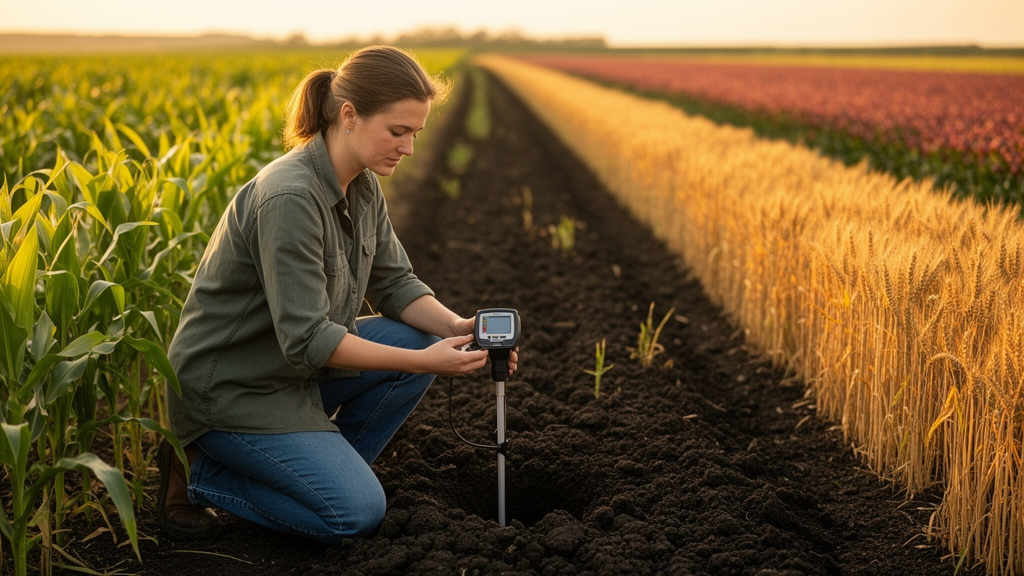
Soil is the most information-dense archive that agriculture owns. Every handful of field earth carries chemical signatures, physical structure, and microbial traces that together record what has grown there and what could grow there next. A new study published in Scientific Reports shows that when this messy, multi-source archive is cleaned and harmonized properly, a carefully engineered deep learning ensemble can read it well enough to identify crop types with better than ninety percent accuracy — a result that could reshape how governments and farmers plan what to plant where.
The research, led by Abror Shavkatovich Buriboev of Gachon University in the Republic of Korea together with collaborators across Uzbek institutions and Konkuk University, tackles a problem that has quietly limited agricultural data science for years. Soil records do not live in one place or one format. They come from different laboratories with different instruments, different public repositories with different conventions, and different regions with different sampling traditions. Units clash, distributions shift from source to source, values go missing, duplicate observations creep in, and subtle information leakage can inflate results that look impressive on paper but collapse in the field.
The team’s answer is a framework they call ADWTabNet — an architecture-diverse TabNet ensemble designed for multiclass crop-type classification. TabNet itself is a neural network architecture built specifically for tabular data, the rows-and-columns format in which soil measurements arrive. Unlike conventional deep networks that treat every feature equally at every step, TabNet uses sequential attention to select which features matter at each decision step, mimicking the way decision trees reason while retaining the representational power of neural networks. That interpretability-friendly design makes it a natural fit for soil science, where understanding why a model reaches a conclusion matters as much as the conclusion itself.
The underlying dataset was substantial. After integration and harmonization, it contained 18,237 observations spanning seven crop classes and a broad set of soil properties — chemical, physical, microbiological, and categorical. Before any model saw the data, the researchers ran a disciplined preprocessing pipeline: unit standardization to reconcile measurements reported in different scales, duplicate control to remove repeated records, source-distribution harmonization to align datasets that arrived from laboratories with systematically different baselines, and separate imputation strategies for categorical and numerical gaps. Each of these steps addresses a specific failure mode that has plagued earlier multi-source studies, where a model can accidentally learn which laboratory produced a sample rather than what the sample contains.
Hyperparameter tuning was handled by the tree-structured Parzen estimator, a Bayesian optimization technique that models which configurations of a model’s internal settings have historically performed well and samples new candidates from promising regions of the search space. Rather than guessing learning rates, network depths, and decision-step counts by hand, the team let the optimizer explore the configuration space efficiently. The payoff was measurable: a baseline TabNet already improved on a strong XGBoost benchmark, but the TPE-optimized version pushed further, raising test accuracy from 0.8863 to 0.8951 and cutting log loss — a measure of how well-calibrated a model’s confidence is — from 0.3325 down to 0.2566.
The headline innovation, however, is the ensemble itself. Instead of training one optimized TabNet, the researchers trained multiple TabNet models with deliberately different internal architectures and fused their probability outputs. The logic is the same principle that makes a committee wiser than any single expert: models that err in different ways can cancel each other’s mistakes when their predictions are combined. The ADWTabNet ensemble achieved the best reported performance in the study, with a test accuracy of 0.9053, a macro F1-score of 0.9025, a weighted F1-score of 0.9050, a macro ROC–AUC of 0.9930, and a normalized multiclass Brier score of 0.0193. Those last two numbers deserve attention: a ROC–AUC approaching unity means the model ranks crop classes almost perfectly across decision thresholds, while a Brier score near zero indicates predictions whose stated confidence closely matches reality — a property that matters enormously when real planning decisions hang on the output.
The team did not stop at a single favorable split. Repeated-run evaluation confirmed that the ensemble’s advantage over the best individual optimized TabNet was stable rather than a lucky artifact of one particular train-test division. Interestingly, the study also found that the difference between weighting the ensemble members by their validation performance and simply averaging them equally across architectures was not statistically significant — a finding that suggests architectural diversity itself, rather than careful vote-weighting, carries most of the benefit. That is a practically useful conclusion, since equal averaging is simpler to implement and less prone to overfitting the validation set.
Perhaps the most scientifically satisfying part of the work is the interpretability analysis. TabNet’s attention mechanism allowed the researchers to aggregate which soil features the models relied on most when distinguishing crop types. The ranking placed humus, phosphorus, electrical conductivity, nitrogen, and pH among the leading predictors — a list that reads like a textbook summary of the soil properties agronomists have long associated with land suitability. Crucially, the team did not rely on the model’s self-reported attention alone. An independent permutation-importance analysis, which measures how much performance degrades when each feature is randomly shuffled, supported the same ranking. When two fundamentally different interpretability lenses converge on the same answer, confidence in the result rises considerably.
The implications reach well beyond the benchmark numbers. Crop-type classification from soil data underpins land-use planning, subsidy verification, crop rotation monitoring, and food security forecasting. A model that can integrate heterogeneous soil records from multiple laboratories and repositories — and do so with quantified, calibrated confidence — offers a template for data-driven agricultural planning in regions where soil archives are fragmented but rich. The authors are careful, however, about the limits of their claims. All results come from the evaluated integrated dataset under a stratified holdout protocol, and they note explicitly that external validation using previously unseen laboratories and geographic regions is required before broader transferability can be established. In other words, the ensemble has proven itself on the data it was built for; whether it generalizes to new soils, new labs, and new climates remains an open and clearly stated question.
That honesty is part of what makes the study notable in a field crowded with overclaimed results. The research was supported by the National Research Foundation of Korea and the Regional Innovation System & Education program, and it reflects a collaboration spanning ten institutions across Korea and Uzbekistan — a reminder that advances in agricultural AI increasingly emerge from partnerships between computer scientists and soil scientists working across borders. As climate pressure reshapes what can be grown where, tools that turn scattered soil records into reliable, interpretable crop intelligence may become as fundamental to modern farming as the soil itself. The ADWTabNet framework is an early but concrete step in that direction, and its emphasis on harmonization, calibration, and dual-channel interpretability sets a standard that future agricultural machine learning studies would do well to follow.
Subject of Research: Machine learning ensemble classification of crop types from harmonized multi-source soil property data
Article Title: Architecture diverse TabNet ensemble for crop type classification using harmonized multisource soil data
Article References: Buriboev, A. S., Abror, A., Narzullo, M., Fayzullo, N., Yusuf, Y., Buriboyev, S., Bazarbaev, M., Abduvaytov, A., Achilov, G., Kuvandikov, J., Indiaminov, R., Jeon, H. S., & Lee, C. (2026). Architecture diverse TabNet ensemble for crop type classification using harmonized multisource soil data. Scientific Reports. https://doi.org/10.1038/s41598-026-75366-7
Image Credits: AI Generated
DOI: 10.1038/s41598-026-75366-7
Keywords: crop classification, TabNet, ensemble learning, soil data, data harmonization, Bayesian optimization, precision agriculture, interpretability, XGBoost, machine learning, agricultural planning, Scientific Reports
News Source: Alan Morgan. (October 18, 2026). AI Ensemble Reads Soil Chemistry to Identify Crop Types With Record Accuracy. Scienmag.