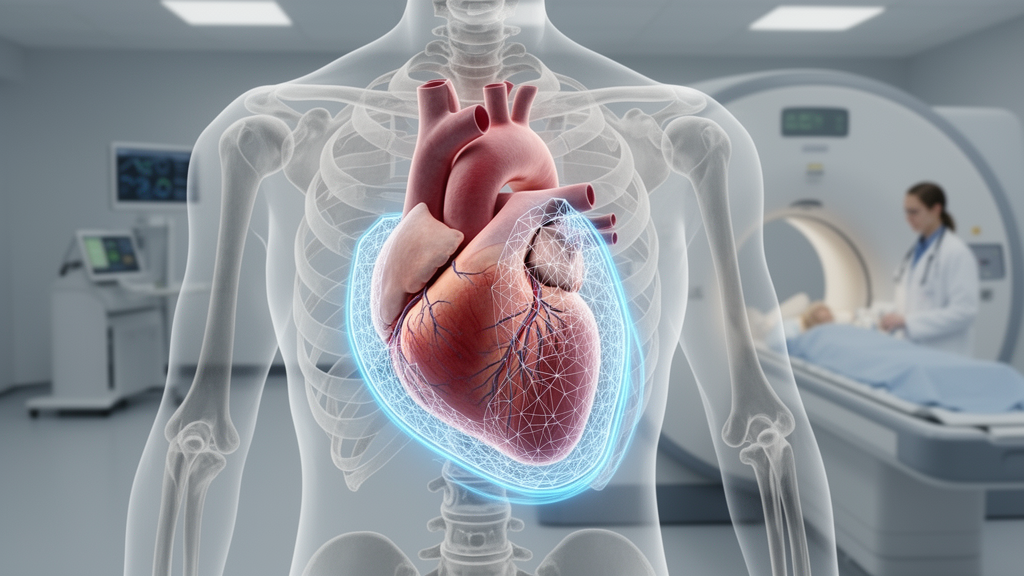
Deep learning-assisted cardiac CT produced six three-dimensional measurements of left atrial shape that behaved as distinct geometric constructs in a retrospective study of 186 patients with atrial fibrillation. The findings show why apparently similar labels—especially “sphericity”—cannot be treated as interchangeable, and why some measurements may be more sensitive than others to small changes in where an anatomical boundary is drawn.
Researchers at a single center analyzed pre-ablation contrast-enhanced cardiac CT angiography images using a MedNeXt-based workflow that generated standardized meshes of the left atrial body. Six global descriptors were then calculated: Wadell sphericity, two coordinate-covariance eigenvalue-ratio indices known as E and F, convex hull ratio, and two diameter-normalized volume sphericity indices based on either the maximum diameter or the mean of three orthogonal diameters. The study was designed to test measurement methods and sensitivity, not to determine whether any descriptor predicts clinical outcomes.
Agreement with expert-guided correction was evaluated in a stratified subset of 40 cases. Relative to the corrected outputs, automated segmentations achieved a Dice coefficient of 0.956 ± 0.015 and a 95th-percentile Hausdorff distance of 1.62 ± 0.55 mm. Intraclass correlation coefficients for the six descriptors ranged from 0.871 to 0.947, indicating agreement between automated and expert-guided results, although the researchers stressed that this was not independent validation against fully manual segmentation. Running the workflow twice produced intraclass correlations of at least 0.996, demonstrating very high consistency in the implementation.
The comparisons also revealed substantial differences among metrics that may sound similar. Wadell sphericity was essentially unrelated to the two diameter-normalized volume sphericity indices, while those two variants were strongly correlated with one another. E, F, convex hull ratio, and both diameter-normalized indices were associated with left atrial volume. A component-based allometric analysis indicated that shape components do not necessarily scale together as overall size changes, so adjusting a measure for volume may not remove all geometric dependence. The AF-subtype-by-volume interaction was not evaluated, limiting interpretation of the exploratory subtype models.
Boundary perturbations produced further warnings about precision. Predefined changes to voxel resolution, mesh construction, and truncation planes by one voxel in either direction were used to assess sensitivity. Convex hull ratio showed the greatest tested boundary sensitivity, with a 95th-percentile change of 4.8%. Its association with AF subtype in an exploratory volume-adjusted model was modest and only nominally significant, with a standardized beta of −0.23 and a 95% confidence interval of −0.42 to −0.04; the authors characterized that result as hypothesis-generating rather than evidence of an independent clinical effect.
Overall, the study indicates that automated CT analysis can generate reproducible left atrial shape descriptors, but the six measures quantify different properties and carry different measurement uncertainties. Clinical use would require transparent formulas, standardized anatomical boundaries, appropriate modeling of size, independent manual validation, assessment of scan-to-scan variability, and validation in external populations. Because the work was retrospective, single-center, and methodological, it did not establish that any shape descriptor improves diagnosis, treatment selection, prediction of recurrence, or patient outcomes in atrial fibrillation.
Subject of Research: Automated three-dimensional left atrial shape analysis in cardiac CT for patients with atrial fibrillation
Article Title: Automated computation and comparison of three-dimensional left atrial shape descriptors from deep learning-assisted CT segmentation in atrial fibrillation: a retrospective methodological imaging study
Article References: Lu, L., & Shi, Z. (2026). Automated computation and comparison of three-dimensional left atrial shape descriptors from deep learning-assisted CT segmentation in atrial fibrillation: a retrospective methodological imaging study. BMC Medical Imaging. https://doi.org/10.1186/s12880-026-02945-5
Image Credits: AI Generated
DOI: 10.1186/s12880-026-02945-5
Keywords: atrial fibrillation, cardiac CT, left atrium, deep learning, image segmentation, shape descriptors, sphericity, medical imaging, methodological study, Automated, computation, comparison
News Source: Ophelia Keating. (October 20, 2026). AI-assisted CT reveals distinct left atrial shape measures in atrial fibrillation. Scienmag.