Researchers have proposed a new pedagogical framework that combines a taxonomy of future-oriented educational objectives with arts-based teaching, positioning artificial intelligence as a generative collaborator within a human-led process of meaning-making. The proposal, published as a conceptual paper in the journal AI, Brain and Child, was developed by Le-Xuan Zhang and Weipeng Yang and has not yet been empirically validated. Its central claim is that the capacities young people need in an AI-driven world can be enacted through embodied, creative, and life-connected artistic experience rather than through knowledge consumption alone.
The framework builds on the SCALE taxonomy, an integrated set of educational objectives introduced by Yang in 2025 in response to the perceived limitations of traditional frameworks such as Bloom’s Taxonomy. SCALE stands for Scientific Literacy, Computational Thinking, AI Literacy, Learning to Learn (metacognition), and Engineering and Design Thinking. Rather than treating these as isolated technical skills, the taxonomy describes them as interdependent habits of mind: habits of inquiry, representation, experimentation, reflection, communication, and adaptation. Its intellectual lineage runs back to Seymour Papert, who co-founded the MIT Artificial Intelligence Laboratory with Marvin Minsky in 1963 and pioneered constructionism, the learning theory holding that people learn best by making objects that are meaningful to them, including computer models.
Each component of SCALE is elaborated into specific practices. Scientific literacy extends beyond factual knowledge to the epistemic processes of science: questioning observable phenomena, formulating testable hypotheses, experimenting and collecting data, analyzing data and answering the question, and reporting findings. Computational thinking, framed as a set of problem-solving practices applicable beyond computer science, involves decomposition, pattern recognition, abstraction, algorithm design, and debugging. AI literacy progresses from engaging with AI, such as prompt engineering, to creating with AI, managing AI systems and their outputs responsibly, and designing AI solutions, informed by the OECD’s 2025 AILit Framework. Learning to learn centers on metacognition, the awareness and regulation of one’s own learning through planning, monitoring, and evaluating. Engineering and design thinking follows an iterative cycle of problem identification, planning, prototyping, testing and iterating, and sharing the final product or process.
The pedagogical half of the proposal draws on Arts-Based Pedagogy, an approach rooted in Dewey’s 1934 view of art as experience and a means of knowing, in which artistic creation serves inquiry, reflection, and knowledge construction. The authors argue that art is not merely a set of products such as paintings, music, dance, drama, poetry, or film. Following Dewey and Vygotsky, they describe art as an embodied and social experience that brings intimate personal dimensions into shared social life, shaped by interactive social connections, sensory and aesthetic awareness, and shareable meaning. A gesture, a movement, a sound, an image, a rhythm, or even silence can communicate personal and social stories that words cannot fully express. The theoretical grounding is embodied cognition, which views cognition as shaped through ongoing interactions among the mind, bodily action, and the environment.
Zhang and Yang organize this arts-based approach as a life-connected learning ecology built on four interrelated dimensions: perception, representation, creative iteration, and resonance. These are explicitly not fixed stages but describe how artistic experience enables learners to notice lived phenomena, give ideas perceptible form, revise meaning through making, and reconnect creation with personal and social life. Perception is characterized as an active process of noticing, attending, discriminating, and recognizing relations, in which different art forms organize attention differently: visual arts direct attention to line and color, music foregrounds repetition and pattern, dance and drama make posture and spatial relation bodily available, and poetry foregrounds imagery, metaphor, and affective association.
Each dimension is then mapped onto the SCALE habits of mind. Perception supports them because habits of mind begin with noticing: scientific literacy depends on observing phenomena and distinguishing evidence from assumptions, computational thinking begins with recognizing patterns and anomalies, and AI literacy requires noticing what machine-generated outputs include, omit, distort, or normalize. Representation, the giving of experience visible, audible, embodied, or digital form, makes abstract ideas perceptible, workable, and revisable, supporting scientific models, computational abstraction, design prototypes, and the representational judgment needed to prompt, interpret, and redesign AI outputs. Creative iteration, the process of testing, revising, and reimagining ideas through making, embeds revision across all five habits, from testing explanations against evidence to debugging and prompt refinement. Resonance, finally, names the communicative and relational process through which learners transform lived experience into artistic form and invite affective, interpretive, and critical responses from themselves and others, returning learning to lived experience rather than ending at a finished product.
The practical translation of this model is what the authors call AI-empowered Arts-Based Pedagogy, or AI-ABP, which builds on the Human-AI Shared Regulation in Learning framework by Järvelä and colleagues, the theory of collaborative creativity, and prior arts-based pedagogies. The working procedure moves from sensorial perception to artistic representation, then to feedback and self-reflection, then to creative making and AI-empowered iteration, and finally to sharing for resonance, with learners able to return recursively to earlier phases. In an illustrative scientific literacy task, learners might create a silent sound map of the schoolyard, using what they notice to generate questions before collecting and analyzing data. In an engineering-oriented task, they might explore textiles, metals, and polymers through direct haptic experience to understand material properties. Learners might enact the water cycle through movement, choreograph a dance in which body parts represent variables in a simple algorithm, or represent the emotional and ethical dimensions of AI through images or sound.
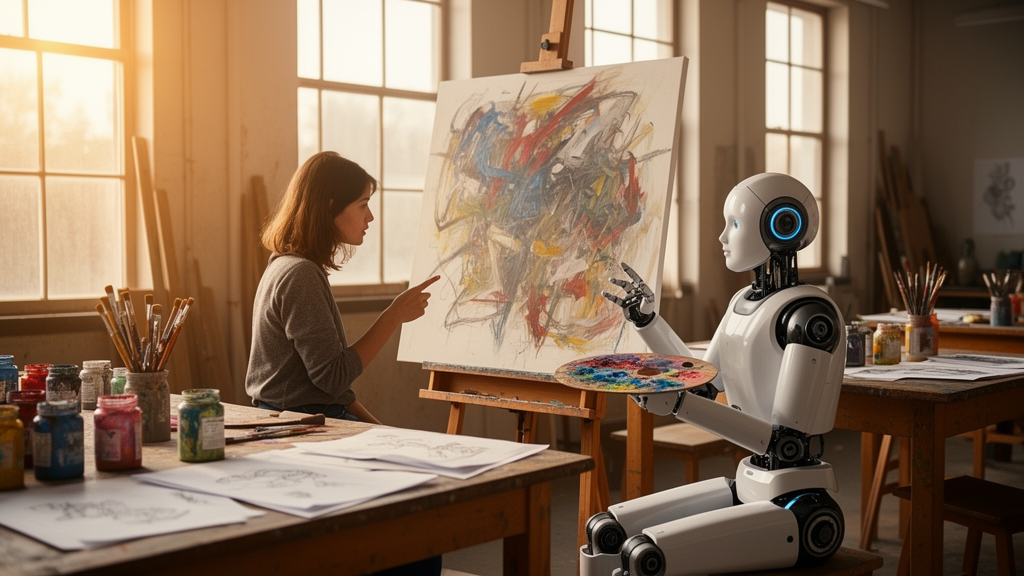
Within this procedure, AI’s role is deliberately constrained. The authors note that AI can already generate text, images, music, and other creative content, but in AI-ABP it does not initiate or direct the meaning-making process; humans do. Generative AI is treated not as an autonomous creator but as an external resource bank acting as collaborator and facilitator that learners question, evaluate, and transform within the artistic process. In one example, students writing a climate-change script might ask AI for alternative dialogue, then critique, combine, or rewrite the suggestions; visual-art learners might generate alternative metaphors for justice and transform selected ideas into their own work. The authors cite research indicating that human agency is better sustained when learners actively integrate their own ideas with AI-generated content rather than allowing AI to dominate creation. Learners retain primary responsibility for intention, interpretation, judgment, and transformation, and feedback is most useful when learners interpret what has been achieved, identify what needs improvement, and decide what to do next, with self-reflection turning feedback into a learning decision.
The paper also offers design criteria for teachers. Learning should be grounded in lived problems noticed through sensory and embodied experience; teachers should provide multiple artistic forms through which learners can externalize thinking, with the purpose being inquiry rather than artistic performance itself; feedback and self-reflection should be built into the creating process rather than reserved for final assessment; AI should be incorporated within a human-led creative process rather than positioned as an independent producer of answers; and assessment should attend not only to products but to how learners inquire, justify decisions, respond to feedback, and use AI critically during iteration. Finally, teachers should design opportunities for student creations to reach audiences who can respond, question, reinterpret, or connect them with wider social and cultural experience, keeping the process open and recursive.
The authors are explicit about the framework’s status. Although AI-ABP was developed by integrating the SCALE taxonomy with previous empirical research, the integrated pedagogical framework has not yet been empirically validated. Future research, they write, should examine its feasibility, teacher usability, and student learning processes across contexts and age groups, with particular attention to how learners move recursively among perception, representation, reflection, creative iteration, AI-supported creation, and resonance, and how different forms of AI participation influence student agency and SCALE-related outcomes. Such validation, they argue, is necessary before AI-ABP can become a reliable and adaptable pedagogical resource for AI-supported K-12 education and beyond.
Subject of Research: A conceptual framework integrating the SCALE taxonomy with arts-based pedagogy to enact future-oriented learning habits in the age of AI
Article Title: Fostering SCALE habits of mind through AI-empowered arts-based pedagogy
Article References: Zhang, L.-X., & Yang, W. (2026). Fostering SCALE habits of mind through AI-empowered arts-based pedagogy. AI, Brain and Child, 2(1), Article 19. https://doi.org/10.1007/s44436-026-00043-5
Image Credits: AI Generated
DOI: 10.1007/s44436-026-00043-5
Keywords: SCALE taxonomy, arts-based pedagogy, artificial intelligence in education, embodied cognition, AI literacy, computational thinking, metacognition, engineering and design thinking, K-12 education, generative AI, human-AI collaboration, creative learning
News Source: Glenn Wilkins. (October 28, 2026). AI as collaborator, not creator: arts-based pedagogy proposed for future learning habits. Scienmag.