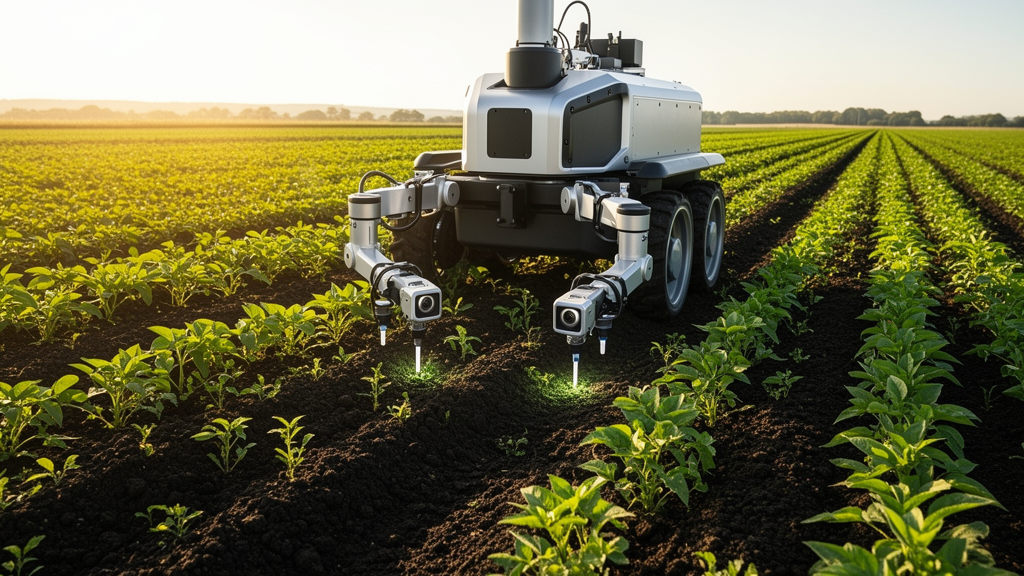
A comprehensive review published in Frontiers in Agronomy synthesizes recent advances in artificial intelligence, remote sensing, and robotics for precision weed management. The study, led by researchers from South Dakota State University and other U.S. institutions, argues that these technologies are shifting agricultural weed control from uniform, field-scale interventions to site-specific, plant-level decision-making. By integrating machine learning with advanced sensing platforms, the review highlights a potential paradigm shift toward agroecological weed management that reduces chemical inputs while preserving beneficial plant communities.
Weeds remain a significant constraint to global crop production, competing with crops for light, water, and nutrients while serving as hosts for pests and diseases. The review notes that nearly 1,800 weed species cause an average 31.5% reduction in plant production, resulting in an estimated annual economic loss of US$32 billion. To meet the projected global population of 9.7 billion by 2050, food production must increase by 50% to 60%, making effective and sustainable weed management a critical component of future food security.
Traditional herbicide applications have been widely used for over half a century due to their scalability and economic benefits. However, broadcast spraying treats entire fields regardless of weed distribution, often leading to unnecessary herbicide use in weed-free areas. This approach contributes to ecosystem disruption and accelerates the evolution of herbicide-resistant weeds, with 548 unique cases of resistance reported worldwide across 275 weed species and 102 crops. The review emphasizes that precision strategies are necessary to account for the spatial variability of weed infestations and enable targeted interventions.
The review details various sensing technologies used for weed detection, including red-green-blue (RGB), multispectral, hyperspectral, fluorescence, and LiDAR systems. RGB imaging is widely used for its low cost and ease of deployment, capable of extracting color and texture information from vegetation. However, its performance is contingent on variable illumination and soil background interference. Multispectral sensing extends RGB by adding near-infrared and red-edge wavelengths, which are sensitive to vegetation structure and plant stress, enabling better discrimination between crops and weeds when visual differences are limited.
Hyperspectral imaging captures hundreds of narrow, contiguous spectral bands, generating a detailed spectral signature for each pixel. This technology allows for the characterization of plant biochemical and physiological properties, such as chlorophyll and water content. The review highlights that hyperspectral data can detect subtle physiological changes that precede visible symptoms, making it valuable for early stress assessment and herbicide-resistance screening. For instance, ground-based hyperspectral cameras have been used to identify glyphosate-resistant Palmer amaranth with 94% to 96% accuracy in greenhouse and field conditions, respectively.
Chlorophyll fluorescence imaging provides a direct, non-destructive window into photosynthetic performance, particularly for detecting herbicides that impair photosynthetic electron transport. Parameters such as the maximum quantum yield of photosystem II can reveal herbicide stress within hours of application, well before visible injury develops. When combined with machine learning, fluorescence and hyperspectral data can be fused to improve the sensitivity and specificity of early herbicide-stress detection, extending weed science from simple detection to herbicide-response phenotyping.
Machine learning and deep learning algorithms have transformed agricultural image analysis by enabling accurate weed identification and classification under complex field conditions. The review describes image processing pipelines that convert raw field images into analysis-ready data using photogrammetric software and geographic information systems. Pixel-based classification and object-based image analysis are used to separate vegetation from non-vegetation areas, with Random Forest and Support Vector Machine models widely adopted for their ability to handle high-dimensional data. Deep learning models such as U-Net and Mask R-CNN perform semantic and instance segmentation, assigning class labels to every pixel or delineating individual plant instances.
Targeted herbicide application systems, or smart sprayers, use deep learning-enabled weed detection to reduce environmental impacts. Segmentation models can separate weeds from complex backgrounds, enabling selective spraying that may reduce herbicide use by up to 90%. Field evaluations of smart sprayers, such as the See & Spray technology, have reported postemergence herbicide savings ranging from 28% to 76%, depending on weed pressure and crop type. These systems also support weed resistance management by enabling real-time scouting and georeferenced mapping of infestations, which can be used to generate prescription maps for variable-rate residual herbicide applications.
Robotic mechanical weeding and laser-based systems offer non-chemical alternatives to herbicide use. Intelligent mechanical weeders employ sensors and AI algorithms for real-time weed detection and site-specific control, minimizing crop disturbance. A pre-commercial prototype called the Weed Chipper achieved 90% weed control efficacy with only 1.8% soil disturbance under low weed density conditions. Laser weeding, such as the commercial system introduced by Carbon Robotics, uses coherent laser beams to deliver concentrated energy to targeted plants. Field experiments demonstrated that laser weeding reduced weed cover by at least 45% and weed density by at least 66%, resulting in significantly lower weed biomass compared with untreated controls.
Despite high accuracy under controlled conditions, the performance of deep learning models often declines when deployed in operational fields. This gap arises from variability in illumination, weather, soil background, and crop growth stages that are poorly represented in training datasets. The review emphasizes the importance of robust validation design, including cross-field and cross-year validation, to avoid inflated accuracy reports due to spatial and temporal autocorrelation. Strategies such as domain adaptation, transfer learning, and uncertainty-aware models are essential for improving model robustness and generalization across different environments.
Translating accurate detection models into operational weed-control systems introduces engineering constraints beyond classification accuracy. Effective performance depends on the entire sensing-to-actuation chain, including on-board computing capacity, inference latency, and precise temporal synchronization between detection and actuation. A model that is accurate but too slow, or a system with mismatched timing between detection and nozzle firing, can miss target weeds or spray crop plants. Real-world evaluation must therefore report system-level outcomes such as targeting accuracy, throughput, and crop-injury risk at realistic operating speeds.
From an agroecological perspective, the review argues for a shift from complete weed eradication to the preservation of ecologically neutral or facilitative weed communities. Current management practices have selected for fewer, highly competitive super-weed species, reducing weed diversity and impacting agroecosystem multifunctionality. AI-driven precision technologies can support this shift by enabling species-specific interventions that suppress highly competitive weeds while conserving beneficial plant communities. This approach requires integrating ecological and evolutionary concepts with advanced remote sensing and analytical techniques to prioritize management of problematic species while safeguarding ecosystem services.
The review concludes that while AI and robotics offer significant potential for sustainable weed management, substantial barriers remain, including limited annotated datasets, poor model generalization, and high capital costs. Future research should focus on developing robust detection methods, open-access global weed datasets, and AI-integrated decision support systems. By grounding precision technologies in fundamental ecological principles, the agricultural sector can reduce reliance on standalone management approaches and enhance the sustainability of agroecosystems.
Sensor fusion platforms and machine learning frameworks have also demonstrated measurable capability in differentiating herbicide-resistant weed biotypes across complex field environments. For example, Xia and colleagues combined a hyperspectral sensor on a six-rotor unmanned aerial vehicle with high-resolution RGB imagery from a quadcopter, employing a deep fusion network to achieve 78% accuracy in separating atrazine-resistant and atrazine-susceptible barnyardgrass and velvetleaf populations. Similarly, Eide and colleagues integrated thermal infrared with multispectral imaging through a random tree classifier, achieving 87% accuracy when classifying glyphosate resistance in redroot pigweed. Using 204 contiguous hyperspectral bands spanning 400 to 1,000 nanometer wavelengths, Singh and colleagues classified fenoxaprop- and imazamox-resistant wild oat populations with approximately 88% accuracy. Real-time vision frameworks show comparable precision, as Upadhyay and colleagues attained 100% precision in indoor trials and 95% outdoors using YOLOv4 for site-specific nozzle activation, while Deng and colleagues documented 99% indoor mean average precision with YOLOv11 that dropped to 69% under field conditions.
Economic evaluations further illustrate the operational balance between chemical savings and implement investment. In postemergence herbicide spraying trials, Avent and colleagues reported cost savings between US$43.22 and US$129.19 per hectare compared to a conventional broadcast expenditure of $227.22 per hectare, while Houser and colleagues observed an economic benefit of $39 per hectare in Iowa soybean fields. Non-chemical mechanical and thermal alternatives present complementary operational trade-offs. An intra-row robotic weeding mechanism tested by Quan and colleagues attained an 86% weed removal efficacy with only 1% injury to standing corn crops. In laser weeding implementations, autonomous diode-laser robotic systems achieved 72% control in cotton fields, yet broad commercial adoption of field-scale laser equipment remains constrained by substantial financial barriers, with individual commercial units requiring capital investments of at least US$500,000.
Finally, the authors emphasize that operationalizing tolerance-based agroecological weed management introduces direct agronomic and regulatory vulnerabilities that require rigorous risk management. Allowing low-risk or neutral plant species to survive can inadvertently replenish the soil weed seedbank, complicating long-term field management. Retained weeds may also host insect pests or plant pathogens, contaminate harvested produce, interfere with harvesting machinery, and violate statutory mandates prohibiting regulated noxious or invasive weeds. Consequently, selective AI-guided suppression must balance ecological diversification against commercial crop standards, farm-level risk tolerance, and strict legal compliance.
Subject of Research: Towards sustainable weed management: the role of artificial intelligence, sensing, and robotics
Article Title: Towards sustainable weed management: the role of artificial intelligence, sensing, and robotics
Article References: Chaudhary, A., Kaushal, S., Desai, H. S., Singh, N., Jakhar, M., Desai, D. H., Kaur, J., Mahajan, K., Vredenburg, M., & Dhanda, S. (2026). Towards sustainable weed management: the role of artificial intelligence, sensing, and robotics. Frontiers in Agronomy, 8, 1898506. https://doi.org/10.3389/fagro.2026.1898506
Image Credits: AI Generated
DOI: 10.3389/fagro.2026.1898506
Keywords: Towards, sustainable, weed, management, role, artificial, intelligence, sensing, robotics
News Source: Denise Maddox. (November 13, 2026). AI and robotics shift weed control to plant-level precision. Scienmag.