Legume breeding has long been dominated by yield, disease resistance and adaptation, while the traits that actually determine whether consumers buy and eat a bean variety—flavor, texture, aroma, appearance and cooking performance—have been relegated to late-stage evaluation. A new review argues that artificial intelligence combined with nondestructive sensing technologies could change that, moving sensory quality from a bottleneck at the end of the pipeline to a scalable screening target applied across entire breeding populations. The catch, the authors stress, is that the evidence linking sensors to human perception in legumes remains thin, and prediction accuracy alone is not enough to justify adoption.
The core problem is a phenotyping bottleneck. Modern breeding programs can genotype thousands of lines quickly, but measuring how those lines taste, smell and cook still depends largely on trained human panels. Recruiting, training and calibrating assessors, then repeating evaluations under controlled conditions, is slow and expensive, and consumer tests require large participant numbers that cannot scale to thousands of breeding samples. In common bean (Phaseolus vulgaris), genome-wide association studies have identified markers associated with flavor and texture attributes, demonstrating that sensory quality is genetically variable and therefore a legitimate breeding target—but only if breeders can measure it at scale.
The review frames human sensory evaluation as ground truth rather than a screening tool. Descriptive methods such as quantitative descriptive analysis (QDA) generate standardized intensity profiles; flash profiling and free-choice profiling let assessors generate their own descriptors to distinguish varieties; temporal dominance of sensations captures how perception evolves during consumption; and affective tests measure consumer liking and preference. In one example, a modified QDA protocol characterized flavor and texture variation across 430 dry bean genotypes and supported genome-wide association analysis, while a 242-line recombinant inbred population evaluated over two years yielded quantitative trait loci for multiple flavor and texture traits. These datasets define the human-perception targets that any instrumental proxy must ultimately be validated against.
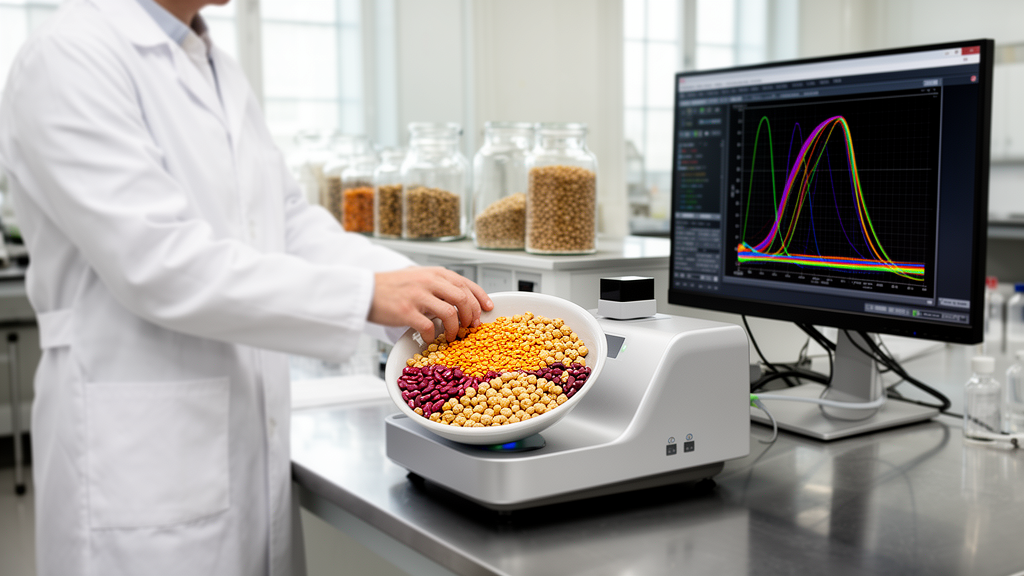
On the sensing side, the technologies are diverse. Near-infrared, mid-infrared and Fourier-transform infrared spectroscopy detect wavelength-dependent signals from O–H, C–H and N–H bonds, providing information on moisture, starch, protein, lipids and fiber—constituents that influence texture and mouthfeel. NIR spectroscopy has already been used to assess protein and starch in faba bean and to predict nitrogen, iron and zinc in common bean germplasm. Hyperspectral imaging adds spatial information to spectral data, enabling machine-learning-based quality detection in common bean flour and visualization of local carbohydrate distribution. Machine vision with RGB cameras captures color, size, shape and surface traits, while X-ray phase-contrast imaging and micro-computed tomography can link internal seed microstructure, such as hilum architecture, to hydration kinetics and cooked texture.
Electronic sensor systems extend the toolkit to aroma and taste. Electronic noses detect patterns of volatile compounds and have been used to screen pulse cultivars for beany off-flavor intensity and to differentiate volatile profiles among soybean varieties. Electronic tongues discriminate soybean genotypes according to sweet, umami, bitter and astringent attributes, correlating with human sensory scores. The review notes, however, that evidence supporting routine use of electronic sensing at breeding scale remains more limited than for spectroscopy and imaging, and that sensor drift, calibration requirements and storage effects pose ongoing challenges.
Artificial intelligence is what turns these high-dimensional sensor outputs into usable phenotypes. Machine learning and deep learning models can extract nonlinear relationships between spectral, imaging and volatile data and quality-related traits, supporting prediction, classification and multimodal data integration. Concrete demonstrations exist: partial least squares regression and support vector machines have predicted sensory color and appearance scores of canned black beans from machine-vision images; visible/NIR spectroscopy and hyperspectral imaging have predicted post-canning texture of black beans from intact dry seeds; and deep learning pipelines using YOLOv8n object detection and the Segment Anything Model have enabled high-throughput phenotyping of canning color quality in dry beans.
But the review draws a sharp distinction between predicting a quality attribute and producing a genuine sensory phenotype. A sensor-derived feature may reflect chemical or optical characteristics without adequately representing what humans actually perceive, and accurate classification does not automatically translate into a breeding-relevant measurement. Models trained under one set of conditions may not perform under another, with performance affected by genotypic diversity, planting year, moisture content, cooking method and calibration strategy. Before instrumental measurements inform large-scale selection, their relationship with sensory reference data must be validated across representative germplasm, ideally spanning independent environments and growing years withheld from model training to prevent information leakage.
The nondestructive nature of these methods offers breeding-specific advantages beyond speed. In early segregating generations, each seed may represent a unique genotype, making destructive testing impractical; nondestructive screening preserves seed for planting and generation advancement. Repeated measurements of the same material enable longitudinal tracking of quality indicators such as volatile release or texture change during storage, and evaluation across multiple environments can characterize genotype-by-environment-by-processing interactions. The proposed framework links validated digital phenotypes to selection indices, parental ranking and early-generation culling, positioning sensory quality alongside yield within so-called Breeding 5.0 paradigms—while cautioning that associations involving sensor-derived features should not be interpreted as genetic associations with sensory traits without establishing biological relevance first.
Practical barriers are substantial. Initial investment in hyperspectral cameras, VOC sensors, computing infrastructure and specialized personnel can be prohibitive for resource-limited breeding institutions, and ongoing costs for calibration, maintenance and data curation are significant. The review suggests matching technology to stage: high-throughput machine vision and NIR suit early-generation screening, while hyperspectral imaging and electronic sensing fit targeted, advanced-stage validation. Lower-cost alternatives, such as reconstructing spectral information from RGB images using deep learning, may broaden access. Deployment should be judged by breeding utility rather than technological novelty—a moderately accurate, inexpensive system that markedly increases screening capacity may outperform a highly accurate but costly one.
The authors also emphasize data governance and responsible deployment. Large volumes of images, spectra and metadata risk becoming a data swamp without standardized formats, metadata schemas and cloud-based infrastructure; models must be traceable to their underlying measurements, reference data and validation performance; and AI outputs should carry uncertainty estimates and function as decision support rather than definitive phenotypic observations. Data ownership, privacy and potential bias in shared consumer datasets require clear governance. The long-term vision is not fully automated sensory evaluation but integrated decision-support systems in which human panels, nondestructive sensing, AI and genomic data complement one another. Direct evidence linking these digital phenotypes to sensory selection decisions in large legume breeding populations is still limited, and future progress should be measured by demonstrated transferability, biological interpretability, cost-effectiveness and measurable improvement in breeding decisions—not model accuracy alone.
Subject of Research: AI-assisted nondestructive phenotyping of sensory-related traits in legume breeding
Article Title: AI-assisted nondestructive phenotyping of sensory-related traits in modern legume breeding: From sensing technologies to a proposed framework for breeding-scale application
Article References: Ghaitaranpour, A., Kebede, B., Duizer, L. M., & Yoosefzadeh-Najafabadi, M. (2026). AI-assisted nondestructive phenotyping of sensory-related traits in modern legume breeding: From sensing technologies to a proposed framework for breeding-scale application. Smart Agricultural Technology, 15, Article 102668. https://doi.org/10.1016/j.atech.2026.102668
Image Credits: AI Generated
DOI: 10.1016/j.atech.2026.102668
Keywords: legume breeding, sensory phenotyping, nondestructive evaluation, artificial intelligence, machine learning, hyperspectral imaging, NIR spectroscopy, electronic nose, common bean, flavor and texture, phenotyping bottleneck, breeding framework
News Source: Alan Morgan. (October 26, 2026). AI and Nondestructive Sensing Could Bring Flavor Into Legume Breeding at Scale. Scienmag.