Artificial intelligence systems are no longer lurking in the background of hospitals as silent tools that generate scenarios or crunch performance data. Across health professions, AI agents are moving into clinical teams as collaborative entities that flag deteriorating patients, recommend drug dosing, interpret imaging, and present diagnostic alternatives in real time. That shift, two simulation researchers argue, demands a fundamental rethink of how healthcare professionals are trained — and they contend that human-AI teaming is the next frontier for healthcare simulation education and research.
The argument comes from Sonia Jawaid Shaikh and Walter Eppich, writing in a comment article published in the journal Advances in Simulation in October 2026. Their central claim is conceptual rather than experimental: healthcare simulation continues to treat AI as a tool that serves the scenario rather than one that inhabits it, and that framing is no longer adequate. The clinical environments for which practitioners are being prepared, they write, demand that professionals learn to team with AI, not merely use it. The authors call on the simulation community to treat this as a first-order priority and to commit to developing fidelity standards for AI agents in simulation, validating human-AI teaming assessment tools, establishing ethical frameworks for AI-inclusive scenario design, investing in curriculum and faculty development, and pursuing research on whether such training translates into improved performance in AI-augmented clinical practice.
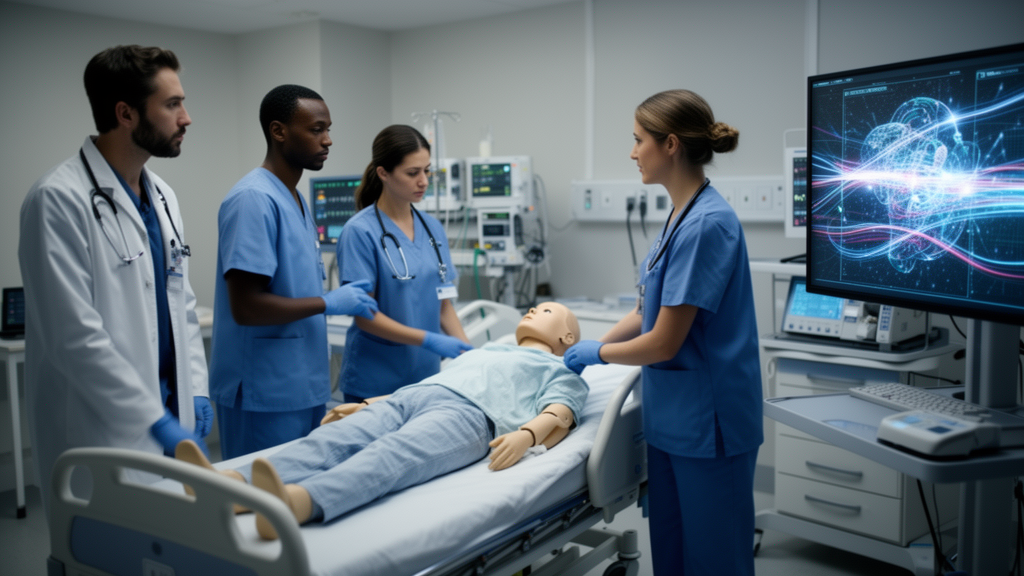
To make the case concrete, the authors open with a vignette set in the year 2030. A team of neurosurgeons, anaesthetists, nurses, and surgical technicians is performing a complex neurosurgical procedure while an intelligent decision-support system integrates findings from sophisticated neuroimaging to assist them. Midway through, the system suggests a course of action with which not all team members agree. How, the authors ask, should the team engage with the assistant, evaluate its recommendation, and decide on the best course of action? That question, they argue, is a prediction of upcoming clinical reality — one that simulation has not yet caught up with.
The authors draw on a definition from prior team-science work to pin down what they mean by human-AI teaming. In their framing, a human-AI team is a type of team in which at least one human works together with at least one autonomous agent possessing a partial or high degree of self-governance over decision-making, adaptability, or communication, toward a common goal. What distinguishes such teams from conventional human-computer interaction, they stress, is precisely this collaborative attribute: AI agents are not passive instruments but active participants capable of generating recommendations, flagging disagreement, and adapting their behaviour based on team decisions. The addition of AI agents as members of healthcare teams, they argue, fundamentally alters how teams think, communicate, work together, and accomplish goals — and, by extension, how simulation systems must be designed for education and research.
At the heart of the comment is a structured analysis of five dimensions of teamwork that the authors say AI is already reshaping, each drawn from the broader science of teams and each carrying direct implications for simulation design. The first is communication and information exchange. Research from human-AI teaming shows that human members of such teams revert to minimal, task-focused exchanges, forgoing the rich elaboration of information that characterises effective human-only teams. Applied to healthcare simulation, the authors argue this means clinicians must be trained not only to communicate with AI agents using directed, closed-loop language, but also to actively elicit unique AI-generated information — because the data an AI holds may never surface if humans do not know to ask for it, evaluate it, and act on it.
The second dimension is shared mental models: the aligned understanding of team goals, roles, and capabilities. This becomes harder to achieve, the authors note, when one team member is an AI whose reasoning and breadth of knowledge may not be well understood. The challenge extends to transactive memory systems, in which knowledge about who does what is cognitively distributed among team members; in human-AI teams, that distribution must extend to an accurate understanding of what the AI knows and when its outputs can be trusted. In simulation, the authors suggest this calls for pre-scenario briefings that explicitly establish the AI’s role, scope, and known limitations, with scenario designs and debriefing practices that explore and shift misaligned expectations rather than assuming they will resolve on their own.
Working alongside AI requires clinicians to develop well-calibrated trust that neither defers to AI recommendations uncritically nor dismisses them without due consideration. They identify three failure modes that are especially relevant in clinical human-AI teams: overtrust, in which clinicians accept AI advice without adequate scrutiny; overreliance, in which AI input is sought or followed even when it adds no value; and undertrust, in which clinicians reject AI advice even when it is clinically useful. Simulation, they argue, offers a safe learning environment in which clinicians can be deliberately exposed to AI error, studied as trust shifts in response, and trained to override AI recommendations without harm to patients.
The fourth dimension is team reflexivity, which the authors describe, drawing on prior conceptual work, as a team’s capacity to reflect collectively on its goals, strategies, and processes before, during, and after performance, and to adapt accordingly. In human-AI teams, this capacity acquires added complexity: the team must reflect not only on its own functioning but on the quality of its relationship with the AI, developing the ability to communicate clearly, interrogate AI outputs appropriately, and determine whether and how the AI’s contributions were integrated or ignored. Simulation, with its structured debriefing tradition, is described as the natural venue for developing this form of reflexivity. The fifth dimension is team performance. The authors cite research showing that the value of human-AI combinations depends highly on task type and design — human teams tend to underperform on decision-making tasks compared to creative tasks, with outcomes moderated by team structure — and that one driver is the tendency of human members to revert to minimal, shallow exchanges with AI agents rather than richer coordination patterns. Performance outcomes, they conclude, are sensitive to task design and teaming conditions, which is precisely the domain simulation is positioned to address.
From these five dimensions, the authors derive five imperatives they say healthcare simulation must address. The first is fidelity: the concept must be reconceptualised so that an AI agent’s communication style, response latency, uncertainty expression, and failure modes reflect those of real clinical AI systems rather than an idealised, cooperative surrogate. The second is assessment. The non-technical skills tools that simulation has validated over two decades — the authors name ANTS, OTAS, and TEAM — were designed to assess human-human interaction and do not capture trust calibration, information elicitation from an AI agent, or the quality of override decisions; new validated instruments grounded in the five dimensions are needed before the field can claim to measure human-AI teaming competency with rigour. The third imperative spans ethics, governance, and medico-legal framing: the authors highlight attribution of responsibility, burden of acknowledgement in decision-making, bias in AI agents, and the quality of training datasets, arguing that explicit ethical frameworks and institutional governance structures are needed before the field can responsibly scale human-AI-based simulation.
The remaining imperatives concern education and evidence. Curriculum and faculty development, the fourth, must equip simulation educators who are skilled at designing and debriefing human team scenarios but not yet trained to design scenarios in which AI holds a defined role, to facilitate debriefs that interrogate human-AI dynamics, or to identify moments where trust was miscalibrated or information exchange failed; the authors propose scenario designs incorporating AI archetypes such as AI misuse or disuse during patient deterioration, extended debriefing frameworks with structured prompts about how humans responded to incorrect AI, and faculty programmes with the conceptual and practical tools to match. The fifth imperative is transfer of learning: a clinician who performs well in a simulated human-AI scenario must also be able to calibrate trust, elicit information, and reflect on AI-team dynamics when working alongside real AI systems in real clinical settings, and the authors call for longitudinal studies that follow trainees from simulation into AI-augmented clinical practice, describing such studies as urgently needed. Together, the five dimensions and five imperatives constitute what the authors describe as a research and education agenda for a field built on the science and art of preparation. They are candid about the state of the evidence: the science of human-AI teaming is in its infancy, and whether simulation training in these skills improves performance in AI-augmented clinical practice remains an open research question. But their conclusion is emphatic. AI agents are already in healthcare teams, already generating recommendations, and already demanding responses that require trust, judgment, and coordination from their human colleagues, while the educators, curricula, assessment tools, and fidelity standards needed to train for that reality do not yet exist. The new frontier, they write, is here — and healthcare simulation must meet it.
Subject of Research: Human-AI teaming as an emerging agenda for healthcare simulation education and research
Article Title: The next frontier in healthcare simulation is human-AI teaming
Article References: Shaikh, S. J., & Eppich, W. (2026). The next frontier in healthcare simulation is human-AI teaming. Advances in Simulation, 11(1), Article 74. https://doi.org/10.1186/s41077-026-00479-y
Image Credits: AI Generated
DOI: 10.1186/s41077-026-00479-y
Keywords: human-AI teaming, healthcare simulation, AI agents, trust calibration, team reflexivity, shared mental models, team performance, fidelity, assessment tools, curriculum development, transfer of learning, simulation ethics
News Source: Courtney Benton. (October 28, 2026). AI Agents Are Joining Clinical Teams and Simulation Must Catch Up, Researchers Argue. Scienmag.