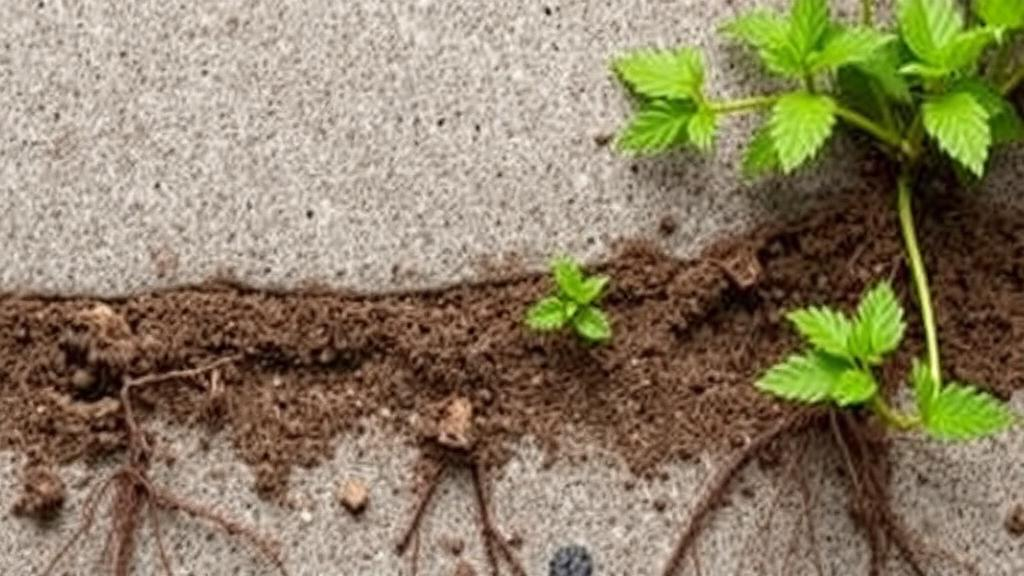
Vegetation-growing concrete, the porous material that lets plant roots thread through sidewalks and green infrastructure, has a hidden weakness: the very organic acids that roots secrete slowly eat away at its cementitious matrix. A new laboratory study has now quantified how two of those acids, oxalic and acetic, attack the material under different acidity levels and exposure times, and the results point to acetic acid as the more destructive of the pair.
Researchers exposed vegetation-growing concrete specimens to oxalic and acetic acid solutions at pH 1.5, 2.5, and 3.5 for periods ranging from 3 to 56 days. They then measured compressive strength, mass change, porosity, and water permeability, and used scanning electron microscopy and X-ray diffraction to track how the material’s microstructure and mineral phases evolved during the attack.
The central finding is a clear hierarchy of damage factors. Acid type emerged as the dominant variable governing strength loss, followed by exposure duration, with pH playing a smaller role. In other words, whether the acid was oxalic or acetic mattered more to the concrete’s survival than how concentrated the solution was or how long the sample sat in it.
Acetic acid proved the more aggressive attacker. According to the study, it decomposes both portlandite, the calcium hydroxide phase that helps bind hydrated cement, and the calcium silicate hydrate gel, known as C-S-H, which is the primary glue of the cementitious matrix. Dissolving both of these phases strips the concrete of its structural backbone, and the damage accumulates as exposure continues.
Oxalic acid behaves differently. Instead of simply dissolving the binding phases, it reacts with calcium to precipitate calcium oxalate inside the pore network. This produces a temporary pore-filling effect that can partially offset the acid’s corrosive action, at least in the short term. The authors characterize this filling as temporary, meaning the protection does not necessarily hold as degradation proceeds over longer exposures.
The practical implications extend to mix design. The study reports that adding 20% mineral powder to the concrete reduced the strength loss rate by 45.4%, a substantial improvement that suggests supplementary cementitious materials can meaningfully buffer the material against organic acid attack. This finding supports the durability design of vegetation-growing concrete, where engineers must balance the interconnected pores that plants need against the long-term structural integrity that those same pores make vulnerable.
Vegetation-growing concrete occupies a niche in modern infrastructure precisely because of its porosity. The interconnected voids allow water, air, and roots to pass through, enabling vegetation to grow in or on the material. But that same open network gives root-secreted organic acids direct access to the cement phases that hold the material together, and the new results show that this access translates into measurable, mechanism-specific degradation.
The experimental design allowed the researchers to separate the effects of the three variables they tested. By holding the acid solutions at three fixed pH values and sampling at multiple time points across nearly two months, they could attribute strength loss to acid type, duration, and acidity with statistical confidence. The microstructural observations from SEM and XRD provided the mechanistic explanation behind the macroscopic measurements: calcium oxalate crystals filling pores in the oxalic acid specimens, and dissolved portlandite and C-S-H in the acetic acid specimens.
For engineers specifying green infrastructure, the study’s findings clarify which acid environments pose the greatest threat and which mitigation strategies are most effective. The identification of acetic acid as the more damaging agent, and of mineral powder substitution as a partial defense, gives durability designers concrete parameters to work with when vegetation-growing concrete is specified for projects where root acid exposure is expected to be significant.
Subject of Research: Degradation mechanisms of vegetation-growing concrete exposed to oxalic and acetic acid at varying pH and duration
Article Title: Effect of pH and exposure duration on the deterioration of vegetation-growing concrete attacked by oxalic and acetic acid
Article References: Pan, C., Yan, F., Bao, H., Li, B., Kang, T., Li, Y., & Wang, F. (2026). Effect of pH and exposure duration on the deterioration of vegetation-growing concrete attacked by oxalic and acetic acid. Frontiers in Materials, 13, Article 1968898. https://doi.org/10.3389/fmats.2026.1968898
Image Credits: AI Generated
DOI: 10.3389/fmats.2026.1968898
Keywords: vegetation-growing concrete, acid erosion, oxalic acid, acetic acid, compressive strength, porosity, C-S-H gel, portlandite, calcium oxalate, mineral powder, durability, microstructure
News Source: Denise Maddox. (October 28, 2026). Root-Secreted Acids Degrade Vegetation-Growing Concrete, With Acetic Acid the Worst Offender. Scienmag.