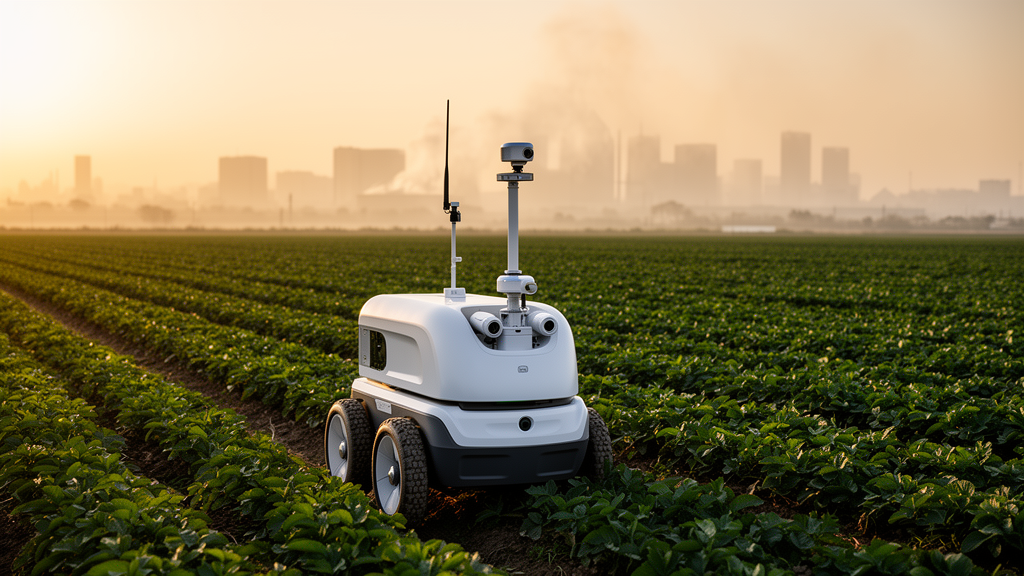
A team of researchers at Central South University in China has developed a hybrid artificial intelligence model that allows mobile agricultural robots to forecast the concentration of environmental pollutants before dangerous levels are reached, moving farm monitoring away from reactive clean-up and toward genuine early warning. The work, published in the journal Engineering Agriculture, addresses one of the most persistent weaknesses in smart agriculture: even when robots and sensor networks sweep fields efficiently, most existing systems still only detect contamination after it has occurred, by which point the damage to crops, soil and food safety may already be done.
The research was led by Professor Hui Liu, whose group set out to give monitoring robots what the authors describe as a smart brain capable not only of sensing current conditions but of anticipating how pollutant levels will evolve over the coming hours. The effort comes at a moment when global climate change and food security pressures are pushing agriculturalists to abandon the old paradigm of passive remediation after pollution events and adopt proactive, prevention-first strategies. In precision agriculture, a few hours of advance notice about rising carbon monoxide, hydrocarbon or nitrogen oxide levels can be the difference between a minor incident and a harvest-ruining event.
The core challenge lies in the character of the data itself. Time series of pollutant concentrations in agricultural environments are highly nonlinear, non-stationary and contaminated by noise from weather, machinery and natural variation. Conventional machine learning approaches struggle with such signals for two reasons: they fail to effectively separate the different frequency components hidden inside a fluctuating measurement stream, leaving important features unextracted, and the attention mechanisms often bolted onto modern neural networks are computationally inefficient when confronted with high-dimensional data. Traditional attention designs also ignore the intrinsic information entropy of the time series, wasting a valuable clue about which parts of a signal actually carry predictive content.
The team’s answer is a model named VMD-SE-DLAM-LSTM, an acronym that unpacks into variational mode decomposition, sample entropy, a double-layer attention mechanism and a long short-term memory neural network. Each component tackles a specific obstacle. Variational mode decomposition is applied first as a data preprocessing stage, adaptively splitting a raw pollutant signal into multiple modal components, each with a clear physical meaning in the frequency domain. This decomposition step is what allows the system to sidestep the notorious mode mixing problem, in which different underlying oscillations in a signal become entangled and confuse downstream learning modules.
Once the signal has been decomposed, the second stage introduces a novel use of sample entropy. Sample entropy is a measure of the complexity and information content of a sequence, and here it is computed for each decomposed sub-sequence and used as prior knowledge to weight features across the model. In practical terms, sub-signals that carry richer information are amplified in the attention computation while redundant or repetitive components are suppressed. This is a significant departure from standard attention mechanisms, which treat all inputs with equal prior standing and must discover relevance through sheer statistical effort, at considerable computational expense.
The third stage hands the weighted, entropy-optimized feature sequences to a long short-term memory network, a recurrent architecture specifically designed to capture long-range temporal dependencies. LSTMs excel at remembering how earlier events in a sequence influence later ones, which is precisely what is needed when pollutant trends unfold gradually under the influence of weather fronts, irrigation cycles or nearby emission sources. The combination of decomposition, entropy-weighted attention and recurrent prediction forms the rigorous three-step strategy of decomposition, weighting and prediction that defines the model.
Experiments on the prediction of three representative agricultural pollutants, carbon monoxide, non-methane hydrocarbons and nitrogen dioxide, demonstrated clear superiority over a slate of mainstream baselines including ARIMA, vanilla recurrent neural networks, support vector machines and gated recurrent units. On the coefficient of determination, the standard measure of how well a prediction tracks observed values, the hybrid model improved on the strongest competing architecture, the GRU, by 6.9 percent for carbon monoxide, 10.1 percent for non-methane hydrocarbons and 4.8 percent for nitrogen dioxide. Gains of that magnitude on noisy real-world environmental data are substantial, and they came without inflating computational complexity beyond what a mobile robot’s onboard hardware can tolerate, a constraint that often forces compromises in deployed systems.
Equally important is what the accuracy gains mean for the bottom-line error metrics. The study reports significant reductions in mean absolute error, directly addressing the twin pain points of inaccurate measurement and insufficiently early prediction that have long frustrated agricultural environmental monitoring. For a robot patrolling a greenhouse or an open field, lower absolute error translates into fewer false alarms, fewer missed warnings and more trustworthy input for the automated decisions that follow. When predictions are reliable enough, a robot can recommend or autonomously initiate interventions, such as ventilation, before pollutant concentrations cross harmful thresholds.
The industrial implications extend beyond a single algorithmic improvement. By building a closed-loop pipeline of monitoring, prediction and decision-making, the system converts fleets of sensor-equipped robots from passive recorders of contamination into active guardians of the growing environment. The researchers frame the work within China’s Digital Village and smart agriculture strategies, noting that the technology offers direct support for national food security and ecological security goals. In a broader global context, as climate volatility intensifies and farm labour for environmental sampling becomes scarcer, the economics of proactive prevention grow steadily more attractive relative to post-event remediation.
The study also highlights a broader lesson for the design of AI systems deployed on edge devices in the field. Rather than simply scaling up a generic deep network, the Central South University team showed that embedding domain knowledge, in this case signal decomposition theory and information-theoretic entropy, directly into the model architecture can deliver both better accuracy and lower computational cost. That combination is exactly what mobile robotics demands, and it suggests a promising template for future prediction tasks, from soil gas monitoring to greenhouse climate control, where the data are noisy, nonlinear and unforgiving. If the approach generalizes, agricultural robots may soon routinely operate with a genuine sense of what is coming next, turning early warning from an aspiration into a standard capability of the smart farm.
Subject of Research: A hybrid deep learning prediction model enabling mobile robots to forecast agricultural environmental pollutants
Article Title: Giving agricultural robots the wisdom to “predict the future”! Central South University team achieves precise early warning of environmental pollutants
Article References: Giving agricultural robots the wisdom to “predict the future”! Central South University team achieves precise early warning of environmental pollutants. (n.d.). Original publication
Image Credits: AI Generated
DOI: Not provided
Keywords: agricultural robotics, pollutant prediction, variational mode decomposition, sample entropy, attention mechanism, LSTM, smart agriculture, environmental monitoring, time series forecasting, Central South University, Engineering Agriculture, food security
News Source: Alan Morgan. (October 16, 2026). Agricultural robots gain ability to predict pollution before it happens. Scienmag.