BUFFALO, NY- May 31, 2022 – A new research paper was published in Aging (Aging-US) on the cover of Volume 14, Issue 10, entitled, “Effect of Humanin G (HNG) on inflammation in age-related macular degeneration (AMD).”
Credit: Aging-US.com
BUFFALO, NY- May 31, 2022 – A new research paper was published in Aging (Aging-US) on the cover of Volume 14, Issue 10, entitled, “Effect of Humanin G (HNG) on inflammation in age-related macular degeneration (AMD).”
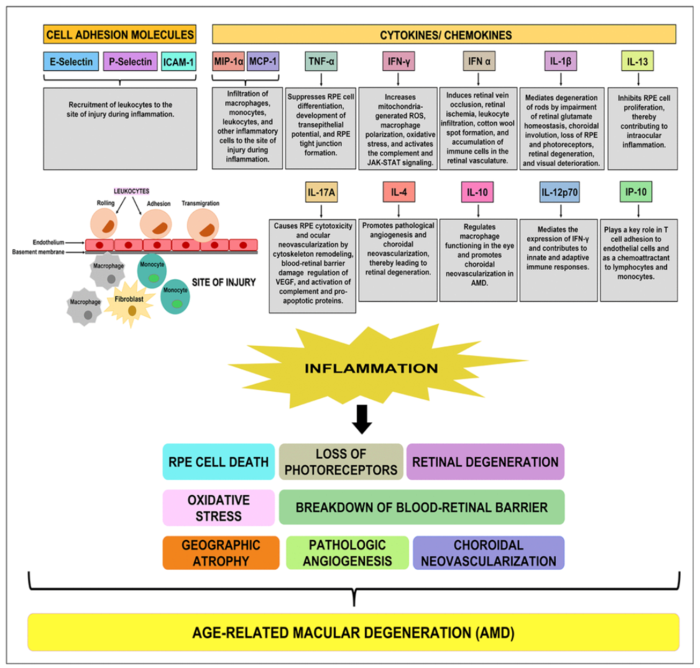
Inflammatory processes drive the progression of age-related macular degeneration (AMD) disease—a leading cause of vision loss in the United States.
In this new Aging study, researchers from the University of California Irvine and University of Southern California compared the protein levels of inflammation markers in normal and AMD retinal pigment epithelial (RPE) transmitochondrial cybrid cells and investigated the effects of treatment with exogenous Humanin G.
Humanin G (HNG) is a mitochondrial derived peptide that is cytoprotective in AMD and can protect against mitochondrial and cellular stress induced by damaged AMD mitochondria.
“The goal of this study was to test our hypothesis that inflammation-associated marker protein levels are increased in AMD and treatment with HNG leads to reduction in their protein levels.”
Humanin G protein levels were measured in the plasma of AMD patients and normal subjects using ELISA assay. Humanin G was added to AMD and normal (control) cybrids derived from clinically characterized AMD patients and normal (control) subjects. Cell lysates were extracted from untreated and HNG-treated AMD and normal cybrids, and the Luminex XMAP multiplex assay was used to measure the levels of inflammatory proteins.
The researchers found that there were differential levels of inflammation proteins between normal and AMD plasma samples. Compared to control plasma samples, AMD plasma showed higher protein levels of inflammation markers. However, plasma levels of endogenous Humanin protein were 36.58% lower in AMD patients compared to that in age-matched normal subjects. After treatment with Humanin G, the researchers observed a marked reduction in protein levels of inflammation markers that were elevated in AMD RPE transmitochondrial cybrid cells.
“In conclusion, we present novel findings that: A) show reduced Humanin protein levels in AMD plasma vs. normal plasma; B) suggest the role of inflammatory markers in AMD pathogenesis, and C) highlight the positive effects of Humanin G in reducing inflammation in AMD.”
To the teams’ knowledge, this is the first study to report notably reduced Humanin protein levels in AMD patients, thereby corroborating the pivotal role of Humanin in maintaining tissue homeostasis and normal functioning in the eye.
“Our discovery is novel and may contribute to the development of therapeutics/ tools for reducing inflammation to alleviate AMD disease pathology.”
DOI: https://doi.org/10.18632/aging.204074
Correspondence to: Cristina Kenney – Email: [email protected]
Keywords: Humanin G, HNG, AMD, inflammation, age-related macular degeneration
Sign up for free Altmetric alerts about this article: https://aging.altmetric.com/details/email_updates?id=10.18632%2Faging.204074
About Aging-US:
Launched in 2009, Aging (Aging-US) publishes papers of general interest and biological significance in all fields of aging research and age-related diseases, including cancer—and now, with a special focus on COVID-19 vulnerability as an age-dependent syndrome. Topics in Aging go beyond traditional gerontology, including, but not limited to, cellular and molecular biology, human age-related diseases, pathology in model organisms, signal transduction pathways (e.g., p53, sirtuins, and PI-3K/AKT/mTOR, among others), and approaches to modulating these signaling pathways.
Follow Aging on social media:
- SoundCloud – https://soundcloud.com/Aging-Us
- Facebook – https://www.facebook.com/AgingUS/
- Twitter – https://twitter.com/AgingJrnl
- Instagram – https://www.instagram.com/agingjrnl/
- YouTube – https://www.youtube.com/agingus
- LinkedIn – https://www.linkedin.com/company/aging/
- Pinterest – https://www.pinterest.com/AgingUS/
For media inquiries, please contact [email protected].
Aging (Aging-US) Journal Office
6666 E. Quaker Str., Suite 1B
Orchard Park, NY 14127
Phone: 1-800-922-0957, option 1
Journal
Aging-US
DOI
10.18632/aging.204074
Method of Research
Experimental study
Subject of Research
Human tissue samples
Article Title
Effect of Humanin G (HNG) on inflammation in age-related macular degeneration (AMD)
Article Publication Date
16-May-2022
COI Statement
The authors declare that they have no conflicts of interest.