BUFFALO, NY- August 10, 2022 – A new research paper was published in Aging (“Aging (Albany NY)” by Medline/PubMed, “Aging-US” by Web of Science) Volume 14, Issue 14, entitled, “Common electrocardiogram measures are not associated with telomere length.”
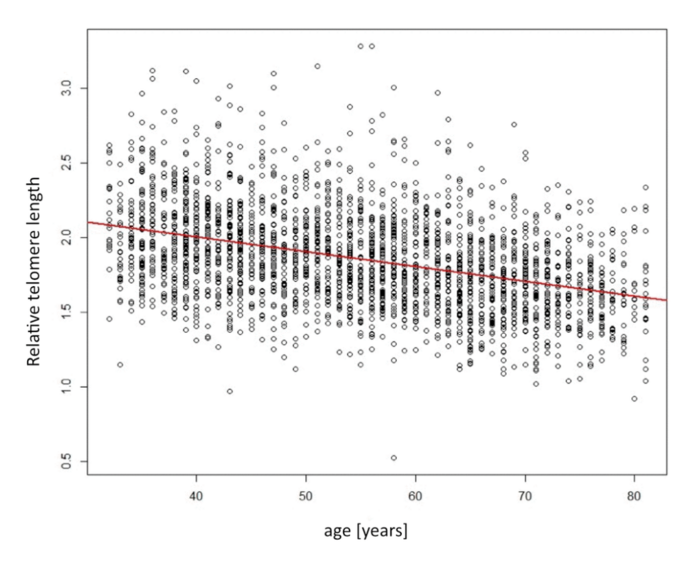
Credit: Falkenhausen et al.
BUFFALO, NY- August 10, 2022 – A new research paper was published in Aging (“Aging (Albany NY)” by Medline/PubMed, “Aging-US” by Web of Science) Volume 14, Issue 14, entitled, “Common electrocardiogram measures are not associated with telomere length.”
Aging is accompanied by telomere shortening. Increased telomere shortening is considered a marker of premature aging. Cardiac aging results in the development of cardiac pathologies.
Electrocardiogram (ECG) measures reflect cardiac excitation, conduction, and repolarization. ECG measures also prolong with aging and are associated with cardiac pathologies including atrial fibrillation. As premature prolongation of ECG measures is observed, researchers (Aenne S. von Falkenhausen, Rebecca Freudling, Melanie Waldenberger, Christian Gieger, Annette Peters, Martina Müller-Nurasyid, Stefan Kääb, and Moritz F. Sinner), from Ludwig-Maximilians-University Munich, Partner Site Munich Heart Alliance, German Research Center for Environmental Health, and Johannes Gutenberg University, hypothesized that such prolongation may be associated with telomere length.
“We studied the large, community-based KORA F4 Study. Of 3,080 participants enrolled between 2006 and 2007 with detailed information on demographic, anthropometric, clinical, and ECG characteristics, 2,575 presented with available data on leukocyte telomere length.”
Telomere length was determined by real-time quantitative PCR and expressed relative to a single copy gene. The researchers fitted multivariable adjusted linear regression models to associate the ECG measures RR-interval, PR-interval, QRS-duration, and heart rate corrected QTc with telomere length.
In this cohort, the mean age was 54.9±12.9 years and 46.6% were men. Increased age was associated with shorter telomere length (p<0.01), and men had shorter telomere length than women (p<0.05). In unadjusted models, heart rate (p=0.023), PR-interval (p<0.01), and QTc-interval (p<0.01) were significantly associated with shorter telomere length. However, no significant associations remained after accounting for age, sex, and covariates.
The researchers found that ECG measures are age-dependent, but not associated with shortened telomere length as a marker of biological aging. Further research is warranted to clarify if shortened telomeres are associated with clinical cardiac pathologies including atrial fibrillation.
“In conclusion, ECG measures are clearly age-dependent. However, in a large, well-characterized, and sufficiently powered cohort we were not able to substantiate the hypothesis that telomere length as a marker of biological age is a relevant contributor to this age-dependent prolongation of ECG measures.”
DOI: https://doi.org/10.18632/aging.204149
Corresponding Author: Moritz F. Sinner – Email: [email protected]
Keywords: electrocardiogram, telomere length, cardiac aging
Sign up for free Altmetric alerts about this article: https://aging.altmetric.com/details/email_updates?id=10.18632%2Faging.204149
About Aging-US:
Launched in 2009, Aging (Aging-US) publishes papers of general interest and biological significance in all fields of aging research and age-related diseases, including cancer—and now, with a special focus on COVID-19 vulnerability as an age-dependent syndrome. Topics in Aging go beyond traditional gerontology, including, but not limited to, cellular and molecular biology, human age-related diseases, pathology in model organisms, signal transduction pathways (e.g., p53, sirtuins, and PI-3K/AKT/mTOR, among others), and approaches to modulating these signaling pathways.
Please visit our website at www.Aging-US.com and connect with us:
- SoundCloud – https://soundcloud.com/Aging-Us
- Facebook – https://www.facebook.com/AgingUS/
- Twitter – https://twitter.com/AgingJrnl
- Instagram – https://www.instagram.com/agingjrnl/
- YouTube – https://www.youtube.com/agingus
- LinkedIn – https://www.linkedin.com/company/aging/
- Reddit – https://www.reddit.com/user/AgingUS
- Pinterest – https://www.pinterest.com/AgingUS/
For media inquiries, please contact [email protected].
Aging (Aging-US) Journal Office
6666 E. Quaker Str., Suite 1B
Orchard Park, NY 14127
Phone: 1-800-922-0957, option 1
###
Journal
Aging-US
DOI
10.18632/aging.204149
Method of Research
Experimental study
Subject of Research
People
Article Title
Common electrocardiogram measures are not associated with telomere length
Article Publication Date
5-Jul-2022