“The current work provides potentially actionable information that could help to limit premature or accentuated aging in the context of HIV.”
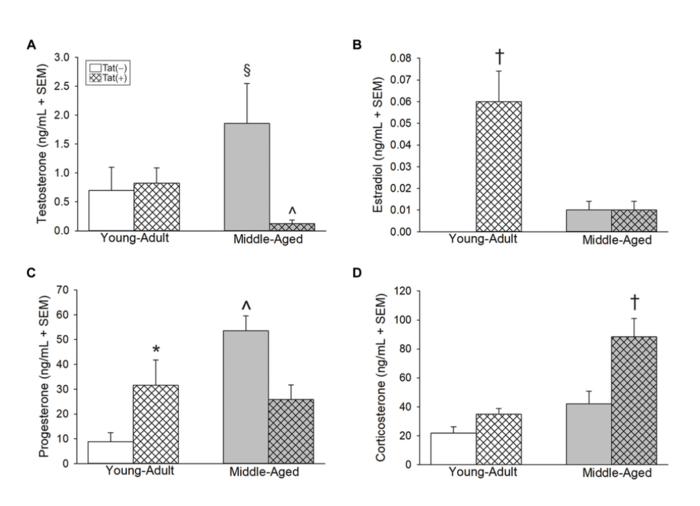
Credit: Qrareya et al.
“The current work provides potentially actionable information that could help to limit premature or accentuated aging in the context of HIV.”
BUFFALO, NY- July 28, 2022 – A new research paper was published in Aging (“Aging (Albany NY)” by Medline/PubMed, “Aging-US” by Web of Science) Volume 14, Issue 13, entitled, “Age-related neuroendocrine, cognitive, and behavioral co-morbidities are promoted by HIV-1 Tat expression in male mice.”
In the United States, approximately 1.2 million people are living with human immunodeficiency virus type-1 (HIV-1), with men accounting for the majority of cases (~75%). About half of HIV-infected individuals are 50 years of age and older. People living with HIV contend with an accelerated onset of age-related diseases and disorders; however, the pathophysiology underlying accelerated aging is poorly understood.
While the mechanisms(s) are unknown, the HIV-1 trans-activator of transcription (Tat) protein disrupts neuroendocrine function in mice partly by dysregulating mitochondria and neurosteroidogenesis.
Researchers Alaa N. Qrareya, Fakhri Mahdi, Marc J. Kaufman, Nicole M. Ashpole, and Jason J. Paris, from the University of Mississippi and Harvard Medical School’s McLean Hospital, investigated the combined effects of aging and HIV-1 Tat expression on the development of neuroHIV-like sequelae in young adult (6–8 months) and middle-aged (11–13 months) male mice to determine whether Tat precipitates age-related dysfunction.
“We hypothesized that conditional Tat expression in middle-aged male transgenic mice [Tat(+)] would promote age-related comorbidities compared to age-matched controls [Tat(−)]. We expected Tat to alter steroid hormone milieu consistent with behavioral deficits.”
Middle-aged Tat(+) mice had lower circulating testosterone and progesterone than age-matched controls and greater circulating corticosterone and central allopregnanolone than other groups. Young Tat(+) mice had greater circulating progesterone and estradiol-to-testosterone ratios. Older age or Tat exposure increased anxiety-like behavior (open field; elevated plus-maze), increased cognitive errors (radial arm water maze), and reduced grip strength. Young Tat(+), or middle-aged Tat(−), males had higher mechanical nociceptive thresholds than age-matched counterparts. Steroid levels correlated with behaviors. Thus, Tat may contribute to HIV-accelerated aging.
“In conclusion, our data suggest that older age and Tat expression exert independent and interactive effects to worsen neuroendocrine, affective, cognitive, and neuromuscular comorbidities. Novel steroid replacement therapies may be useful adjunctive therapeutics to cART in the aging HIV+ population.”
DOI: https://doi.org/10.18632/aging.204166
Corresponding Author: Jason J. Paris – Email: [email protected]
Keywords: aging, hypothalamic-pituitary-adrenal axis, hypothalamic-pituitary-gonadal axis, secondary hypogonadism, trans-activating transcriptor
Sign up for free Altmetric alerts about this article: https://aging.altmetric.com/details/email_updates?id=10.18632%2Faging.204166
About Aging-US:
Launched in 2009, Aging (Aging-US) publishes papers of general interest and biological significance in all fields of aging research and age-related diseases, including cancer—and now, with a special focus on COVID-19 vulnerability as an age-dependent syndrome. Topics in Aging go beyond traditional gerontology, including, but not limited to, cellular and molecular biology, human age-related diseases, pathology in model organisms, signal transduction pathways (e.g., p53, sirtuins, and PI-3K/AKT/mTOR, among others), and approaches to modulating these signaling pathways.
Please visit our website at https://www.Aging-US.com and connect with us:
- SoundCloud – https://soundcloud.com/Aging-Us
- Facebook – https://www.facebook.com/AgingUS/
- Twitter – https://twitter.com/AgingJrnl
- Instagram – https://www.instagram.com/agingjrnl/
- YouTube – https://www.youtube.com/agingus
- LinkedIn – https://www.linkedin.com/company/aging/
- Pinterest – https://www.pinterest.com/AgingUS/
For media inquiries, please contact [email protected].
Aging (Aging-US) Journal Office
6666 E. Quaker Str., Suite 1B
Orchard Park, NY 14127
Phone: 1-800-922-0957, option 1
###
Journal
Aging-US
DOI
10.18632/aging.204166
Method of Research
Experimental study
Subject of Research
Animals
Article Title
Age-related neuroendocrine, cognitive, and behavioral co-morbidities are promoted by HIV-1 Tat expression in male mice
Article Publication Date
12-Jul-2022