


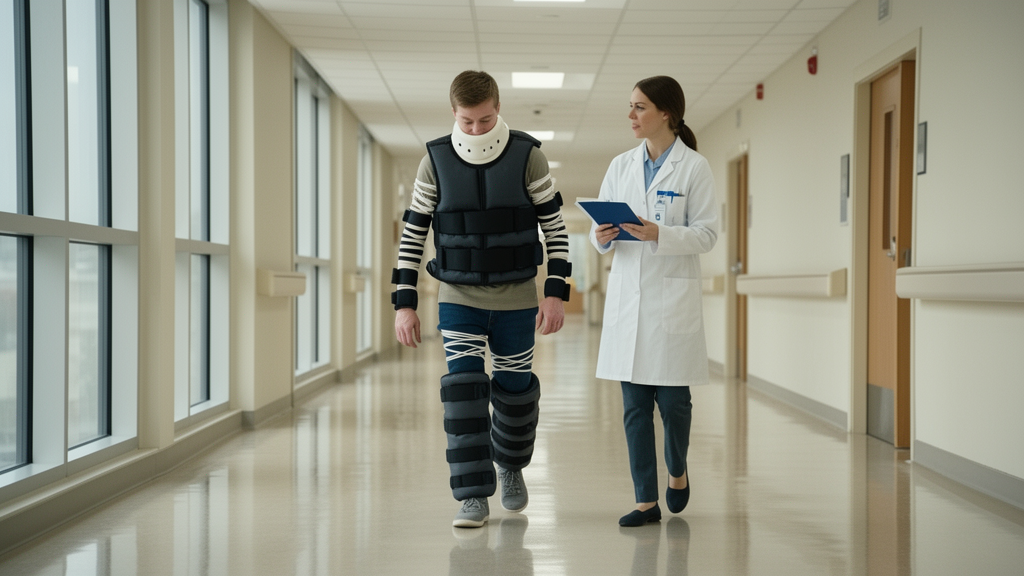
Strapping healthy twenty-somethings into a suit loaded with weights, stiff bandages, blurred goggles and earmuffs was enough to make them walk like much older adults, yet their ability to memorize words remained untouched. The findings offer a rare experimental separation of the physical and cognitive strands of aging, and they suggest that the two contribute to everyday difficulties in strikingly different ways.
The age simulation suit is an elaborate piece of experimental equipment rather than a costume. Special goggles blur vision, alter colour perception and narrow the visual field; earmuffs mimic high-frequency hearing loss; a neck brace restricts head movement; knee and elbow bandages limit joint flexibility. A weighted vest carrying 10 kilograms, plus 2.3-kilogram ankle weights and 1.5-kilogram wrist weights, simulates muscle weakness, while thick foam-soled overshoes dampen proprioceptive feedback and special gloves impair grip. Crucially, the suit imposes these peripheral constraints without altering the brain itself, leaving central cognitive processes intact.
The statistical picture that emerged was clean and, in places, surprising. Across all three groups, both walking and memory performance dropped significantly when the tasks were combined, with main effects of task condition at p < .001 for each domain. Memory recall fell from an average of 12.45 words in the single-task condition to 11.25 words under dual-task conditions, while gait speed dropped from 1.64 to 1.46 metres per second. Older adults showed the poorest performance overall in both domains, and the interaction between group and task condition was not significant for either measure, meaning the absolute decline from single- to dual-task was statistically similar across groups.
The suit’s selective effect was the study’s most striking dissociation. Young adults wearing it walked significantly slower than their unsuited peers, at 1.45 versus 1.92 metres per second averaged across conditions, and showed slower cadence, shorter stride length and longer double-support time, changes that closely mirror the gait alterations typical of aging populations. Yet their memory performance, at 13.48 correctly recalled words on average, did not differ significantly from unsuited young adults, with a comparison yielding p = .729. Both young groups significantly outperformed older adults on memory, who averaged 9.50 words. Even though supplementary analyses showed the suit degraded visual acuity beyond the level measured in the older adult group, encoding of words was unaffected, apparently because participants could compensate with intact cognitive resources and adaptive strategies.
Gait told a different story. Suited young adults did not slow all the way to the older adults’ pace of 1.30 metres per second; they still walked significantly faster, though the gap narrowed dramatically compared with their unsuited peers. The authors attribute this residual advantage to intact central nervous system function, greater neuromuscular reserves and more efficient motor control. Interestingly, cadence was the only parameter in which suited young adults fared worse than older adults, a pattern the researchers tentatively link to the inertia added by the ankle weights, which likely prolonged the swing phase of each step. They caution that the current design cannot disentangle the effect of added physical load from other suit components such as restricted joints or altered sensory input.
The dual-task cost analysis added an important nuance. Older adults exhibited significantly higher relative dual-task costs in gait speed than either young group, according to a Welch analysis of variance, F(2, 47.78) = 6.60, p = .003. But because the absolute reductions from single- to dual-task walking were comparable across groups, the authors argue that these larger proportional costs may partly reflect older adults’ lower baseline gait speed rather than stronger dual-task interference per se. Comparable absolute changes translate into proportionally larger costs when the starting point is lower. The researchers also suggest older participants may have strategically prioritized the cognitive task at the expense of walking, a posture-second strategy that could explain the pattern, though memory dual-task costs themselves did not differ between groups.
Theoretically, the results support a division of labour in explaining age-related dual-task difficulties. Peripheral sensorimotor constraints alone proved sufficient to substantially impair gait and produce an older-looking gait profile in healthy young people, but they did not reproduce the broader cognitive dual-task impairments seen in older adulthood. That broader impairment, the authors conclude, likely depends additionally on central cognitive and attentional changes, such as diminished processing speed, working memory capacity and inhibitory control, that no suit can simulate. The distinction matters practically as well: cognitive limitations might respond to cognitive training, whereas peripheral impairments may be better addressed through physical exercise or mobility interventions.
The study carries important caveats. The older participants were recruited from local sports groups and met health-related inclusion criteria, so the sample likely represented relatively healthy, physically active older adults with above-average function, which may have understated age-related differences expected in the broader population. The fixed task order could in principle introduce practice or fatigue effects, although supplementary comparisons of the two single-task trials found no evidence of either. Most fundamentally, the authors stress that age simulation suits cannot reproduce the complex, systemic processes of biological aging, including long-term neurophysiological adaptation, sarcopenia, fatigue or motivational change, and should be regarded as an experimental manipulation of peripheral constraints rather than a comprehensive simulation of growing old.
Within those limits, the experiment delivers a memorable message: the body can be aged by fiat in a laboratory afternoon, slowing steps and reshaping strides within minutes, but the mind cannot. Peripheral restrictions alone were enough to impair motor function even in otherwise healthy young individuals, yet memory held firm. The everyday image that opens the paper, of an older adult slowing and staggering slightly while reading a departure board in a busy train station, thus appears to arise from an entanglement of fading sensory and motor systems with shrinking central attentional reserves, and it is the interaction of the two, not either alone, that best explains why dual-tasking becomes harder with age.
Subject of Research: Effects of an age simulation suit and aging on dual-task walking and memory performance
Article Title: Aging in motion: how age and age simulation shape dual-task walking and memory
Article References: Heggenberger, A., Harth, P., Schaefer, S., & Kaczmarek, C. (2026). Aging in motion: how age and age simulation shape dual-task walking and memory. European Review of Aging and Physical Activity, 23(1), Article 29. https://doi.org/10.1186/s11556-026-00426-w
Image Credits: AI Generated
DOI: 10.1186/s11556-026-00426-w
Keywords: aging, dual-task performance, gait analysis, age simulation suit, memory, walking speed, sensorimotor decline, attentional resources, fall risk, older adults, wearable sensors, cognitive aging
News Source: Ophelia Keating. (October 30, 2026). Age Simulation Suit Slows Young Walkers but Spares Memory Under Dual Tasks. Scienmag.



