Deep in the eastern lowlands of Nepal, a tree with one of the most storied reputations in the history of fragrance is quietly rewriting its own biography. Agarwood, the resinous heartwood of Aquilaria malaccensis, has been prized for centuries across the Middle East and Asia, perfuming temples, markets and royal courts. Yet few would have predicted that this tropical species, listed as critically endangered across much of its native range, would find an unlikely stronghold in the terraced farms and home gardens of Koshi Province. A new study published in Plant Biosystems documents, for the first time in systematic detail, how agarwood arrived in Nepal, where it now grows, how much carbon it stores, and how local communities use it as medicine.
The story of Nepali agarwood begins not with foresters or perfume merchants but with refugees. In 1990, Bhutanese refugees settling in Jhapa District carried seeds and seedlings of Aquilaria malaccensis with them, planting the species as a living reminder of home and as a speculative crop. Over the following three decades, those first plantings multiplied. Word spread among farmers that the resin-soaked wood, known as oudh or gaharu, could command extraordinary prices on international markets. Government agencies began distributing seedlings, and a quiet cultivation boom took root across the eastern plains and hills.
To chart this unfolding experiment, a large team of Nepali researchers led by Bishal Ghimire of the Ministry of Forests and Environment and Ripu Kunwar of Tribhuvan University combined three lines of evidence. Between April 2024 and June 2025, they conducted a systematic review of the literature, interviewed 101 agarwood farmers, and carried out field surveys at 38 sites spread across 10 districts of Koshi Province. The result is the most comprehensive portrait to date of a species that has become, in the authors’ words, the epicenter of agarwood cultivation in Nepal.
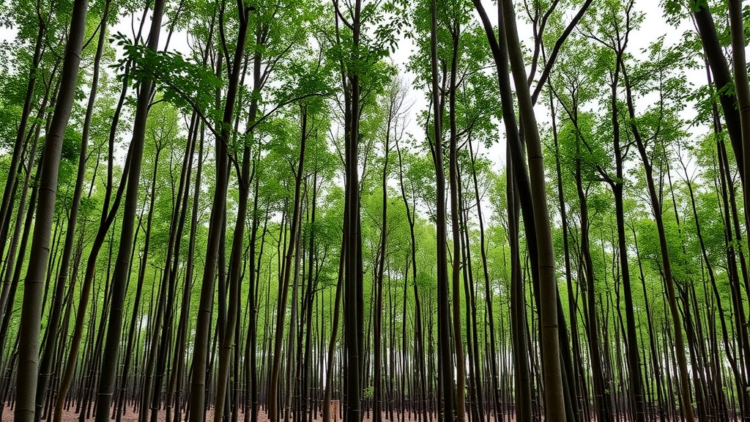
The geographic findings are striking. More than 30,000 agarwood trees have now been planted across eight districts, at elevations ranging from just 75 meters above sea level in the subtropical lowlands to a remarkable 2,600 meters in the hills. That vertical span, covering more than two and a half kilometers of elevation, demonstrates a bioclimatic adaptability that few tropical hardwoods can match. For a species whose wild populations are collapsing under logging pressure across Southeast Asia, the discovery of such ecological flexibility in a new range carries real conservation weight. It suggests that cultivated populations outside the native range could serve as a genetic reservoir, a living archive of a tree that the IUCN Red List classifies as critically endangered.
But the study did not stop at counting trees. The researchers measured individual specimens to estimate biomass and carbon, applying allometric models of the kind used in international carbon accounting under IPCC guidance. The numbers they obtained were eye-opening. A single 30-year-old agarwood tree in eastern Nepal had accumulated 1,585 kilograms of above-ground biomass, corresponding to a carbon stock of 745 kilograms per tree. That figure exceeds what has been reported for Malaysian plantations of comparable age, a comparison the authors attribute to favorable growing conditions and management practices in Nepal. Scaled across tens of thousands of trees, the implication is that Nepal’s young agarwood estates are functioning as a meaningful, if unheralded, carbon sink.
This carbon dimension gives the agarwood story a contemporary urgency it would not otherwise have. As Nepal pursues its national commitments on climate change, agroforestry species that combine economic value with substantial sequestration are increasingly attractive. Agarwood, the study suggests, could deliver both: farmers gain a high-value crop, while the landscape gains a dense, fast-growing tree that locks carbon into its wood for decades. Similar reasoning has driven interest in agarwood as a climate-resilient livelihood option in Indonesia, and the Nepali findings now extend that argument to the Himalayan foothills.
The ethnomedicinal side of the research adds a cultural layer to the ecological one. Through structured interviews with farmers across the province, the team documented how agarwood is used in traditional medicine, with the highest consensus recorded for treating asthma and stomach discomfort. These uses echo a pharmacological lineage that stretches back millennia, from Vedic hymns and ancient trade routes to the pharmacological tables of medieval Persian physicians. Modern laboratory studies have found anti-inflammatory, antibacterial and central nervous system effects in agarwood extracts, lending at least tentative scientific support to practices that Nepali farmers maintain today. In Koshi Province, the tree is not merely a speculative investment; it is a household remedy.
Yet the study also exposes a frustrating bottleneck. Although planting has been extensive and the government supports growers through seedling distribution and a royalty rate of 50 Nepali rupees per kilogram, formal inoculation for resin induction remains underdeveloped, and commercial production is negligible. This is the crux of the agarwood paradox: the precious resin forms only when the tree is wounded and colonized by fungi, a natural defense response that in commercial settings must be deliberately provoked through artificial inoculation techniques. In Malaysia, China and Indochina, researchers have refined fungal and chemical induction methods, some validated with tools as sophisticated as sonic tomography. In Nepal, by contrast, most farmers grow healthy trees but have no reliable way to trigger the resin that gives the wood its value. The result is a plantation estate that is, economically speaking, still waiting to be switched on.
The authors are candid about what would change that. Realizing the potential for carbon sequestration and rural livelihood improvement, they write, requires reliable inoculation techniques, farmer capacity building, and supportive value chain services. In practical terms, that means training programs that teach induction methods, extension services that connect growers with buyers, and research that adapts inoculation protocols developed elsewhere to Nepali conditions. The government’s demonstration plots for agarwood management and inoculation, run by the Department of Forest and Soil Conservation, represent a first step, but the gap between planting and production remains wide.
What emerges from this study is a portrait of an accidental success still searching for its business model. A refugee-introduced tree has spread across a Himalayan province, proven its climatic range, outperformed tropical plantations in carbon accumulation, and embedded itself in local medicine cabinets. The missing piece is the resin economy that made the species famous. If inoculation technology takes hold, Nepal’s 30,000 agarwood trees could transform from a botanical curiosity into a genuine engine of rural income and climate mitigation. If it does not, they will remain a beautiful, carbon-rich monument to an opportunity deferred. Either way, the eastern hills of Nepal have secured a place in the global story of one of the world’s most coveted woods, and scientists now have the baseline data to track what happens next.
Subject of Research: Introduction, population status, carbon stock and ethnomedicinal uses of cultivated agarwood (Aquilaria malaccensis) in Koshi Province, eastern Nepal
Article Title: Agarwood (Aquilaria malaccensis, Thymelaeaceae) in eastern Nepal: introduction, population, carbon stock, and ethnomedicinal uses
Article References: Agarwood (Aquilaria malaccensis, Thymelaeaceae) in eastern Nepal: introduction, population, carbon stock, and ethnomedicinal uses. (n.d.). https://doi.org/10.1007/s44473-026-00269-4
Image Credits: AI Generated
DOI: 10.1007/s44473-026-00269-4
Keywords: Agarwood, Aquilaria malaccensis, Nepal, Koshi Province, carbon stock, biomass, ethnomedicine, critical endangered species, agroforestry, resin inoculation, Bhutanese refugees, Plant Biosystems
Cite Scienmag News
APA MLA Chicago
Margaret Porter. (September 12, 2026). Agarwood Trees Planted by Refugees Now Store Surprising Carbon in Nepal. Scienmag. https://scienmag.com/agarwood-trees-planted-by-refugees-now-store-surprising-carbon-in-nepal/
Margaret Porter. “Agarwood Trees Planted by Refugees Now Store Surprising Carbon in Nepal.” Scienmag, 12 September 2026, https://scienmag.com/agarwood-trees-planted-by-refugees-now-store-surprising-carbon-in-nepal/. Accessed 12 September 2026.
Margaret Porter. “Agarwood Trees Planted by Refugees Now Store Surprising Carbon in Nepal.” Scienmag. September 12, 2026. https://scienmag.com/agarwood-trees-planted-by-refugees-now-store-surprising-carbon-in-nepal/
Copy citation Download RIS
Tags: AgarwoodAgarwood cultivation in NepalagroforestryAquilaria malaccensisBhutanese refugeesBiodiversity and ecosystem benefits of agarwood treesbiomassCarbon sequestration by Aquilaria malaccensiscarbon stockConservation of critically endangered agarwoodcritical endangered speciesethnomedicineImpact of agarwood planting on local communitiesKoshi ProvinceMarket value of Nepalese agarwood productsNepalPlant BiosystemsRefugee-led agroforestry projectsResilient agroforeresin inoculationRole of refugees in reforestation effortsSocioeconomic impact of agarwood farmingSustainable harvesting of agarwood resinTraditional medicine uses of agarwood in Nepal