Electronic devices are getting more and more complex as they are built to carry out an ever-increasing number of functions. This can be seen in the increased functionality in our personal devices such as our phones, tablets and watches, let alone in industrial devices. However, their growing complexity can lead to performance and safety issues. These issues include device overheating or emitting microwaves that can result in health issues and that can reduce a device’s performance and interfere with other devices.
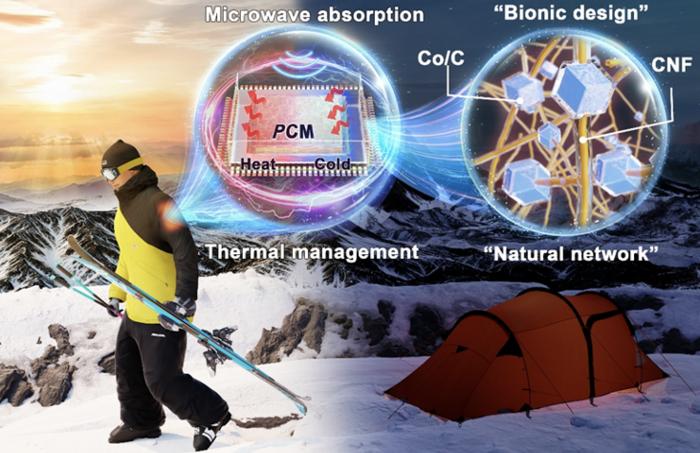
Credit: Beijing Normal University and University of Science and Technology Beijing
Electronic devices are getting more and more complex as they are built to carry out an ever-increasing number of functions. This can be seen in the increased functionality in our personal devices such as our phones, tablets and watches, let alone in industrial devices. However, their growing complexity can lead to performance and safety issues. These issues include device overheating or emitting microwaves that can result in health issues and that can reduce a device’s performance and interfere with other devices.
Chinese scientists from Beijing Normal University have been working on building shielding for electronic devices using multifunctional composite phase change materials (PCMs) to address these performance issues. PCMs are man-made materials built by combining different types of elements, allowing the creation of a new material with very specific purpose driven characteristics. In this case the researchers are looking to improve thermal management, solar-thermal conversion and microwave absorption in the electronic devices.
Using engineering inspired by biological systems, a bionic design, they built a neural network-inspired aerogel that increases the efficiency of thermal management and the absorption of microwave emissions.
“Our developed functionally integrated composite PCMs provide a prospective application of highly integrated and miniaturized electronic devices in complex and changeable outdoor environments,” said Xiao Chen, a researcher from the Institute of Advanced Materials, Beijing Normal University, China.
This research was published on April 3 in Nano Energy Research.
To ensure it had the necessary properties—improved thermal management which optimizes heat dissipation and heat storage, solar-thermal conversion which allows devices to heat up for normal start-up in cold environments, and microwave absorption—the researchers very carefully chose the elements that would be incorporated into their new aerogel shield. Given the space limitations, they could not layer the different materials, so they needed to create a new composite material with all the necessary properties.
The researchers knew that “thermally enhanced PCMs have the ability to store and release massive energy as latent heat, they are widely acknowledged for the ability to ensure precise temperature control,” said Yang Li, first author on the paper and researcher at the Institute of Advanced Materials, Beijing Normal University, Beijing, China. These composites can undergo phase change as the temperature increases from solid to liquid, which increases the available heat storage, and when the temperature cools the liquid reverts to solid. However, while pure PCMs do not show promise in solar-thermal conversion, “bacterial cellulose (BC) is a highly desirable natural biomass due to its numerous advantages including biodegradability, low cost, high purity, renewability, easy modification and functionalization. BC-derived carbon nanofiber through high temperature carbonization has been considered as a promising solar-thermal material.”
Another element would be used to address the issue of microwave emissions. “Recent interest in microwave absorption has focused on metal-organic frameworks due to their exceptional porosity, adjustable pore structure and high specific surface area,” said Ge Wang, from the School of Materials Science and Engineering, University of Science and Technology Beijing, China. “Numerous studies have demonstrated that a porous network structure not only provides large specific surface area for absorbing PCMs, but also dissipates microwave energy through scattering or multiple reflection.”
Finally, the material was encased in paraffin wax, which can undergo phase change, as a method of thermal storage. The final material was then tested to see how well the composite hybrid aerogel maintained the desired characteristics.
When testing for solar-thermal conversion to determine how well the composite could store solar energy for heating a device in colder climates, the aerogel-based composite PCMs showed over 90% absorption of broadband and the full light spectrum. It converted solar energy into thermal energy with a greater than 95% efficiency and showed a thermal storage capacity of 122.19 J/g. Finally, when the microwave absorption was tested, the incident electromagnetic waves were efficiently absorbed by the aerogel-based composite PCMs.
The researchers concluded “our bionically fabricated high-performance and functional integrated aerogel-based composite PCMs with thermal management, solar-thermal conversion and microwave absorption functions show a good prospective application in overcoming overheating or overcooling and EMI of electronic devices,” said Xiao Chen.
Other Contributors
Panpan Liu, Yuhao Feng and Xuemei Diao from the Institute of Advanced Materials, Beijing Normal University, Beijing, China and the College of Nuclear Science and Technology, Beijing Normal University, Beijing, China, Peicheng Li from the School of Environment, Beijing Normal University, Beijing, China, and Yan Gao from Beijing Advanced Innovation Center for Materials Genome Engineering, Beijing Key Laboratory of Function Materials for Molecule & Structure Construction, School of Materials Science and Engineering, University of Science and Technology Beijing, Beijing, China.
This work was financially supported by the National Natural Science Foundation of China.
About Nano Research Energy
Nano Research Energy is launched by Tsinghua University Press and exclusively available via SciOpen, aiming at being an international, open-access and interdisciplinary journal. We will publish research on cutting-edge advanced nanomaterials and nanotechnology for energy. It is dedicated to exploring various aspects of energy-related research that utilizes nanomaterials and nanotechnology, including but not limited to energy generation, conversion, storage, conservation, clean energy, etc. Nano Research Energy will publish four types of manuscripts, that is, Communications, Research Articles, Reviews, and Perspectives in an open-access form.
About SciOpen
SciOpen is a professional open access resource for discovery of scientific and technical content published by the Tsinghua University Press and its publishing partners, providing the scholarly publishing community with innovative technology and market-leading capabilities. SciOpen provides end-to-end services across manuscript submission, peer review, content hosting, analytics, and identity management and expert advice to ensure each journal’s development by offering a range of options across all functions as Journal Layout, Production Services, Editorial Services, Marketing and Promotions, Online Functionality, etc. By digitalizing the publishing process, SciOpen widens the reach, deepens the impact, and accelerates the exchange of ideas.
Journal
Nano Research Energy
DOI
10.26599/NRE.2024.9120120
Article Title
Neural network-inspired hybrid aerogel boosting solar thermal storage and microwave absorption
Article Publication Date
3-Apr-2024