Ammonia is one of the most consequential molecules humanity has ever learned to make. Roughly half the nitrogen atoms in the food we eat passed, at some point, through an industrial ammonia synthesis plant, and the chemical is now being seriously evaluated as a carbon-free fuel for shipping and as a convenient carrier for hydrogen energy. Yet almost every gram of ammonia produced today comes from the Haber-Bosch process, a thermochemical route that consumes vast quantities of natural gas or coal and, according to widely cited estimates, accounts for around one to two per cent of global energy use and a comparable share of carbon dioxide emissions. The process also demands enormous, centralised facilities operating continuously at high temperature and pressure, which makes it structurally difficult to couple with wind and solar farms whose output is variable, geographically dispersed, or located far from any industrial customer.
Electrochemical ammonia synthesis promises a way out of this bind. In principle, a modular electrolyser powered by renewable electricity could split water for protons and electrons, draw nitrogen straight from the air, and combine the two into ammonia at ambient temperature and pressure, wherever cheap clean power happens to be available. In practice, the field has been haunted by a stubborn problem: energy efficiency. Among the various electrochemical strategies explored over the past decade, one approach has clearly outperformed the rest. It relies on lithium, which under the right conditions can bind and activate the nitrogen molecule, an extraordinarily stable species whose triple bond resists almost every attempt at chemical persuasion at room temperature. This lithium-mediated nitrogen reduction can indeed deliver ammonia at practical rates, but its underlying chemistry imposes what researchers believed was an intrinsic ceiling on how efficient the process could ever become.
That ceiling has now been broken. A team at Monash University in Melbourne, working with colleagues at RMIT University, has demonstrated that the key lies not in tweaking the electrolyte or the operating conditions, but in redesigning the cathode itself. Writing in Cell Press Blue, the researchers describe a new class of lithium-alloying electrode materials that allow the lithium-mediated reaction to proceed at substantially more favourable electrical potentials while still activating nitrogen and producing ammonia. The work, led by Dr Rebecca Hodgetts of the Monash University School of Chemistry, provides proof of concept that a limitation long treated as fundamental to the technology can be engineered away through electrode design.
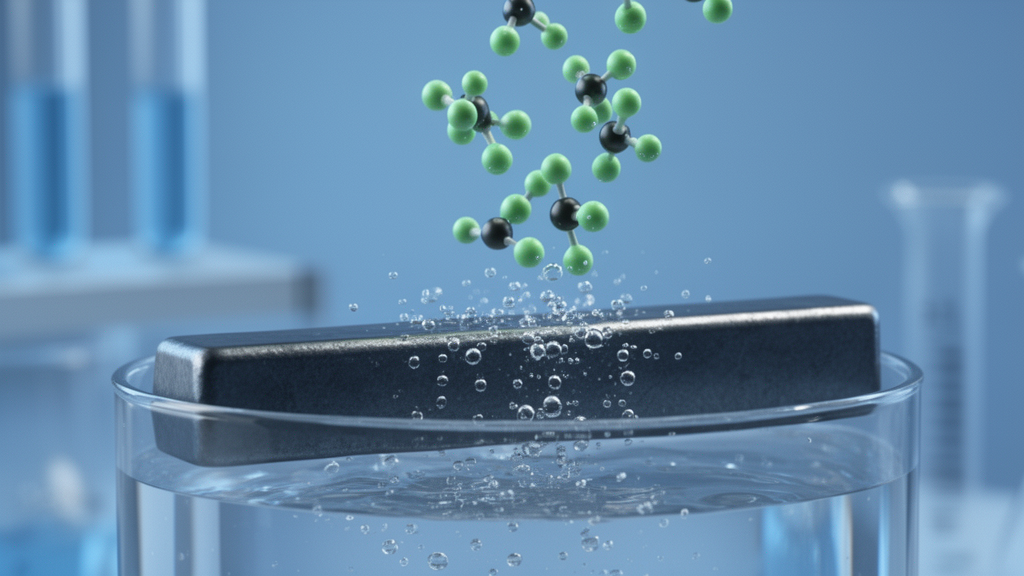
To appreciate why this matters, it helps to understand how lithium-mediated nitrogen reduction works. In the conventional configuration, a current passed through the electrolytic cell deposits metallic lithium on the cathode. This freshly formed lithium reacts spontaneously with dissolved nitrogen gas, forming lithium nitride, which is then protonated to yield ammonia and regenerate lithium, closing the catalytic cycle. The problem is thermodynamic. Depositing lithium metal requires a large electrical potential, and once that energy has been sunk into making the metal, a significant fraction of it is unavoidably lost as heat rather than being carried into the nitrogen-fixation step. The result is a voltage penalty baked into the chemistry itself, one that no amount of optimisation of catalysts, electrolytes or current densities could remove. Energy efficiencies reported for the lithium-mediated route have therefore remained stubbornly low, far below the thresholds proposed for commercially viable green ammonia.
The Monash team’s insight was to sidestep the formation of free lithium metal altogether. Instead of a conventional electrode on which lithium plates out as a solid metal, the researchers employed gallium-based materials that alloy with lithium. When current flows, lithium atoms insert into the gallium-containing host, forming a lithium alloy rather than a layer of pure metal. Crucially, this alloyed lithium remains chemically potent enough to react with nitrogen and sustain the ammonia-producing cycle, but the electrical potential at which the alloying reaction occurs is markedly more favourable than the potential needed to deposit metallic lithium. In effect, the electrode material absorbs part of the thermodynamic burden, changing the energy landscape of the entire reaction sequence. As Dr Hodgetts put it, the new cathode materials change the rules of the game by redefining this fundamental limit and opening previously unexplored opportunities for more energy- and cost-effective production of green ammonia.
The experimental results are striking. Under optimised conditions, the team achieved ammonia production with a faradaic efficiency of 96 plus or minus 6 per cent, meaning that almost every electron pushed through the cell went into making ammonia rather than into wasteful side reactions such as hydrogen evolution. Faradaic efficiency has long been a sore point in electrochemical nitrogen fixation, where competing hydrogen production can devour the majority of the current, particularly in aqueous systems. A figure approaching unity in a lithium-mediated system indicates that the alloying cathode not only lowers the operating potential but also preserves the selectivity that makes this chemistry attractive in the first place. The researchers further estimate that the findings could support future electrochemical ammonia production with an overall energy efficiency of at least 22 per cent, a level that begins to approach the territory discussed in commercial feasibility assessments.
The team is careful to note that further improvements are still required to reach the proposed commercial targets for green ammonia electrolysers. A 22 per cent estimated energy efficiency, while transformative relative to the intrinsic limit of the conventional lithium-metal route, does not by itself guarantee economic competitiveness with fossil-derived ammonia, whose prices are heavily distorted by decades of scale and subsidised feedstocks. What the study does establish, and what its significance rests on, is that the longstanding energy barrier is not an immutable fact of nature. It is a consequence of a particular electrode chemistry, and electrode chemistry can be changed. That reframing converts a perceived dead end into an open design space, which is precisely the kind of shift that has historically accelerated energy technologies from laboratory curiosities to industrial processes.
Emeritus Professor Douglas MacFarlane, also of the Monash School of Chemistry and one of the leading figures in electrochemical nitrogen reduction, emphasised that the discovery widens the chemical toolkit available to the entire field. According to Professor MacFarlane, the field has essentially been limited to a single cathode process based on lithium-mediated nitrogen reduction, and introducing lithium-alloying materials broadens that chemistry considerably. Instead of being constrained to one composition, researchers can now begin exploring different combinations of materials capable of activating the extremely unreactive nitrogen molecule under relatively mild conditions. Gallium is unlikely to be the last word; the alloying strategy invites systematic exploration of other low-melting or soft metals and mixed-composition hosts, each potentially offering a different balance of potential, stability, nitrogen reactivity and cost.
Considerable engineering challenges remain between the present results and a working industrial electrolyser. Lithium-mediated systems typically operate in non-aqueous electrolytes with carefully controlled proton donors, and scaling such cells from laboratory electrodes to large-area, long-lived cathodes is a nontrivial undertaking. Gallium-based materials bring their own questions of mechanical stability, cost and behaviour over thousands of hours of cycling. Professor Alexandr Simonov, also from the School of Chemistry, identified the immediate priority as translating the discovery from laboratory experiments into practical devices. The next key step, he said, is to integrate the new lithium-alloying cathodes into electrolyser prototypes that more closely mimic the conditions needed for practical ammonia production, while also scaling up the cathodes and demonstrating long-term ammonia production at competitive energy efficiency, a milestone he described as critical to taking the technology towards commercial application.
If those steps succeed, the implications extend well beyond a single reaction. Decentralised ammonia production powered by stranded renewable resources, wind farms in remote regions or solar installations far from any grid connection, could decouple fertiliser supply from natural gas markets and reduce the vulnerability of global food systems to energy price shocks. Ammonia produced this way could likewise serve as a storable, transportable form of renewable energy, feeding into the emerging infrastructure for carbon-free shipping fuels. The Monash technology is being further developed through ongoing research in collaboration with Jupiter Ionics Pty Ltd, a Monash University spin-out company, signalling that the team intends to pursue the path from proof of concept to product. For a chemical industry that has produced ammonia the same way for more than a century, the demonstration that a supposedly fundamental efficiency limit can be redesigned out of existence is a genuinely consequential result, and one that other laboratories working on renewable nitrogen fixation will now be racing to build upon.
Subject of Research: Lithium-alloying cathode design for energy-efficient electrochemical reduction of nitrogen to green ammonia
Article Title: New electrode design breaks key barrier to greener ammonia production
Article References: New electrode design breaks key barrier to greener ammonia production. (n.d.). Original publication
Image Credits: AI Generated
DOI: Not provided
Keywords: green ammonia, electrochemistry, lithium-mediated nitrogen reduction, cathode design, lithium alloys, gallium, faradaic efficiency, renewable energy, fertilisers, Haber-Bosch, Monash University, energy efficiency
News Source: Bethany Barker. (October 9, 2026). Lithium-alloying cathode shatters energy-efficiency barrier for green ammonia. Scienmag.